

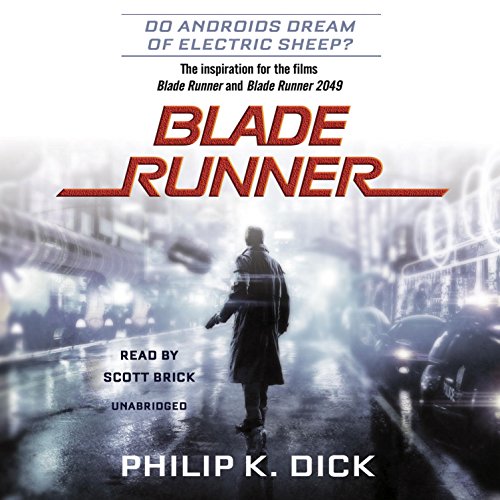
Blade Runner
Originally published as Do Androids Dream of Electric Sheep?
No se pudo agregar al carrito
Solo puedes tener X títulos en el carrito para realizar el pago.
Add to Cart failed.
Por favor prueba de nuevo más tarde
Error al Agregar a Lista de Deseos.
Por favor prueba de nuevo más tarde
Error al eliminar de la lista de deseos.
Por favor prueba de nuevo más tarde
Error al añadir a tu biblioteca
Por favor intenta de nuevo
Error al seguir el podcast
Intenta nuevamente
Error al dejar de seguir el podcast
Intenta nuevamente
Obtén 30 días de Standard gratis
$8.99 al mes después de que termine la prueba. Cancela en cualquier momento

Blade Runner
Narrado por:
Scott Brick
Compra ahora por $15.73
-
Narrado por:
-
Scott Brick
-
De:
-
Philip K. Dick
By 2021, the World War has killed millions, driving entire species into extinction and sending mankind off-planet. Those who remain covet any living creature, and for people who can’t afford one, companies build incredibly realistic simulacra: horses, birds, cats, sheep. They’ve even built humans. Immigrants to Mars receive androids so sophisticated they are indistinguishable from true men or women. Fearful of the havoc these artificial humans can wreak, the government bans them from Earth. Driven into hiding, unauthorized androids live among human beings, undetected. Rick Deckard, an officially sanctioned bounty hunter, is commissioned to find rogue androids and “retire” them. But when cornered, androids fight back—with lethal force.
Praise for Philip K. Dick
“[Philip K. Dick] sees all the sparkling—and terrifying—possibilities . . . that other authors shy away from.”—Rolling Stone
“A kind of pulp-fiction Kafka, a prophet.”—The New York Times©1968 Philip K. Dick; (P)2007 Random House, Inc. Random House Audio, a division of Random House, Inc.
Los oyentes también disfrutaron:






Editorial review
Editorial review
By Emily Martin
IF YOU READ ONLY ONE ANDROID NOVEL IN YOUR LIFETIME, IT SHOULD BE BLADE RUNNER
I have a poster of Ridley Scott's Blade Runner hanging up in my living room, but, like any self-respecting book person, before I'd seen the famous movie adaptation, I read Do Androids Dream of Electric Sheep? The first time I read Philip K. Dick's novel, straightforward but filled to the brim with invention and thought-provoking concepts, was for a science fiction class as an undergrad. At the time, I had no idea what "cyberpunk" meant, and I certainly didn't understand the difference between an android and a robot. But Do Androids Dream of Electric Sheep? opened up my eyes to how sci-fi could engage the imagination.
If you've seen Blade Runner and have read or listened to the novel it’s based on, then you know that the film is not exactly what one would call a "faithful" adaptation. In fact, when I teach this book and this film in my dystopian fiction courses, students are often disappointed in the movie after reading the book first. But I think both the movie and the film are essential parts of the sci-fi canon. Both works are in conversation with each other. And both have significant things to say about the meaning of life, what it means to feel emotions, and (most essentially) what it means to be human.
Simply put, science fiction would not be where it is today without the influence of Blade Runner. And yet the audiobook is more than just an important part of sci-fi history. It's actually an incredibly engrossing, edge-of-your-seat, unforgettable ride. The future world that Philip K. Dick paints for us in his novel is a bleak one, filled with desperate characters fighting to find meaning in a world that has left them behind. But it's also a world where humanity—including androids—fights to do so much more than just survive. They're fighting for a life that feels full. Just like the rest of us.
Continue reading Emily's review >
adbl_web_anon_alc_button_suppression_c
Featured Article: The top 100 classics of all time
Featured Article: The top 100 classics of all time
Before we whipped out our old high school syllabi and dug deep into our libraries to start selecting contenders for this list, we first had to answer the question, "How do we define a classic?" The answer isn’t as straightforward as you might guess, though there’s a lot to be said for the old adage, "You know it when you see it" (or, in this case, hear it). Of course, most critically, each of our picks had to be fabulous in audio. So dust off your aspirational listening list—we have some amazing additions you don’t want to miss.

Las personas que vieron esto también vieron:




Like Quicksand
Se ha producido un error. Vuelve a intentarlo dentro de unos minutos.
Terrible narrator
Se ha producido un error. Vuelve a intentarlo dentro de unos minutos.
Far less interesting than the movie
Se ha producido un error. Vuelve a intentarlo dentro de unos minutos.
You’ll find yourself examining what it means to be human from several angles, considering the value of organic life in all its forms, and wondering where the hell we’re headed as a species and society.
The narrator is excellent, especially in his reading of J.R. Isidore and the female characters. When listening to a book like this—with quite a few characters, alternating protagonists, and an “unreliable narrator” writing style—it really really helps to have a performer who really knows how to do consistent and distinct character voices.
So much more than Blade Runner
Se ha producido un error. Vuelve a intentarlo dentro de unos minutos.
Amazing Book
Se ha producido un error. Vuelve a intentarlo dentro de unos minutos.