

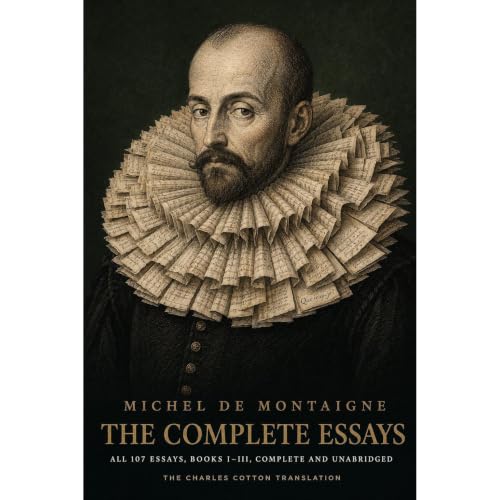
Michel de Montaigne: The Complete Essays (Annotated)
All 107 Essays, Books I–III, Complete and Unabridged — The Charles Cotton Translation
No se pudo agregar al carrito
Add to Cart failed.
Error al Agregar a Lista de Deseos.
Error al eliminar de la lista de deseos.
Error al añadir a tu biblioteca
Error al seguir el podcast
Error al dejar de seguir el podcast
Obtén 30 días de Standard gratis

Michel de Montaigne: The Complete Essays (Annotated)
Compra ahora por $6.99
-
Narrado por:
-
Virtual Voice

Este título utiliza narración de voz virtual
This annotated edition includes:
- All 107 essays, complete across all three Books (1580–1595), in Charles Cotton's classic English translation
- A critical study, "The Man Who Was Educated by His Own Book," on how a private commonplace book became the first work of its kind in European literature
- A biographical portrait that separates the verified life from the legend that has grown around it
- A Note on the Text, naming the translation, its editorial history, and this edition's policy
He set out to write about everything, and ended up writing the first book in which the subject was simply a mind changing its own opinion in real time.
Montaigne began the Essays as a private exercise — notes on his reading, kept for his own family, with no thought of an audience. He said as much himself, in the address to the reader that opens this book: he wrote for his kinsfolk, not for glory, and painted himself "in mine own genuine, simple, and ordinary manner." What he produced instead, almost by accident, was something without precedent: a book whose subject is not a set of conclusions but the motion of a mind arriving at them, revising them, and openly contradicting itself a hundred pages later without apology. He wrote about cannibals and about coaches, about the death of his closest friend and about the failures of his own memory, about war and about the proper management of a household — and across all of it, the real subject never changes. It is himself, examined without flattery, essay by essay, for the better part of twenty years.
That method is why he still reads as startlingly modern four and a half centuries later. He doubted nearly everything that could be doubted, including his own doubt — his motto, "What do I know?", is not a rhetorical flourish but the operating principle of the entire book. He wrote with equal candor about his kidney stones and about the nature of custom, treating both as equally worth a mind's full attention. The critical study included here traces the single thread running underneath the apparent randomness — the invention, essay by essay, of a way of thinking on the page that had no real predecessor and has never entirely gone out of fashion since.
This edition presents Cotton's translation entire, as revised by William Carew Hazlitt for a more accurate nineteenth-century readership, with nothing abridged, modernized, or silently altered.