

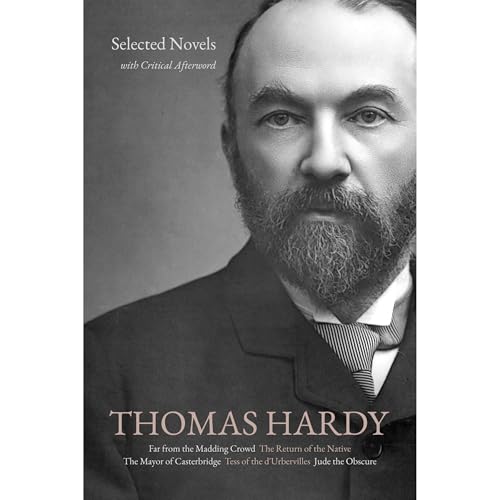
Thomas Hardy: Five Major Novels (Annotated)
Far from the Madding Crowd, The Return of the Native, The Mayor of Casterbridge, Tess of the d'Urbervilles, and Jude the Obscure
No se pudo agregar al carrito
Add to Cart failed.
Error al Agregar a Lista de Deseos.
Error al eliminar de la lista de deseos.
Error al añadir a tu biblioteca
Error al seguir el podcast
Error al dejar de seguir el podcast
Prueba gratis de 30 días de Audible Standard

Thomas Hardy: Five Major Novels (Annotated)
Compra ahora por $5.99
-
Narrado por:
-
Virtual Voice
-
De:
-
Thomas Hardy

Este título utiliza narración de voz virtual
Thomas Hardy spent twenty years writing about people destroyed by forces they could neither name nor escape. Then he stopped writing novels entirely.
The five novels in this volume — published between 1874 and 1895 — form one of the most coherent and unrelenting bodies of work in English fiction. Hardy's subject is always essentially the same: the collision between individual desire and the indifferent machinery of fate, class, and social convention in a rural England that was itself disappearing. His characters want things — love, dignity, a different life — and the world he places them in is not cruel so much as simply indifferent to what they want.
Far from the Madding Crowd (1874) — follows Bathsheba Everdene, who inherits a farm and refuses to be managed by any of the three men who want her, with consequences she could not have avoided.
The Return of the Native (1878) — Eustacia Vye wants to escape to Paris and finds herself instead on Egdon Heath with a man who has returned from Paris and thinks it empty.
The Mayor of Casterbridge (1886) — Michael Henchard sells his wife at a fair while drunk, spends twenty years building a life, and watches it dismantle itself with the precision of a mechanism he cannot stop.
Tess of the d'Urbervilles (1891) — subtitled A Pure Woman, which was the provocation Hardy intended — follows Tess through a series of events that no reading of justice or morality can make add up correctly. That is exactly Hardy's point.
Jude the Obscure (1895) — Hardy's last novel, which caused such a scandal that he never wrote another — follows Jude Fawley, who wants to be a scholar, and Sue Bridehead, who wants a freedom the Victorian world has no category for.
Bathsheba Everdene — who said she didn't want a husband and meant it; punished for meaning it by a world that couldn't process a woman who refused.
Tess Durbeyfield — a pure woman, Hardy insisted; the character whose treatment is Hardy's most sustained moral argument.
Jude Fawley — who wanted books and was given stones; who wanted a life and was offered a role.
✦ The complete, unabridged texts of all five novels — nothing condensed or omitted — together with two original critical afterwords and a full biography by Henry Bugalho.
This edition also includes:
✦ Against the Current: Fate, Desire, and the Architecture of Suffering in Hardy's Novels — a critical reading of the five works as a unified project: the recurring structures of desire and obstruction, the function of landscape as fate
✦ The Undoing of Wessex: Thomas Hardy and the Vanishing World — historical context: the agricultural transformation of rural England, the class system that blocked Jude and crushed Tess, and the world Hardy was simultaneously mourning and indicting
✦ About the Author: Thomas Hardy (1840–1928) — from his birth in Dorset through his architectural career, the scandal of Jude the Obscure, and his turn to poetry
For readers who enjoy:
✦ Victorian literary fiction at its most psychologically serious and morally unsparing
✦ Fiction about women who want more than their world will give them — Bathsheba, Tess, Sue Bridehead
✦ Historical fiction set in rural England, in a landscape that is both real and symbolic
✦ The complete arc of one of the most uncompromising literary careers in English literature
"Time changes everything except something within us which is always surprised by change."