Modern Law Library Podcast Por Legal Talk Network arte de portada

Modern Law Library

Modern Law Library

De: Legal Talk Network
Escúchala gratis

Exclusivo para miembros Prime | $0.99/mes por 4 meses + $20 de crédito en Audible

$8.99 al mes después de 4 meses. Consulta términos y condiciones.
Discover books and stories that explore the law in new and surprising ways through eye-opening conversations with their authors. Whether it’s fiction or non-fiction that you seek, Modern Law Library features today’s top legal authors and delves into legal theories, historical events, true crime, and law-inspired storytelling. Join Lee Rawles twice a month as she opens up a new legal publication on Modern Law Library, a Lisagor Award-winning podcast. Arte Ciencia Política Economía Historia y Crítica Literaria Política y Gobierno
Episodios
  • Where are America's hate speech laws?
    Sep 23 2026
    "In most other countries, there are laws, criminal laws that prohibit the expression of racial hatred or incitement to racial hatred," says Samantha Barbas, author of Hate Speech: The Legal and Cultural History of an American Dilemma, in this episode of the Modern Law Library. "There are no hate speech laws in the United States, and that makes the U.S. a true exception, a true outlier in the world. And so my book was trying to get to the question, why did the U.S. take this unique path? How do we explain that historically? Where and when and why did we diverge from the path that was taken by most other countries?" World War II prompted a barrage of hate speech legislation after it ended, but not in the United States, Barbas tells host Lee Rawles. "We had just seen how totalitarian governments establish themselves through censorship," Barbas says. "There are two really important ideals that seem to be clashing in the post-war era. Many hate speech laws are proposed, but they are rejected or struck down on free speech grounds. So at this moment when Europe is adopting hate speech laws, America is going the other way: Proposing them, but then rejecting them, and that consensus in favor of freedom of speech is going to hold for several decades." In this episode of the Modern Law Library, Barbas and Rawles discuss how American courts and society have dealt with hate speech issues in the past, and how the growing awareness of psychological harm has impacted public attitudes about hate speech. They also explore Henry Ford and the Dearborn Independent, D. W. Griffith and Birth of a Nation, the Streisand Effect, and a series of cases about Illinois Nazis.
    Más Menos
    42 m
  • Are you getting paid what you're really worth?
    Sep 9 2026
    Vanessa Ugatti is the True Worth Expert, a UK-based international keynote speaker, transformational trainer and coach, and author of How to Get Paid Your True Worth Ethically, Without Selling Your Soul. Through her unique True Worth™ Methodology, Vanessa helps forward-thinking law firms and sole practitioners get paid their true worth ethically, without over-servicing, discounting or losing clients. “Lawyers are quite fearful people, certainly in the UK, and I’m imagining it’s probably not that much different in the States,” Ugatti tells Modern Law Library host Lee Rawles. "They're driven by fear. Fear of losing the client, fear of getting in trouble with their board. Just fear. And so they'll tend to focus on doing the legal work at the expense of the business–that comes second–and the expense of themselves." In her new book, How to Get Paid Your True Worth Ethically: Without Selling Your Soul (and Keeping Your Clients Happy!), Ugatti shares her methodology, based on the acronym TRUE WORTH. "Getting paid your true worth is not just about making enough revenue to have a sustainable life and business," says Ugatti. "It's also to make sure that you are well, you can supply the right work to your clients, and you can give them the level of service that they need." In this episode of the Modern Law Library, Ugatti outlines what each letter of TRUE WORTH stands for, and discusses her own journey towards having the confidence to value herself properly.
    Más Menos
    41 m
  • We need to rein in Silicon Valley unicorns, says law prof
    Aug 5 2026
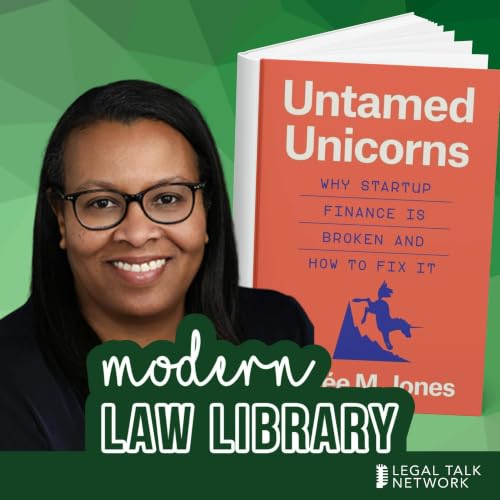
    In Silicon Valley, a "unicorn" is a private startup with a net worth of $1 billion. As the term suggests, these were once incredibly rare creatures. Most startups would go public within 4-7 years, long before they had a $1 billion valuation. But two key pieces of legislation made the rare into the rampaging, starting in 1996. In her new book, Untamed Unicorns: Why Startup Finance is Broken and How to Fix It, Renée M. Jones warns that by staying private and shielded from oversight and disclosure, these startups could be endangering the stability of our financial system. Jones, who served as the director of the Securities and Exchange Commission's Division of Corporation Finance under President Joe Biden, shows how these tactics were used (and misused) by startups like FTX, WeWork, Uber and Theranos. "One of the big concerns is that startups are taking advantage of the secrecy to engage in, we could call it 'antisocial' or 'unsocial' behavior, but there are not really any mechanisms for the public to really see what's going on," Jones tells Modern Law Library host Lee Rawles. "If Theranos's investors and directors understood that they were going to have to go public and prove that the product worked, they would've been more demanding on Elizabeth Holmes most likely, and they wouldn't have been able to get away with all of those lies." A big concern Jones has is with the recent push by private equity companies to allow regular retail investors and 401K plan managers to invest in these opaque and risky private startup companies. "That includes private equity, it includes infrastructure. It could even include crypto. Again, these are illiquid assets," says Jones. "There's no ready market for those shares. And they're high risk assets and there's not a lot of information to even know, 'What am I actually invested in?' " "If the Department of Labor's plans are adopted, you're going to have to really work hard to avoid having any private equity in your 401k plans," Jones warns. "There's a risk that these overvalued assets are going to be transferred from professional investors who can act to protect their interest to sort of your average, unsophisticated 401k saver." In this episode, Jones shares her advice for reforming the oversight of these companies, warning signs that financial novices should be on the look for, and introduces a new creature to the financial bestiary: the centicorn.
    Más Menos
    54 m
adbl_web_anon_alc_button_suppression_t1
Todavía no hay opiniones