Episodios

  • He raised a $10M seed with no revenue—then grew 30x to $30M in year two. | Bobby Samuels, Founder of Protege
    Apr 13 2026

    Bobby launched Protege in early 2024 to connect data holders with AI model builders. He raised a $10M seed with almost no demand pipeline. A year later, Protege jumped 30x to $30M in GMV and raised $30M from a16z.

    In this episode, Bobby breaks down how he built a 250-partner data network by leveraging prior healthcare relationships, why he flies from New York every week to close seven-figure enterprise deals, and why the "texting terms" litmus test tells you if a deal is real.

    Why You Should Listen

    • Why ignoring a customer's "no" can be the best sales move you make.
    • How flying to see buyers weekly became the number one growth driver.
    • Why the gap between A and A-plus talent is worth blowing your budget for.
    • How Protege went from $1M to $30M GMV in a single year.

    Keywords startup podcast, startup podcast for founders, product market fit, finding pmf, AI data, enterprise sales, founder-led sales, data licensing, healthcare AI, a16z, B2B startup, Bobby Samuels, Protege

    Chapters

    • 00:00:00 Intro
    • 00:03:01 Building the First Data Network
    • 00:06:12 Why In-Person Sales Changed Everything
    • 00:16:08 Going to Market with No Pipeline
    • 00:21:07 Ignoring the Lab's No
    • 00:27:40 From $1M to $30M in One Year
    • 00:34:55 Why A-Plus Talent Is Worth It
    • 00:38:28 The Moment of True Product Market Fit

    Send me a message to let me know what you think!

    Más Menos
    39 m
  • He ran Prime fulfillment for Amazon—then raised $50M to replace e-commerce with AI. | Maju Kuruvilla, Founder of Spangle
    Apr 9 2026

    Maju ran Prime fulfillment technology for all of Amazon — same-day, one-hour shipping, global logistics during the pandemic. He became CEO at Bolt. Then he walked away to start Spangle in a basement with a co-founder, convinced AI could replace e-commerce infrastructure as we know it. Less than a year out of stealth, he raised a $50M Series A.

    In this episode, Maju breaks down why 40% of e-commerce traffic loses its context the moment it arrives on a brand's site, how Spangle's AI dynamically rebuilds the entire storefront in real time for each visitor, and why he believes the future of commerce will be a battle between AI seller agents and AI buyer agents.

    Why You Should Listen

    • Why 40% of your marketing traffic is wasted the moment it hits your site.
    • Why the future of e-commerce is a showdown between AI seller agents and AI buyer agents.
    • How he signed 11 enterprise brands in under a year with a free POC and rev-share pricing.

    Keywords startup podcast, startup podcast for founders, product market fit, finding pmf, e-commerce, AI commerce, agentic commerce, personalization, dynamic storefronts, conversion optimization, enterprise SaaS, Series A, Spangle, Maju Kuruvilla


    Chapters

    • 00:00:00 Intro
    • 00:01:25 Amazon VP to Basement Startup
    • 00:06:23 Why AI Changes E-Commerce
    • 00:09:34 The 40% Traffic Gap
    • 00:17:43 AI Merchandising in Real Time
    • 00:23:17 Raising $50M for the Seller Agent
    • 00:33:12 Signing 11 Enterprise Brands
    • 00:37:17 The Moment of True Product Market Fit

    Send me a message to let me know what you think!

    Más Menos
    42 m
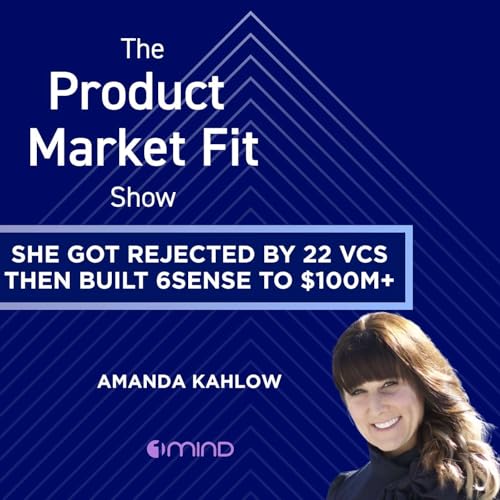
  • She got rejected by 22 VCs—then built 6sense to $100M+ in revenue. Now she's back for AI. | Amanda Kahlow, Founder of 1mind
    Apr 6 2026

    Amanda spent 16 years running a services business for Cisco and Intel. When she tried to productize her business, 22 VCs rejected her. That became 6sense, a $200M ARR company. After stepping aside as CEO and taking five years off, she's back with an AI startup called 1 mind.

    In this episode, Amanda breaks down why she always goes enterprise-first when everyone tells her to start small, how she used an AI clone of herself to pitch 60 VCs and raise 1mind's Series A in three days, and why she believes the entire sales process—SDRs, AEs, sales engineers—is about to be collapsed into a single AI "superhuman."

    Why You Should Listen

    • Why 22 VC partner meetings said no—and how one change fixed it overnight.
    • How she used an AI clone of herself to close a Series A in 3 days.
    • Why starting enterprise-first beats moving upmarket.
    • Why outbound AI email is a race to the bottom and what to build instead.

    Keywords startup podcast, startup podcast for founders, product market fit, AI agents, AI sales, enterprise sales, 6sense, 1mind, finding pmf, B2B SaaS, AI enabled services, net dollar retention

    Chapters

    • 00:00:00 Intro
    • 00:05:58 22 VC Rejections—Until She Found the Right Co-Founders
    • 00:08:49 Why She Always Starts Enterprise-First
    • 00:22:00 Five Years Off—Then the AI Wave Hit
    • 00:27:32 Why AISDRs Are a Race to the Bottom
    • 00:43:23 Using Her AI Clone to Raise the Series A
    • 00:49:52 The Moment of True Product Market Fit

    Send me a message to let me know what you think!

    Más Menos
    52 m
  • How this AI founder is on track to hit $50M ARR just 2 years after launch. | Tarek Alaruri, Co-Founder of Stuut
    Apr 2 2026

    Tarek already built a B2B software company to $30M ARR. But when the AI wave hit, he realized he could build a generational business by automating the manual world of accounts receivable. So, he left to start Stuut.

    In this episode, Tarek breaks down how he reached $1M ARR in a couple of months and is on track to hit up to $50M this year. He reveals how he pre-sold his first $65k contract with just wireframes, why he forces new customers to introduce him to five peers, and the brutal reality of finding message-market fit through hundreds of cold calls.

    Why You Should Listen

    • How to pre-sell a $65k enterprise contract before writing code.
    • The "Closing Discount" hack to generate 5 referrals from every new customer.
    • Why finding "Message Market Fit" is more important than your ICP.
    • How to spot and avoid early-stage startup "vultures".
    • Why scaling a B2B sales motion requires hiring misfits over pedigree.

    00:00:00 Intro
    00:01:41 Leaving a $30M Startup to Build with AI
    00:08:06 Finding Message Market Fit Through Cold Calling
    00:20:07 Pre-Selling a $65k Contract with Wireframes
    00:27:51 The Voice AI "Aha" Moment
    00:33:07 The Closing Discount Referral Hack
    00:37:18 The Brutal Reality of B2B Sales
    00:42:19 Hitting $1M ARR and Pacing for $50M
    00:45:05 Why Product Market Fit is Never Truly Found

    Send me a message to let me know what you think!

    Más Menos
    47 m
  • He launched a free product for enterprise customers—then grew to $12M ARR in 2 years. | Bhaskar Sunkara, Founding CTO of AppDynamics
    Mar 30 2026

    Description

    Bhaskar was employee #1 at AppDynamics, which was sold to Cisco for $3.7B. He and co-founder Jyoti found a way to change how enterprise monitoring tools worked. From tracking low-level code metrics that ops teams didn't understand to monitoring what the business actually cares about.

    In this episode, Bhaskar breaks down how that one insight won them Netflix and Priceline as early customers, why they ran production POCs that no competitor would dare try, and how a free download called AppDynamics Lite generated over 60% of their leads—in an industry where getting started normally took weeks of professional services and six-figure contracts.

    Why You Should Listen

    • Why selling to developers is operating on hard mode.
    • How one-day POCs became the killer enterprise sales weapon.
    • Why freemium disrupted an industry that required weeks of professional services to get started.
    • How they grew from $2M to $12M in revenue in just one year post launch.

    Keywords

    startup podcast, startup podcast for founders, product market fit, AppDynamics, application monitoring, enterprise SaaS, B2B sales, finding pmf, freemium strategy, Cisco acquisition, production POC

    Chapters

    • 00:00:00 Intro
    • 00:11:33 Choosing the ICP
    • 00:20:37 Landing Netflix with Freemium
    • 00:28:44 Growing from $2M to $12M in Year Two
    • 00:30:10 The Free Download Strategy That Generated 60% of Leads
    • 00:32:04 Days from the NASDAQ Bell—Then Cisco Offered $3.7B
    • 00:41:28 The Moment of True Product Market Fit

    Send me a message to let me know what you think!

    Más Menos
    45 m
  • He raised $41M in one year to replace enterprise accountants with AI. | Yogi Goel, Founder of Maxima
    Mar 26 2026

    Yogi spent 20 years living the nightmare of enterprise accounting. As a senior finance leader at Rubrik, he watched highly paid professionals spend three weeks every month manually wrangling data into spreadsheets—a problem that caused mass burnout and multi-million dollar stock corrections.

    When ChatGPT launched, Yogi knew the technology was finally ready to solve the problem. In this episode, he breaks down how he left his executive track to found Maxima, how he landed massive enterprises like Scale AI and Rippling as early design partners, and why he managed to raise $41M from top-tier VCs like Kleiner Perkins and Redpoint before he even had a pitch deck.

    Why You Should Listen

    • How a 1st-time founder raised an $11M Seed and a $30M Series A in a year.
    • Why replacing accountants with AI is a bigger opportunity than replacing SaaS tools.
    • How to use the "Design Partner Playbook" to secure Fortune 500 customers.
    • Why charging for an MVP creates the friction you actually need to find true PMF.
    • The difference between selling "digital shelves" and selling "folded laundry" in the age of AI.

    Keywords

    startup podcast, startup podcast for founders, AI in accounting, enterprise SaaS, product market fit, finding pmf, raising seed round, raising series a, B2B sales, design partners

    00:00:00 Intro
    00:07:37 Leaving a CFO Track to Become a Founder
    00:11:52 Raising an $11M Seed Round from Kleiner Perkins
    00:20:07 The Design Partner Playbook
    00:22:34 Why You Must Charge Your Early Design Partners
    00:28:36 The Aha Moment for Product Market Fit
    00:33:20 Selling "Folded Laundry" Instead of "Digital Shelves"
    00:36:47 Raising a $30M Series A Pre-Emptively

    Send me a message to let me know what you think!

    Más Menos
    44 m
  • How he grew his AI startup from $2M to $20M ARR in 12 months. | Omar Haroun, Co-Founder of Eudia
    Mar 23 2026

    Omar already built and sold an AI startup for over $100M. But when the generative AI wave hit, he realized the technology wasn't just the future of software—it was the future of labor. So he started Eudia to completely transform how enterprise legal teams operate.

    In this episode, Omar breaks down how he scaled from $2M to $20M ARR in just 12 months. He reveals the exact cold email strategy he used to land C-suite design partners, why he bought an existing legal services company to accelerate his AI platform, and why replacing human labor with AI is the ultimate business model.

    Why You Should Listen

    • Why selling AI as a service is a much bigger opportunity than selling SaaS.
    • How to secure Fortune 500 design partners using cold emails.
    • Why playing to win beats playing not to lose.
    • How to build a data moat that AI wrappers can't compete with.
    • Why ARR shouldn't be your only measure of startup success in the AI era.

    Keywords

    startup podcast, startup podcast for founders, AI startups, product market fit, AI enabled services, legaltech, B2B SaaS, enterprise sales, finding pmf, generative AI

    00:00:00 Intro
    00:01:45 Why AI is the Future of Labor
    00:04:55 Replacing In-House vs. Outsourced Legal Teams
    00:09:35 Selling His First AI Startup for $100M
    00:12:11 Why the $1 Trillion Law Firm Industry is at Risk
    00:21:59 Landing Fortune 500 Design Partners via Cold Email
    00:28:26 Playing to Win vs. Playing Not to Lose
    00:33:45 Raising a $6M Seed Round with an 80-Page Transcript
    00:38:53 Buying a Legal Services Company to Accelerate Growth
    00:44:55 Scaling from $2M to $20M ARR in 12 Months

    Send me a message to let me know what you think!

    Más Menos
    49 m
  • She raised $20M from Accel to replace QuickBooks with AI. | Helen Hastings, Founder of Quanta
    Mar 19 2026

    Helen was a software engineer who noticed a massive problem: accounting software for startups was broken, manual, and weeks out of date. Instead of just building a shiny new dashboard on top of legacy platforms, she decided to completely replace the offshore accounting model with AI.

    In this episode, Helen breaks down how she raised a $4.7M seed round pre-product as a solo founder and why she chose to build an AI-enabled service instead of pure software. She reveals the exact user research playbook she used across 200 interviews, how to rebuild a monopoly like QuickBooks, why hitting product-market fit actually forced her to stop taking new customers, and how she raised a $15M Series A.

    Why You Should Listen

    • How to raise a $4.7M seed round as a solo founder with zero revenue.
    • Why building an AI-enabled service beats selling pure SaaS.
    • Why saying "yes" to too many customers will destroy your growth.
    • How to conduct 200 user interviews before writing a single line of code.
    • Why rebuilding a legacy monopoly is no longer a crazy idea.

    Keywords

    startup podcast, startup podcast for founders, product market fit, AI enabled services, fintech startup, user research, solo founder, raising seed round, B2B SaaS, finding pmf

    00:00:00 Intro
    00:02:13 The Origin Story
    00:05:31 Doing 200 User Interviews Before Building
    00:11:49 The "Magic Wand" Framework for User Research
    00:14:33 Raising a $4.7M Seed as a Solo Founder
    00:22:27 Why AI-Enabled Services Beat Pure SaaS
    00:28:50 Rebuilding QuickBooks from Scratch
    00:39:34 The Public Launch and PR Strategy
    00:50:06 Why Saying "Yes" to Customers Hurt Growth
    00:53:46 The Moment of True Product Market Fit

    Send me a message to let me know what you think!

    Más Menos
    57 m