unSILOed with Greg LaBlanc Podcast Por Greg La Blanc arte de portada

unSILOed with Greg LaBlanc

unSILOed with Greg LaBlanc

De: Greg La Blanc
Escúchala gratis

unSILOed is a series of interdisciplinary conversations that inspire new ways of thinking about our world. Our goal is to build a community of lifelong learners addicted to curiosity and the pursuit of insight about themselves and the world around them.*unSILOed Podcast is produced by University FM.*All rights reserved. Arte Economía Historia y Crítica Literaria
Episodios
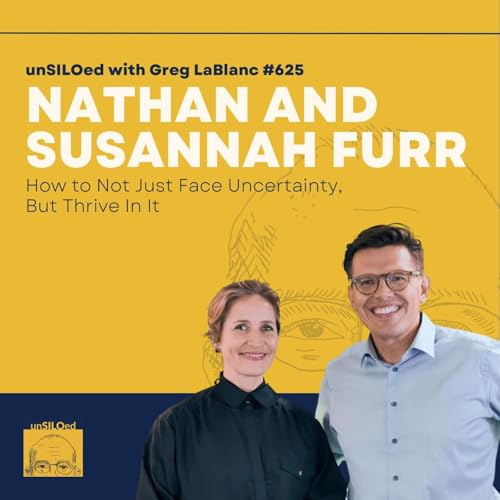
  • 625. How to Not Just Face Uncertainty, But Thrive In It feat. Nathan and Susannah Furr
    Mar 2 2026
    We live in an age where uncertainty lurks around every corner, but what if uncertainty didn’t have to be an anxiety-inducing, uncomfortable part of life? The Upside of Uncertainty: A Guide to Finding Possibility in the Unknown, by INSEAD professor Nathan Furr and entrepreneur Susannah Harmon Furr, presents strategies and tools to embrace uncertainty and turn it into opportunity. Nathan, Susannah, and Greg discuss why humans are naturally wired to avoid the unknown, and how our capacity to face it can be strengthened through learnable tools. The conversation covers some of the strategies described in the book like creating “islands of certainty” through rituals and support systems, maintaining a portfolio of personal options instead of going all-in too early, and focusing on what’s within one’s control while pursuing other meaningful goals, internally. *unSILOed Podcast is produced by University FM.* Episode Quotes: The golden space of uncertainty 26:59: [Nathan Furr] The American can-do attitude is it was this kind of illusion that we control the world. And most people who have been through something hard recognize it is not totally in our control. We sure we influence it, we nudge it, but a lot of things are outside our control. And so the people who are able to approach uncertainty with greater calm also kind of said, you know, what is in my control? I will focus on that, and what is outside of my control, or partially outside of my control, I am not going to obsess about that. And so there is this kind of golden space where you are focused on what are my internal goals, being the best, doing my best, making a contribution in the world. And I recognize that, there is some element of, in this complex, ambiguous world that I do not control, and so I am just going to focus on the things I can control and let the other pieces go. That leads to a much calmer view of the world. The video and audio are not synched On being comfortable with uncertainty 11:42: [Susannah Furr]: All of us could have cooler and more brilliant lives if we just tried a little bit more, if we got a little bit more comfortable with uncertainty. It is good to know, like, Ooh, I do not like risks. And we have a tool for that. Like, know what risks you have affinities and aversions for, but definitely do not just decide, Nope, I do not do uncertainty, because you are, you are missing out. The real danger isn’t risk 18:29: [Nathan Furr] The real danger is not that you are going to go all in on the uncertain thing, it is that you are probably going all in on the certain thing, and you are not bringing that thing you care about, that thing you dream about, into the portfolio of options in your life. Show Links: Recommended Resources: Ben Feringa World Uncertainty Index Sam Yagan Martin Seligman Kathleen M. EisenhardtAyana Elizabeth Johnson Guest Profile: Nathan Furr Faculty Profile at INSEADNathan Furr on LinkedInSusannah Harmon Furr Profile at INSEADSusannah Harmon Furr on LinkedInThe Uncertainty Possibility School Guests’ Work: The Upside of Uncertainty: A Guide to Finding Possibility in the UnknownThe Innovator's Method: Bringing the Lean Start-up into Your OrganizationLeading Transformation: How to Take Charge of Your Company's FutureInnovation Capital: How to Compete--and Win--Like the World’s Most Innovative Leaders Hosted by Simplecast, an AdsWizz company. See pcm.adswizz.com for information about our collection and use of personal data for advertising.
    Más Menos
    55 m
  • 624. Time, Distraction, and Investing in What Matters with Cassie Holmes
    Feb 27 2026
    What happens when you start thinking of time as a scarce resource? What practical strategies can you use to protect it from being passively spent or hijacked so that you can spend the time you have in more fulfilling and meaningful ways? Cassie Holmes is a professor at UCLA’s Anderson School of Management, and also the author of the book Happier Hour: How to Beat Distraction, Expand Your Time, and Focus on What Matters Most. Greg and Cassie discuss how to use time more intentionally to increase both day-to-day joy and overall life satisfaction. Cassie explains how even though these happiness questions are timeless, they have become newly urgent due to modern distractions, cell phones, productivity culture, and the pandemic’s effects on time perception, anxiety, burnout, and workplace engagement. Cassie describes exercises such as tracking one’s time and rating activities to identify what is personally most joyful and meaningful, noting common low-happiness activities (commuting, work, housework) and how individuals can find variation within them. Cassie opens the window on some of the examples of this within her own life through her regular coffee dates with her daughter and a prearranged commitment device that allows her to count on date nights with her husband. They also cover bundling chores with enjoyable activities, selectively outsourcing tasks, and the tradeoffs of pricing time in money, emphasizing that better time management enables more meaningful and satisfying life activities, not simply doing less. *unSILOed Podcast is produced by University FM.* Episode Quotes: Why being busy doesn't make you fulfilled 08:46: The unhappiness comes from when you have been busy and have spent your time and are looking back on it, feeling unfulfilled, like it got spent without you having invested in anything that ultimately matters to you. Whether it is things that give you that like true sense of joy and enjoyment, oftentimes through our interpersonal relationships, but also even that sense of satisfaction when you are making actual progress on whatever your project is, whatever that endeavor that you are sort of working towards is in line with your purpose, whether it is your personal purpose, which is really what my focus on is in the book, is the individual, and then ideally it is aligned. Your personal purpose is aligned with the sort of purpose of the work that you are doing. What is time poverty? 40:31: What time poverty is, it is this feeling of having too much to do and not enough time to do it. It is a feeling of being limited by the resources, in this case, time that you have available to achieve what you set out to do. Why isn't more enough, when it comes to happiness? 20:22: Not recognizing the role of hedonic adaptation is sure that first half hour, like, yes, that is the delight, right? You have your glass of wine, and you finally can kick back. But once you press, next episode, and you are three hours into your watching TV that night, you see on the happiness ratings that it, your enjoyment goes down over time. So that is also really helpful information, right? Because if we are trying to optimize using your optimization, sort of discipline and thinking, then we will, well, actually, we should spread out those positives, like my TV watching. This is also where intentionality comes into play. Like instead of zoning out for like many hours every night, just watch that first half hour. Show Links: Recommended Resources: HappinessHedonic TreadmillIntentionalityMarie KondoGeorge ShultzTime PovertyKaty Milkman Guest Profile: CassieHolmes.comFaculty Profile at UCLA Anderson School of ManagementLinkedIn Profile Guest Work: Happier Hour: How to Beat Distraction, Expand Your Time, and Focus on What Matters MostTEDx Talk | Finding Happiness in Ordinary Moments Hosted by Simplecast, an AdsWizz company. See pcm.adswizz.com for information about our collection and use of personal data for advertising.
    Más Menos
    52 m
  • 623. From Classroom to Boardroom: Unstoppable Entrepreneurs with Lori Rosenkopf
    Feb 25 2026
    What makes for a good entrepreneur in today’s start-up landscape? How do you work to scale and when is it right to go from bootstrapping to seeking funding? How are the roots of innovation now fundamentally different than the dot com era? Lori Rosenkopf is a Professor of Management and also the Vice Dean of Entrepreneurship at the Wharton School, San Francisco campus. She is also the author of the book Unstoppable Entrepreneurs: 7 Paths for Unleashing Successful Startups and Creating Value through Innovation. Greg and Lori discuss Lori’s focus on Wharton’s student and alumni entrepreneurial ecosystem, and she explains how entrepreneurship skills overlap with the innovation inside large organizations and universities. Lori describes seven entrepreneurial pathways and six “Rs” that reflect an entrepreneurial mindset, emphasizing that many successful entrepreneurs first build industry experience in standard careers rather than launching ventures immediately after school. Their conversation covers how Wharton’s curriculum has evolved over time, adding majors and coursework in entrepreneurship, innovation, analytics, and now AI; experiential learning; venture pitching for credit. Greg asks how the Venture Acceleration Lab helps expose students to scaling alumni ventures. Lori and Greg discuss different stereotypes of entrepreneurs, and Lori touches on why alumni and industry-affiliation networks remain powerful, how innovation increasingly happens through ecosystems, partnerships, and acquisitions rather than in-house R&D, and the continuing importance of universities in basic science commercialization, including Penn’s Pennovation initiative and strong biomedical startup activity. *unSILOed Podcast is produced by University FM.* Episode Quotes: The stereotype of a unicorn founder 17:18: I think that we have grown accustomed to a stereotype, which is, let us name them out, college dropout. Young. Venture capital backed tech, unicorn, great personal and commercial wealth. And now we are depending on them for philanthropy. We can have a whole discussion just about whether that is a good thing or not. But that is sort of the image. Is there a way people can cultivate their resilience? 32:00: Resilience, it can come from being in love with your problem and wanting to solve that so deeply. Now it has to be a problem that enough of the marketplace shares that they are willing to think about your solution. But people who want to solve a problem are going to claim lots and lots of different ways to attack it. And this is what entrepreneurs are constantly dealing with, negative feedback and challenges. In many cases, it is very rare that companies of ventures first offering is something that everybody falls in love with. What has Lori learned about information diffusion over 30 years of research? 11:17: I think that as we have gone to where more digital products and services, that it gives us the opportunity to build up these bigger ecosystems where different parties are collaborating in a variety. So it might be as extreme as acquisitions. And that is not just happening when Apple, that is CPG companies are buying little startups where people have developed new grants that are cool. They are partnering in many cases, so they may not be a full on acquisition, but there will be a contractual set of arrangements and maybe a conformance to a standard, as well. So that has become more and more common, and the idea that any one firm can invent everything in house, I think it does feel a little bit passé, you know, like rate of change is getting quicker and quicker. Show Links: Recommended Resources: Patrick T. HarkerEntrepreneurshipVenture Lab | University of PennsylvaniaMax WeberBell Labs Guest Profile: Faculty Profile at Wharton Business SchoolLoriRosenkopf.comLinkedIn Profile Guest Work: Unstoppable Entrepreneurs: 7 Paths for Unleashing Successful Startups and Creating Value through InnovationGoogle Scholar Page Hosted by Simplecast, an AdsWizz company. See pcm.adswizz.com for information about our collection and use of personal data for advertising.
    Más Menos
    50 m
Todavía no hay opiniones