touch point podcast Podcast Por touch point media arte de portada

touch point podcast

touch point podcast

De: touch point media
Escúchala gratis

touch point is a podcast dedicated to discussions on digital marketing and online patient engagement strategies for hospitals, health systems, and physicians' practices. In each episode, hosts Reed Smith and Chris Boyer dive deep into a variety of topics on the digital tools, solutions, strategies, and processes that are impacting the healthcare industry today.touch point media © 2023. All rights reserved. Economía Higiene y Vida Saludable Marketing Marketing y Ventas Política y Gobierno
Episodios
  • TP478: The Journey Nobody Told Operations About
    Mar 11 2026
    The language of lifecycle engagement, continuous care relationships, and whole-person experience has fully colonized healthcare strategy decks. Marketing invested in journey maps. Leadership signed off on CRM platforms and digital front door initiatives. The consumer lifecycle is drawn on whiteboards in conference rooms across the country. And yet: the scheduling system still fills slots, not relationships. The EMR still closes the encounter at discharge. The call center still routes to availability, not context. The follow-up that fires after a visit is an automated survey, not a clinical touchpoint. The patient who received a personalized "we care about your whole health" email walks into an appointment where the provider has never seen it. Healthcare has rebranded the patient journey. It hasn't redesigned the organization that delivers it. Chris Boyer and Reed Smith examine the specific gap between what health systems promise through their consumer experience strategy and what patients actually encounter when the operational infrastructure hasn't changed: Why "consumer journey" became a marketing framework rather than an operational commitment — and what got left out when it did The post-discharge cliff: why most health systems treat discharge as an endpoint when a journey framework requires it to be a transition How scheduling logic, EMR workflows, and call center scripts were built for encounter resolution — not relationship continuity The channel handoff failure: why patients who begin digitally often restart from zero when they call or show up Who actually owns the seam between departments — and why the honest answer is usually nobody The episode ends with a direct challenge: before your organization launches its next lifecycle campaign or publishes its next patient journey map, someone should be able to answer a basic question. What is the operational commitment behind this? Not the technology investment. The operational commitment. If your CEO asked you today to show them where in the organization the consumer journey is operationally owned, could you give a straight answer? Mentions from the Show: "Value-based care adoption grows, but challenges remain": https://www.hfma.org/reference/value-based-care-adoption-challenges/ "Innovation in Pursuit of Patient-Centered Care": https://catalyst.nejm.org/doi/full/10.1056/CAT.24.0245 "Reducing Hospital Readmissions": https://www.ncbi.nlm.nih.gov/books/NBK606114/ "Reducing readmission rates through a discharge follow-up service": https://pmc.ncbi.nlm.nih.gov/articles/PMC6616175/ "What is Healthcare CRM?": https://www.leadsquared.com/industries/healthcare/what-is-healthcare-crm/ "The continued growth of VBC, in 4 charts": https://www.advisory.com/daily-briefing/2025/06/04/vbc "Engaging Complex Health System Boards in Quality and Safety Governance": https://catalyst.nejm.org/doi/full/10.1056/CAT.25.0276 Reed Smith on LinkedIn: https://www.linkedin.com/in/reedtsmith/ Chris Boyer on LinkedIn: https://www.linkedin.com/in/chrisboyer/ Chris Boyer website: http://www.christopherboyer.com/ Chris Boyer on BlueSky: https://bsky.app/profile/chrisboyer.bsky.social Learn more about your ad choices. Visit megaphone.fm/adchoices
    Más Menos
    42 m
  • TP477: The Trust Debt: The Hidden Cost of Automating the Wrong Things
    Mar 4 2026
    Automation was sold as a way to scale good experiences. It scales bad ones just as efficiently. Healthcare has spent the last decade deploying chatbots, portals, AI-generated content, and personalization engines in the name of patient experience. The ROI case was built on efficiency: lower cost per interaction, faster throughput, reduced call center volume. What was never put on the balance sheet is what happens to patient trust when those systems fail — and they fail regularly, quietly, and without anyone in the organization knowing it happened. That's trust debt. Every time an automated system fails a patient and the patient absorbs the cost silently — closes the portal, hangs up, stops engaging — a withdrawal is made from an account most health systems never knew they had. It doesn't show up in satisfaction scores. It shows up in churn, in rising call volumes that automation was supposed to reduce, in patients who schedule once and don't come back. Chris Boyer and Reed Smith work through where the debt is accumulating right now — and where automation is actually doing the opposite: Why AI-generated health content optimized for fluency, not accuracy, is seeding doubt in the patients most likely to engage with it How portal adoption metrics are measuring the wrong signal — and why enrollment without satisfaction is just a larger audience for your frustration Where DXP personalization crosses from service into surveillance — and how thin consent frameworks are accelerating that perception What trust-building automation actually looks like, and what it has in common with the best human interactions in healthcare The three questions every team should ask before the next automated touchpoint goes live The research is catching up to what practitioners already sense. AI safety disclaimers in patient-facing responses dropped from 26% in 2022 to under 1% in 2025. Sixty-one percent of patients say they'd consider switching providers over a better digital experience. And the 2025 Edelman Trust and Health report found that no institution — not business, not government, not NGOs — is trusted to address patient needs. Healthcare is operating in a trust deficit it didn't create alone, but automation is making it worse in ways that are largely invisible to the organizations doing it. The question isn't whether to automate. It's whether you've been honest about what you're actually scaling. Mentions from the Show: TP456: When AI Speaks for the Patient — touchpoint.health TP460: When Digital Speaks for the Patient — touchpoint.health TP470: When AI Becomes the First Stop for Care — touchpoint.health AI errors in healthcare — Healthcare Brew, August 2025: https://www.healthcare-brew.com/stories/2025/08/20/healthcare-execs-ai-errors Declining medical safety messaging in AI — npj Digital Medicine, October 2025: https://www.nature.com/articles/s41746-025-01943-1 ECRI Top 10 Patient Safety Concerns 2025: https://www.medtechdive.com/news/ecri-patient-safety-report-2025-ai/742114/ ONC Patient Portal Access Data Brief 2024: https://healthit.gov/data/data-briefs/individuals-access-and-use-patient-portals-and-smartphone-health-apps-2024/ Experian Health patient portal switching stat: https://www.experian.com/healthcare/solutions/patient-engagement-solutions 2025 Edelman Trust Barometer: Trust and Health: https://www.edelman.com/trust/2025/trust-barometer/special-report-health 2026 Edelman Trust Barometer: https://www.edelman.com/trust/2026/trust-barometer Reed Smith on LinkedIn: https://www.linkedin.com/in/reedtsmith/ Chris Boyer on LinkedIn: https://www.linkedin.com/in/chrisboyer/ Chris Boyer website: http://www.christopherboyer.com/ Chris Boyer on BlueSky: https://bsky.app/profile/chrisboyer.bsky.social Reed Smith on BlueSky: https://bsky.app/profile/reedsmith.bsky.social Learn more about your ad choices. Visit megaphone.fm/adchoices
    Más Menos
    38 m
  • TP476: Good Enough for People Is Not Good Enough for Machines
    Feb 25 2026
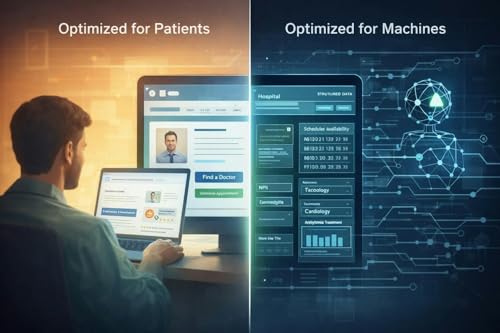
    Health systems have spent 20 years optimizing for the patient who searches, clicks, and reads. They are not optimizing for the agent that queries, evaluates, and routes. Those are two different audiences — and most organizations are only ready for one of them. The digital front door was built on a human assumption: that discovery begins with a search, passes through a website, and ends in conversion. Agentic AI doesn't use doors. It uses structured pathways, machine-readable attributes, and decision logic that operates entirely outside your owned channel. The routing is already happening. The question is whether health systems are in the decision set - or invisible to it. The infrastructure making this possible isn't speculative. Model Context Protocol (MCP), now an open standard backed by Anthropic, OpenAI, and Google DeepMind, defines how AI agents connect to external tools and data sources. NLWeb, launched by Microsoft in May 2025, turns websites into machine-queryable endpoints. Together, they create an execution layer on top of your digital ecosystem. And most hospital websites aren't built to be legible to it. Chris Boyer and Reed Smith work through what this shift actually requires: Why the patient journey now runs conversation → AI interpretation → machine routing → conversion — and health systems control only the last step What breaks when machines encounter unstructured provider bios, inconsistent service line naming, and scheduling availability gaps Why brand strength built on emotional resonance doesn't translate to machine-readable signals — and what does The gap between "78% of health systems engaged in AI projects" and the 52% that feel operationally ready to implement them What a practical machine readiness audit looks like, and who inside the organization should own it The organizational problem is as hard as the technical one. Marketing owns content but rarely owns schema. IT owns infrastructure but rarely thinks in terms of machine-readable patient experience. Someone has to own machine readiness as a cross-functional problem. Right now, almost no one does. If your digital strategy was designed for the patient who searches, clicks, and reads - it was not designed for the agent that queries, evaluates, and routes. Mentions From the Show: Dean Browell on LinkedIn Danny Fell on LinkedIn Reed Smith on LinkedIn Chris Boyer on LinkedIn Chris Boyer website Chris Boyer on BlueSky Reed Smith on BlueSky Learn more about your ad choices. Visit megaphone.fm/adchoices
    Más Menos
    37 m
Todavía no hay opiniones