geneveMonde.ch Podcast Por David Glaser arte de portada

geneveMonde.ch

geneveMonde.ch

De: David Glaser
Escúchala gratis

Find here all the rare interviews of the geneveMonde.ch editorial staff, the collaborative platform on the history of international Geneva, and the exceptional documents coming from the archives of the international organizations based in Geneva and digitized by us, the audio contents of the geneveMonde.ch thematic files as well as our various Sounds of History podcasts The interviews and podcasts are produced by the historian Véronique Stenger and the journalist David Glaser.


---

Retrouvez ici tous les entretiens rares de la rédaction de geneveMonde.ch, la plateforme collaborative sur l'histoire de la Genève internationale, et les documents exceptionnels venus des archives des organisations internationales installées à Genève et numérisées par nos soins, les contenus audio des dossiers thématiques de geneveMonde.ch ainsi que nos différents podcasts Sounds of History/Sons d'Histoire. Les entretiens et les podcasts sont produits par l'historienne Véronique Stenger et le journaliste David Glaser.


Copyright FONSART 2025

Hébergé par Acast. Visitez acast.com/privacy pour plus d'informations.

David Glaser
Ciencia Política Ciencias Sociales Mundial Política y Gobierno
Episodios
  • Hotelier Isabelle von Burg : The Art of Welcoming the World
    Dec 16 2025

    Isabelle von Burg, born in Lausanne to a Swiss-Belgian family, shares how her passion for hospitality has taken her around the globe. From internships in Thailand to leadership positions in Dublin, Berlin, Hong Kong, Dubai, Ras al-Khaimah, Geneva, and Lausanne, she has gained unique experience in luxury hospitality and international diplomacy. Her international career is rooted in strong family values: generosity, authenticity, the joy of welcoming others, a love for languages, people, and culture.


    For Isabelle, service goes beyond mere technique: it is about emotion, attentiveness, and human intelligence. In hotels such as the Lausanne Palace or the Four Seasons Hotel des Bergues in Geneva, she learned to anticipate the needs of guests - diplomats, heads of state, or celebrities - while respecting their privacy and confidentiality. “Luxury is not the lavish suite; it is the ability to experience moments of silence and tranquility,” she explains.


    Anecdotes and Challenges Behind the Luxury


    Isabelle recalls memorable experiences: driving a VIP delegation at 200 km/h in Ras al-Khaimah, organizing banquets for a thousand guests in Hong Kong, welcoming Roger Federer in Geneva, or fulfilling Tom Cruise’s very specific request for a Nespresso coffee in Dubai. Each situation required calm, anticipation, and creativity to deliver a memorable experience.


    Today, Isabelle von Burg dedicates her energy to Next-Gen Hospitality Leaders, a global community that trains and supports young talents in hospitality. The goal is to develop confident leaders who can excel while remaining human, emotionally intelligent, and resilient under pressure. She emphasizes the importance of mentors and the need to share experience and values to inspire the next generation.


    For Isabelle, leading in hospitality is above all about understanding and valuing each person, whether staff or guests. Her management approach is based on listening, adaptability, and authenticity, where technical excellence is always guided by emotion and respect for others. In short, a model we would love to see replicated across all spheres of today’s professional world.


    Interview conducted by David Glaser


    Link to Isabelle’ von Burg’s new community Next-Gen Hospitality Leaders

    Hébergé par Acast. Visitez acast.com/privacy pour plus d'informations.

    Más Menos
    42 m
  • 100 Years of Ideas : Martin Grandjean & Daniel Laqua on Intellectual Cooperation
    Dec 9 2025

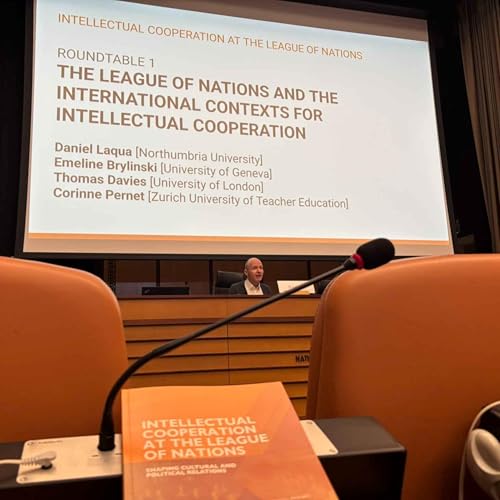
    Order of interviewees: Martin Grandjean (UNIL), Gabriel Galvez Behar (Université de Lille), Thomas Davies (University of London), Emeline Brylinski (UNIGE) et Daniel Laqua (Northumbria University)


    The centenary of the League of Nations and its International Committee on Intellectual Cooperation (1922) offered a moment to reflect on a century of global intellectual exchange. In 2022, a conference at the Palais des Nations in Geneva gathered researchers who have long examined the League’s contributions to science, culture, education, and the arts. The event inspired a collective volume by 17 scholars, Intellectual Cooperation at the League of Nations: Shaping Cultural and Political Relations, edited by Martin Grandjean and Daniel Laqua, launched in early December during two round tables organized by the UN Library & Archives Geneva.


    The Geneva–Paris axis was central to the League’s intellectual cooperation, hosting debates, institutions, and networks that reached worldwide. Around forty national commissions implemented these initiatives, initially focusing on rebuilding universities and scientific networks in Eastern Europe after World War I. Cooperation later expanded to Asia and South America, reflecting the League’s broader international scope.


    Early efforts were dominated by scientific collaboration, inspired by the rise of international congresses in the late 19th century. From the late 1920s, cultural, literary, and artistic communities increasingly shaped the agenda. Post-war institutions like CERN continued this spirit of transnational scientific dialogue.


    Today, UNESCO carries forward this work on a global scale, integrating education, science, and culture. Education—largely neglected by the League—has become one of its core missions. Other organizations, such as WIPO, emerged from the same roots to address issues like intellectual property at the intersection of industry and innovation. These institutions embody the evolution of intellectual cooperation toward greater inclusivity.


    Thomas Davies (University of London) recalls early thinkers such as Paul Otlet and Marc-Antoine Jullien, who imagined systems of international intellectual exchange long before the League existed. Figures like Gilbert Murray and Alfred Zimmern played major roles during the League era, though many projects were interrupted by World War II. UNESCO later rebuilt these ambitions on a broader global basis.

    According to historian Gabriel Galvez Behar (University of Lille), early scientific cooperation often fell short: budgets remained incomplete, treaties stalled, and disagreements slowed progress. Yet these efforts laid the groundwork for post-war collaboration, influencing instruments like the Frascati Manual.


    Women participated from the beginning, though often in marginalized roles. While Marie Curie is a prominent exception, many women contributed through translation, coordination, and mediation. The book highlights their essential but long-overlooked work.


    Emeline Brylinski (University of Geneva) emphasizes the importance of the International Bureau of Education (IBE), founded in Geneva in 1925. As one of the first intergovernmental education bodies, it later helped shape UNESCO. Focused on primary education, the IBE complemented the League’s work on secondary and elite education. Guided by Jean Piaget—alongside Elizabeth Rotten, Pierre Bovet, Edouard Claparède, and Adolphe Ferrière—the IBE promoted educational innovation and global exchange. It continues to influence contemporary initiatives such as Education for All and Agenda 2030.


    The book revisits a century of intellectual cooperation, offering insights for today. In a period marked by weakening multilateralism, historical experience underscores the value of dialogue, trust, and long-term collaboration. Understanding past achievements and limitations can help institutions strengthen cooperation for the future.


    by David Glaser


    Book 991002769361802391_E.pdf

    Hébergé par Acast. Visitez acast.com/privacy pour plus d'informations.

    Más Menos
    16 m
  • From Santiago to Geneva : How Sport Breaks Barriers and Builds Inclusion
    Dec 9 2025

    Late november, at the Vieux Bois restaurant of the Geneva Hotel Management School—just steps from the United Nations—a remarkable gathering took place. “From Santiago to Geneva – Advancing Inclusive Sport and Physical Education,” organized by UNESCO, brought together experts, athletes, and leaders committed to inclusion in sport.


    Among the speakers were Bea Stadler, co-director of Swiss Inclusive Sport; Sebastian Mozer, president of Swiss Open Geneva; Raymon Blondel, president of the European Paralympic Committee; Theren Bullock, head of the FIBA Foundation; and Sabrina Bonanno of Decathlon. Paralympians such as Théo Gmür and Daniele Cassioli shared powerful stories of resilience. RTS journalist Odessa Blanc moderated the event, organized by Francesca Lualdi.


    The discussions highlighted how sport can drive inclusion, accessibility, and determination. Bullock described the FIBA Foundation as basketball’s social engine, linking global initiatives with local communities through “Basketball for Good,” focusing on health, gender equality, refugee inclusion, and disability sport.


    Basketball emerged as a democratic, unifying game. From street courts to international arenas, it bridges differences. Since James Naismith’s 1891 invention, the sport has grown to 650 million players and more than 3.3 billion fans. FIBA’s museum, the Patrick Baumann House of Basketball, traces this evolution. For Bullock, inclusivity is not an add-on but the sport’s core: “every player is a basketball player, regardless of ability.”


    Heroes shape the game—Michael Jordan, Kobe Bryant, Victor Wembanyama—but inclusion champions like Bea Stadler show impact in other ways. She described inclusion as a mindset: children play together naturally, focusing on strengths rather than limits. Wheelchair basketball balances abilities through a point system. Mozer noted that wheelchair tennis has gained visibility thanks to Grand Slam events, encouraging wider acceptance.


    Momentum for inclusive sport in Switzerland is rising. Landmark events such as the 2029 World Winter Games and the 2027 European Championships in Geneva will spotlight inclusion on a global stage. Blondel outlined the European Paralympic Committee’s efforts to foster inclusive societies, while Bonanno emphasized Decathlon’s commitment to accessible sports products as part of its core identity.


    The message was clear: inclusion in sport is intentional. It demands planning, collaboration, and long-term engagement to embed accessibility into culture and infrastructure. From grassroots actions to federations and adaptive design, the goal is universal—sport as a tool for equality, empowerment, and connection. Sport for everyone, without distinction.


    Text and photo by David Glaser


    Our galleries about olympic history related to internationalism is available here :


    genevemonde.ch/galleries/lausa...


    genevemonde.ch/galleries/lolym...


    For more information on UNESCO’s International Forum on inclusive sport and physical education : unesdoc.unesco.org/ark:/48223/...


    Hébergé par Acast. Visitez acast.com/privacy pour plus d'informations.

    Más Menos
    28 m
Todavía no hay opiniones