Write of Passage by Vanessa Riley Podcast Por Vanessa Riley arte de portada

Write of Passage by Vanessa Riley

Write of Passage by Vanessa Riley

De: Vanessa Riley
Escúchala gratis

Join bestselling author Vanessa Riley as she delves into untold histories, reflects on current events through a historical lens, shares behind-the-scenes writing insights, and offers exclusive updates on her groundbreaking novels.

vanessariley.substack.comVanessa Riley
Ciencias Sociales
Episodios
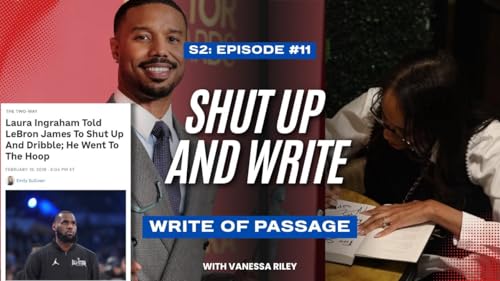
  • Shut Up and Write
    Mar 3 2026
    Every time the world feels unstable, and an artist dares answer an interview question, we get the same memo: stay in your lane. Entertain. Distract. Don’t dare analyze what’s happening. Don’t name it. Don’t challenge it. Shut up.I’m sorry to inform you—I’m not your minstrel on demand. If you’re big mad about that, go sit in the corner and think about why.Art has always been political. Perhaps your outrage is the real performance. So maybe, you need to quiet and listen.Shut Up and WriteIn February 2018, Fox News host Laura Ingraham responded to comments made by NBA superstar LeBron James with a phrase that ricocheted across the culture: “Shut up and dribble.”She was reacting to an interview James gave alongside Kevin Durant, in which he spoke not only about basketball but about race, leadership, and the lived reality of being a Black man in America. Ingraham dismissed his words as “barely intelligible” and suggested that someone “paid $100 million a year to bounce a ball” should keep his political opinions to himself.But here’s the thing: the minute you ask a Black person about their experience in America, you are no longer asking about “just sports.” You are asking about history. You are asking about citizenship. You are asking about survival. And you are asking for our truth.When you tell him or her or them to shut up and dribble, what you are really saying is:Perform. Entertain. Produce. But do not speak.That phrasing doesn’t emerge in a vacuum. It echoes a long American tradition—of Black bodies celebrated for talent but silenced in intellect; commodified for labor but dismissed in leadership; applauded for artistry but censored in analysis. From minstrel stages to modern arenas, the script has too often been the same: dazzle us, but do not disrupt us.And yet, LeBron did not shut up.He went about his business—on and off the court. He used the moment to amplify conversations about injustice, education, and opportunity. He built schools. He funded scholarships. He made sure that his platform included not just athletic excellence but civic voice. When he was told to shrink, he expanded.I guess that is what unsettles people. Not that LeBron dribbles—but that he keeps speaking.So on Threads, Twitter, pretty much all your parasitical streets, I hear authors being told a version of that command:“Just shut up and write.”Don’t talk politics.Don’t analyze power.Don’t interrogate policy.Stick to romance.Stick to fiction.Tell us about dukes and wagers and stolen glances, but do not dare connect the past to the present. In my June release, A Deal at Dawn, some readers are dying to know if the Duke of Torrance survives a chronic illness Black communities still suffer from today, but many more want to hear about the hurt-comfort caregiving in his bathtub or his foot fetish.In Fire Sword and Sea, some want to hear about the hijinks of women cross-dressing as men but forget about the systems of government that oppress them and force them into piracy as their way to survive.And since I’ve been writing to you weekly, I’ve gotten those nasty little emails telling me that I should stick to writing historical fiction and leave politics alone.To those folks, what the heck do you think I have been writing all along?When I describe women rising up in hostile systems, about enslavement and trafficking, about corrupt leaders, white supremacy, about diseases neglected because they ravage Brown bodies—I am writing politics. I’m writing about policy. I am writing about power. Corsets and cravats and crowns never dilute the truth.You cannot celebrate the art and forbid analysis.You cannot applaud the talent and mute the testimony.You cannot consume the culture and silence the creator.The expectation that artists remain apolitical is itself political.It says:We want your labor, LeBron, not your leadership, JasmineYour imagination, Micheal B, not your insight—DelroyYou are for entertainment, forget the lived experiences that got you here.But identity is not something I can toggle off between chapters. When you ask me about my work, you are asking about my worldview. When you ask about my characters, you are asking about justice and injustice as much as you reading for love.And love is power, and it is always political.We are living in times that feel combustible. Many are waking up to realities they once refused to see.They don’t know who to trust. They want words of comfort. But where are you going to get that? You told me to shut up and write.Writers, creators—moments like this, it’s easier to retreat—to binge-watch comfort shows, to lose ourselves in manuscripts, to hide in deadlines and drafts. I, too, would love to stay in my rom-com era. I would love to focus solely on shenanigans and happily-ever-afters. But even I can only binge-watch MythBusters, hockey, and Bridgerton for so long.So no, I cannot just shut up and write.I must write. Writing is my blood ...
    Más Menos
    12 m
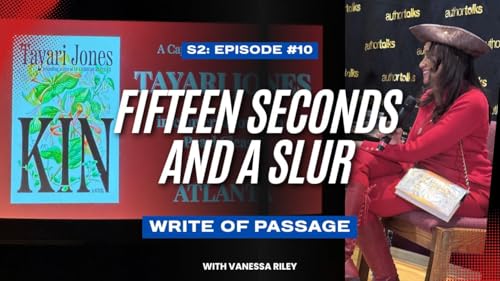
  • Fifteen Seconds and a Slur
    Feb 24 2026
    For any writer or creator, the edit is your best tool or best weapon. Every paragraph, article, headline, every broadcast, even every post is a choice—what stays in, what gets cut, who gets protected, and who gets exposed are choices. If you have the power to edit, you have the power to do better. Let’s talk about the superpower that comes with great responsibility.Fifteen Seconds and a SlurThe edit is intentional.The greatest tool any author carries is not talent, not inspiration, not even discipline. It is the edit. The edit is where intention meets responsibility. It is where raw creation becomes art.No one—no one—sits down and instantly produces a masterpiece. Manuscripts are not born polished. They are wrestled into being. They are drafted in confusion, in bursts of brilliance, in gaps of missing facts and half-remembered details. I cannot tell you how many times I’ve left myself placeholders—XXX—so I can go back and hunt down what I actually meant: the correct monetary value of a tavern meal in pirate haven Port Royal, the historical cut of a waistcoat or falls of breaches, the name of a street or rue in Hispaniola. It’s never right on the first go.Returning to it on the next pass, the next edit—that’s where the magic happens. The edit is the intentional power to clarify what you meant. The power to fix what you missed. The power to elevate what almost worked into what truly does.I’ve worked with brilliant editors and those who gave me brilliant headaches. I even hire my own. A good editor helps me see what I cannot see. They bring perspective, distance, and rigor. But even then, I choose. I decide what advice to accept, what to reconsider, and what to reshape. Editing is collaboration—but it is also stewardship. Before any manuscript moves to the next level—before submission or publication—it carries the weight of my choices. Another set of eyes will add more to the manuscript. Every perspective reveals something new. That’s how diligent writers reach the best version of a book earthly possible.Writers are not the only ones who wield this magic tool.Video editing is editing. What you choose to upload to your social feeds—what you trim, what you blur, what you cut out—matters. I am more conscious of accidentally revealing mailing addresses in the background of one of my post office runs. Everyone should hide vulnerable information that should not be public, and watch for angles that misrepresent.The edit shapes our experience. On TikTok, Threads, Bluesky, Instagram—even if you wander back to Twitter—you should be curating what we see. That curation, that social edit is power.Journalists edit, too. They decide:* Whose names appear?* Which details matter?* Which context is included?* And which bits of info are left out?That is why it unsettles me when journalists act as if they are powerless—when they behave as though they must show everything, or they both-sides-things normalizing crazy, and seem to be okay with pieces that distort or wound.When civil rights leader and Rainbow Coalition founder Jesse Jackson died peacefully at 84 on February 17, 2026, after long battles with Parkinson’s disease, the headline was clear: a giant of the civil rights movement had passed, noting Jackson was:* A key figure in the struggle after Martin Luther King Jr.* A two-time presidential candidate.* A successful hostage negotiator (over 100 returned to the US).* A man whose life reshaped American political possibility.Yet in a brief radio mention—a mere fifteen-second clip to commemorate his death—the spot highlighted not only Jackson’s death but his son’s past troubles. Fifteen seconds. In a moment meant for legacy, painful and tangential details were inserted. That is an edit. That is a choice.Editing is not neutral.The same lesson unfolded at the BAFTA Film Awards. During a broadcast on BBC, Tourette syndrome campaigner John Davidson shouted a racial slur while actors Delroy Lindo and Michael B. Jordan stood on stage presenting an award. Both men—accomplished, respected, peers among peers—were subjected to one of the most dehumanizing words in the English language, the N-word. The live moment was shocking enough. But the editing was worse.The slur remained in the BBC broadcast and was replayed worldwide three hours later. The corporation later apologized, saying producers in the truck had not heard it. Meanwhile, other moments—such as calls of “Free Palestine”—were edited out of the rebroadcast. Actor Alan Cumming, hosting the ceremony, initially offered an explanation centered on Tourette syndrome and apologized “if you are offended.” Later reactions grew sharper. Producer Hannah Beachler criticized what she described as a throwaway apology.Editing is a choice.The decision to leave a racial epithet while removing a political statement is not accidental neutrality. It reveals priority. It reveals what is deemed urgent to correct and what is allowed...
    Más Menos
    14 m
  • P&P – Persecution and Paranoid
    Feb 17 2026
    Have you ever felt like the walls were closing in — like doors were shutting and you couldn’t figure out why?Today’s essay is about that season. The P & P season.Persecution… and the paranoia that follows.If you’ve ever wondered whether you deserved the storm you were in, this one is for you.Persecution is an odd thing.When everything starts going wrong, I feel myself shrink. I feel extremely small. Then every slight becomes magnified. A look. A tone. An unanswered email. And suddenly we’re dangerously close to the other P word — paranoia.Your once-hopeful persona begins to fade. You start waiting for the next blow.As a type A person, an engineer at heart, I look for cause and effect. I try to pinpoint the moment I FAed and FOed. While I search, I double down on hope, prayer, and producing. I can be one productive fool when I feel the walls closing in.Still, I will lie awake trying to figure out what I did to deserve this.And for the whole of last year, I couldn’t find the culprit. Did I cross a line? I would like to know. Did I cut somebody? Did I punch somebody really, really hard? Did I steal your chair or your parking space?No.I didn’t take anybody’s anything. Nope. I have my own.In our twisted parasocial world, I will wonder if I liked the wrong posts, which now give you beef.You can see how the paranoia can ramp. Deep down, I think many of us want to feel like we deserve this punishment. If I earned it, at least there’s logic. At least there’s control.But the painful lesson I’ve had to grapple with is this:Other than being overly eager and overly enthusiastic, I didn’t do anything wrong. Persecution is not necessarily earned.Somewhere in the strange karma of the cosmic universe, you were chosen. And we all want to be chosen, right? But just not like this.Congratulations, you were chosen to have doors slammed in your face. Sometimes your hand was still on the seal — so you get that extra sting. You were chosen to lose. You were chosen to have your integrity questioned. You were chosen to decide whether you were going to grow up, go high… or sink low. If you’ve contemplated being the villain and getting revenge, put it in the comments.Now I’ve said before — and if you’ve read Fire Sword and Sea, you know — I believe in something called holy anger. There is a righteous anger. As a woman, I was urged to hold it in. To not sin in my anger. Yet, you can be angry and still be whole.Nonetheless, that is the struggle. How do we keep ourselves together as we wait for relief?I won’t pretend I’ve mastered survival. I haven’t. But I can say I didn’t curse anybody out — at least not where it could be recorded. I kept my cool for the most part. And when it came time to fight the battle, I didn’t yell. I let other people stand in the gap. I brought my hurt to those who could counsel me. I found fellowship. I found sisterhood. I saw rapiers lifted to defeat an armada.I found in real time who was on your team, my crew, and who wasn’t.My blessed crew found the time to encourage me, and gave me grace to rise above every point of contention. The P&P season, it’s very shocking. It’s hurtful.When you find you’re in the P&P-season, hold yourself together even when you find traitors in your midst.Persecution shows you who’s pulling for you. You find out who will show up, and the ones who have your back, even when it costs them something.It’s priceless the perspective I now have. And let me say this clearly: persecution is momentary. It may feel fresh, but there is an expiration date.Despite the pain, I am grateful for the experience.Why?Because it has made me more appreciative of those who advocate for me. It has made me more discerning about praise and opportunity. It has made me double down on what connects me most to you.This podcast--I do this podcast every week because it allows me to express what I’m going through — not just as an author, but as a human being. And in putting a voice to thoughts and sharing, I feel closer to you. My books may move you, yes. But when I talk about the shared experiences we are all living through — just in different forms — something deeper happens.We bond. We may commiserate. And maybe I’ve given voice to shared pain, shared struggle.When I started writing weekly essays, I was angry at the world. Frankly, I was pissed off. Somewhere along the way, this became therapeutic. I often write about the past. This podcast became a bridge to our shared present. It’s our bridge. And this bridge energizes every facet of my heart and mind.Every week, I look forward to this space, to sharing a revelation. A story. Something that made me angry. Something that brought me joy. Something that might shift your perspective.Listen to me. I know some of you are hurting. Some of you are still in the storm. I wish you comfort and safety. When you get close to the other side of through, I want you to see the sunlight breaking ...
    Más Menos
    16 m
Todavía no hay opiniones