

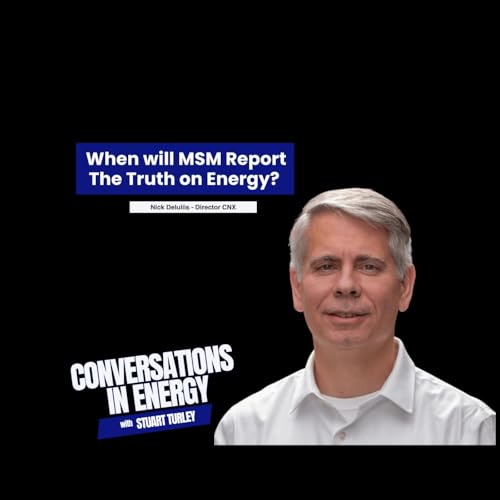
When will the Main Stream Media Report the Truth on Energy? Nick Deluliis Stops By to Talk about the Truth In Energy
No se pudo agregar al carrito
Add to Cart failed.
Error al Agregar a Lista de Deseos.
Error al eliminar de la lista de deseos.
Error al añadir a tu biblioteca
Error al seguir el podcast
Error al dejar de seguir el podcast

When will the Main Stream Media Report the Truth on Energy? Nick Deluliis Stops By to Talk about the Truth In Energy
-
Narrado por:
-
De:
Nick Deluliis is a Director on the CNX Board and an author, bringing decades of experience to the discussion. On his website, he cites WSJ reporting and notes that the mainstream media (MSM) is letting the American Public down. He also raises some compelling points about how this can play out.
With Bill Gates admitting we are not going to die from "Climate Crisis" to Larry Fink admitting at Davos that we need stable power, when will the MSM follow these stories? Is it up to the podcastsers?
1. Concerns about biased and inaccurate energy news reporting:
The host and guest discuss how energy news reporting, particularly in outlets like the Wall Street Journal, often fails to provide objective, fact-based coverage. They cite the "Gell-Mann amnesia effect" where readers trust the reporting on topics they are unfamiliar with, even when the reporting on the guest's area of expertise (energy) contains significant flaws and omissions.
2. The challenges of transitioning the energy grid to renewable sources:
The transcript explores how the push for large-scale adoption of wind and solar power has led to "manufactured inefficiencies" in energy systems. The guests argue that intermittent renewable sources are not viable replacements for reliable baseload power from fossil fuels and nuclear, resulting in grid instability and higher costs for consumers.
3. The importance of rational, fact-based energy policies:
The discussion highlights how ideologically-driven energy policies, often favoring renewable energy over more reliable sources, have had negative consequences for energy affordability, grid reliability, and industrial competitiveness. The guests advocate for policymaking grounded in scientific and economic realities rather than political agendas.
4. The potential of the Marcellus Shale region for reviving American manufacturing:
The guests express optimism about leveraging the abundant natural gas resources in the Marcellus Shale to support domestic manufacturing and economic growth, if policies enable the efficient development and utilization of these energy assets.
5. The emerging global divide on energy and climate policies:
The transcript suggests a bifurcation of the world into two camps - those pursuing net-zero emissions policies that undermine industrial competitiveness, versus those focused on energy affordability and reliability to support economic prosperity.
We emphasized the need for objective, fact-based journalism to inform the public and policymakers on the complex realities of the energy transition.