

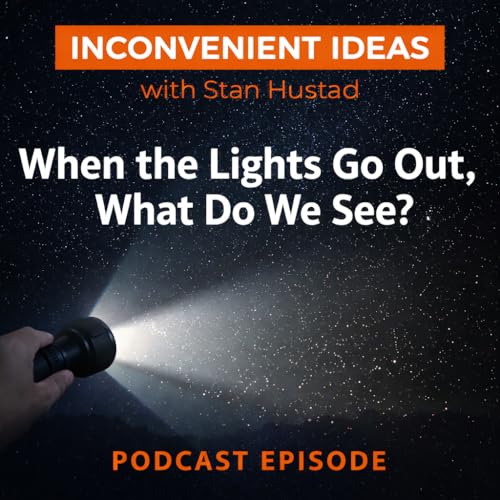
When the Lights Go Out in Tucson, What Do We See?
No se pudo agregar al carrito
Add to Cart failed.
Error al Agregar a Lista de Deseos.
Error al eliminar de la lista de deseos.
Error al añadir a tu biblioteca
Error al seguir el podcast
Error al dejar de seguir el podcast

When the Lights Go Out in Tucson, What Do We See?
-
Narrado por:
-
De:
Some ideas don't announce themselves with flashing lights.
In fact, this one is about what happens when the lights aren't there at all.
This week on Inconvenient Ideas, I found myself talking about Tucson, Arizona — a place my wife Karen and I once called home for nearly sixteen years — and a current news story that stopped me cold. An elderly woman has gone missing in Tucson. She happens to be the mother of a very well-known broadcaster, which is why the story caught national attention. But what really caught my attention was something deeper, quieter, and frankly more unsettling.
Light pollution. Or rather… the lack of it.
If you've never lived in Tucson, you might not know this: much of the city — especially the desert communities — is intentionally dark. No streetlights. Limited exterior lighting. Strict rules designed to protect the night sky. Tucson is one of the great stargazing cities in the world, home to observatories, astronomers, and people who truly treasure the stars.
When Karen and I moved there from Minnesota, one of the first things we noticed was how dark it was at night. At first, we thought something was broken. Nope. It was by design. And once we adjusted, we fell in love with it.
Dark skies. Brilliant stars. Quiet nights. Space to breathe.
But here's the inconvenient part.
Darkness, while beautiful and good for the soul, can also hide things. It can obscure danger. And in scattered desert neighborhoods — where homes are tucked into the landscape and security lights are rare — it raises hard questions about safety, vulnerability, and unintended consequences.
That tension is what this episode explores.
I share stories from our years in the desert: walking at night with a flashlight because you had to, being stopped by security if you didn't have one, learning to live with coyotes, javelinas, bobcats, and yes, the occasional mountain lion triggering motion lights. I talk about the peace of sitting under the stars with no music, no noise, just silence — and how much I miss that.
And then I zoom out.
Because this isn't really just about Tucson.
It's about the balance we all have to strike between clarity and safety, beauty and realism, solitude and responsibility. It's about knowing when darkness is restorative — and when it might be hiding something we need to pay attention to.
Even Jesus, we're told, regularly withdrew from the noise, the crowds, and the chaos to find strength in quiet places. But the Gospels also remind us that darkness isn't neutral. Every place — even the most beautiful — carries the full range of human nature.
This episode isn't alarmist. It's reflective. It's honest. And yes, a little inconvenient.
I close the program with a reminder that ideas matter — because ideas start things. Movements. Conversations. Changes. And if you have an inconvenient, interesting, or maybe even inspiring idea, I'd love to hear it.
We're always looking for thoughtful guests, bold voices, and people who want to make things move instead of just making noise.
You can reach me anytime at stan@witradio.net.
And if you're curious about learning how to use radio, podcasting, or video to tell your story — to build a business, a message, or a meaningful presence — that's part of what I do too. After more than four decades behind the microphone, I'm still convinced this is one of the most powerful tools for good if it's used well.
So step into the conversation.
Turn down the noise.
And once in a while… don't be afraid of the dark — just be wise about it.
Blessings to you,
and thanks for listening.
— Stan