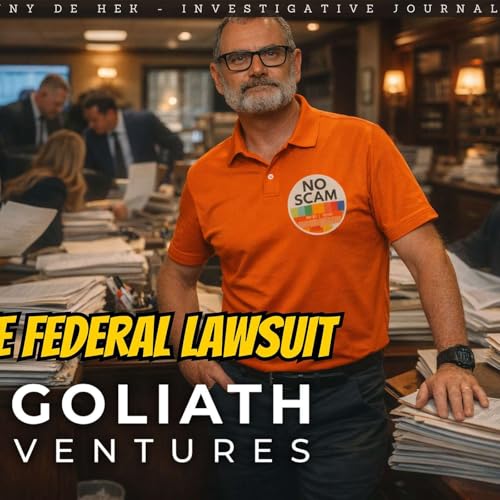
WHAT : DE HEK Podcast Por DANNY : DE HEK arte de portada

WHAT : DE HEK

WHAT : DE HEK

De: DANNY : DE HEK
Escúchala gratis

OFERTA POR TIEMPO LIMITADO | Obtén 3 meses por US$0.99 al mes

$14.95/mes despues- se aplican términos.
DANNY : DE HEK aka “The Crypto Ponzi Scheme Avenger” – I’m a YOUTUBER, PODCASTER, EDUCATOR, BLOGGER a person of influence, I’m that guy who knows everybody and I’ve put together my website to show what I’m passionate about. I’m a firm believer of omnipresence!© 2023 DANNY : DE HEK LIMITED Economía Finanzas Personales Política y Gobierno
Episodios
  • Hyper-Compound Illusions: How GOLIATH VENTURES INC Leaves Investors Watching Dashboards Not Payments
    Jan 11 2026

    If your balance is growing but you can’t withdraw a cent, you don’t have an investment — you have a story being told to you on a screen. That’s where this investigation begins.

    For months, investors were promised regular distributions. When payments slowed or stopped, they were told delays were temporary. While money failed to arrive, dashboards continued to update, balances continued to rise, and investors were encouraged to wait just a little longer. Many did, because the system was designed to make waiting feel rational.

    I’ve been warning about Goliath Ventures since September. What you’re about to see is what happens when patience runs out and evidence replaces hope.

    THE DASHBOARD I WAS GIVEN ACCESS TO

    An investor, whose identity is protected, handed over full backend access to his investor account portal. Not screenshots. Not summaries. Direct access to what investors themselves see when they log in.

    Inside the portal, everything looks legitimate at first glance. Contracts. Identity documents. Assigned partners. Contribution records. Distribution entries. Month after month marked as “hyper-compounded.” It tells a complete story — but only if you don’t try to leave.

    What’s missing is control. There is no self-service withdrawal function. No crypto transfer button. No bank initiation. Every attempt to exit must go through a human gatekeeper.

    That design choice matters when money stops flowing.

    WHEN HYPER-COMPOUNDING REPLACES PAYOUTS

    Hyper-compounding is presented as growth. In reality, it becomes a holding pattern.

    Even after withdrawals fail, balances continue to rise on-screen. The message is subtle but powerful: waiting feels safer than acting. But numbers you can’t access aren’t money. Liquidity is money.

    When balances grow while exits are blocked, hyper-compounding stops being a strategy and becomes a retention mechanism.

    THE WITHDRAWAL THAT CHANGED EVERYTHING

    The investor formally requested a withdrawal under the terms of the contract.

    That contract, which every investor signs, states that withdrawal requests should be processed within a defined window of five to seven business days, with delays allowed only under limited and specific circumstances. In this case, that window passed. No qualifying exception was cited. No funds were returned.

    At that point, this stopped being about technical delays or explanations. It became non-performance under a written agreement.

    Despite that, the account continued to show balance growth. Hyper-compounding entries kept appearing while the withdrawal remained unresolved. That’s not neutral accounting. It’s the appearance of progress without delivery.

    WHAT THIS PATTERN TELLS US

    This is not an isolated experience. Across multiple investors, the same pattern repeats. Withdrawals require permission, not execution. Timelines shift. Some people are paid while others stall. Communication tightens. Balances keep growing while access disappears.

    No single data point proves fraud. Patterns do.

    And once you see the pattern from inside the portal, it’s impossible to unsee.

    WHY THIS MATTERS NOW

    This investigation isn’t about theory or hindsight. It’s about what investors were shown versus what actually happened. It’s about contracts, timelines, and systems that continue to display growth while failing to meet their own obligations.

    If you’re still staring at a dashboard and waiting for reassurance, understand this: waiting doesn’t improve your position. Delay only benefits the people holding your money.

    Buy Me a Coffee
    I’m on @buymeacoffee. If you like my work, you can buy me a coffee and share your thoughts.

    Support the show

    Más Menos
    1 h y 4 m
  • Robert Rolls and Afirmo NZ Ltd: An Unsolicited Email, Two Domains, and Unanswered Questions
    Jan 2 2026

    On 12 December 2025 at 8:13 PM, I received an unsolicited commercial email from Robert Rolls, identifying himself as Founder and Chief Executive of Afirmo NZ Ltd. I had no prior relationship with him or the company, had not requested contact, and had not consented to receive marketing of any kind.

    THE EMAIL ARRIVES

    The message was promotional and lacked an unsubscribe mechanism. Under New Zealand law, a single unsolicited commercial email can be unlawful if it does not meet basic requirements around consent, sender identification, and opt-out. That omission mattered, and it prompted a closer look.

    THE DOMAIN THAT DIDN’T MATCH

    The email did not come from afirmo.com, the company’s established domain. It was sent from robertr@winafirmo.com, a domain registered just weeks earlier and not referenced anywhere on Afirmo’s official website. When accessed, that domain redirected to an unrelated third-party site with no visible connection to accounting or tax services. Domain provenance matters, especially in regulated environments.

    TECHNICAL CHECKS

    A WHOIS and DNS review showed the two domains were registered, hosted, and configured independently. The established domain dates back to 2017; the newer domain was registered in late September 2025. These differences don’t prove misconduct on their own, but they are relevant to questions of sender identification and traceability.

    SEEKING CLARITY

    Before publishing anything, I attempted to verify the situation and provide a right of reply. I phoned the publicly listed office number, called the mobile number associated with Mr Rolls, left voicemail messages, and sent written questions by email. One response arrived from the newer domain, asserting compliance and “deemed consent,” but it did not answer where my email address was sourced, why a separate domain was used, or why no unsubscribe was included.

    INDUSTRY CONTEXT

    In my reporting on electronic spam, I’ve repeatedly encountered a pattern where companies outsource cold outreach to third-party lead generators and use secondary domains to protect the reputation of their primary brand. When issues arise, responsibility still sits with the company whose services are being promoted.

    THE LEGAL CONTEXT

    Even where “deemed consent” is claimed, New Zealand law still requires a functional unsubscribe mechanism. The facts here are simple and observable: the message was unsolicited, the domain was not publicly associated with the company, and no opt-out was provided.

    REFERRAL TO REGULATORS

    Given the lack of resolution, I referred the matter to the Department of Internal Affairs, providing the original email, full headers, and a timeline of correspondence. The referral itself is now a matter of record.

    ON THE RECORD

    This investigation documents verifiable facts and unanswered questions. It does not allege fraud or criminality. If clarification is provided on the record—about the domain used, the source of my email address, or the absence of an unsubscribe—it will be published in full.

    Buy Me a Coffee
    I’m on @buymeacoffee. If you like my work, you can buy me a coffee and share your thoughts.

    Support the show

    Más Menos
    1 h y 5 m
  • The Origins of GOLIATH VENTURES INC: How Proximity Replaced Proof as Millions Were Raised
    Jan 1 2026

    This investigation looks at what existed before Goliath Ventures Inc ever collapsed — before missed payouts, before silence, before the excuses. It examines how trust was established, how credibility was borrowed, and how millions were raised long before anything verifiable was ever built.

    This is not a hindsight critique. It’s a reconstruction of origins.

    HOW TO REPORT GOLIATH VENTURES INC

    dehek.com/general/scam-fraud-investigations/how-to-report-goliath-ventures-inc-and-take-action-if-youve-lost-money/

    THE FOUNDATION BEFORE THE MONEY

    Goliath Ventures did not begin with a functioning product, a proven trading operation, or verifiable revenue. What it began with was proximity — to people, to narratives, to perceived success. Introductions mattered more than evidence. Associations mattered more than documentation. Early confidence replaced early proof.

    From the outset, there were ambitious claims about crypto mining, liquidity pools, and sophisticated strategies. Yet there is no clear record of mining ever being operational, no evidence of mined bitcoin sold to the market, and no independently verifiable proof that any promised strategy was producing external revenue.

    That distinction matters.

    THE SHIFT IN THE STORY

    As time went on, the narrative evolved. Bitcoin mining faded into the background. Liquidity provision became the new explanation. The language grew more technical, more abstract, and harder for the average investor to challenge. Contracts referenced specific mechanisms, but public explanations rarely matched how those mechanisms actually work.

    At the same time, fixed rates of return were offered — monthly, quarterly, yearly. That is not how legitimate mining or liquidity provision typically operates. Profit-sharing is variable. Risk is explicit. Guarantees are rare.

    BORROWED CREDIBILITY

    What did work was trust by association. People trusted people who trusted other people. Social proof traveled faster than verification. Questions were softened by familiarity. Skepticism was reframed as negativity. The absence of proof was masked by confidence and repetition.

    In environments like this, belief spreads faster than facts.

    WHEN PAYMENTS STOPPED

    Once payouts became delayed, then missed entirely, the tone changed. Communication shifted. Responsibility blurred. Investors were told to be patient. Explanations multiplied, but clarity did not.

    Crucially, despite repeated claims that investments were “fully insured,” there has been no evidence presented that any insurance claim was ever filed to cover missed payouts — raising serious questions about whether such insurance ever existed in the first place.

    INTENT, FAILURE, AND ACCOUNTABILITY

    Some argue that if Goliath began with legitimate intent, then this is simply a failed business, not a crime. That question matters legally. But intent is not proven by good storytelling — it’s proven by actions, records, and outcomes.

    A project that never gets off the ground, never produces verifiable external revenue, and yet consistently offers fixed returns while raising new funds does not automatically become legitimate simply because failure is claimed after the fact.

    This investigation does not declare guilt. It documents what can — and cannot — be shown.

    And what’s missing is just as important as what’s claimed.

    WHY ORIGINS MATTER

    If the found

    Buy Me a Coffee
    I’m on @buymeacoffee. If you like my work, you can buy me a coffee and share your thoughts.

    Support the show

    Más Menos
    2 h y 16 m
Todavía no hay opiniones