Vanishing Gradients Podcast Por Hugo Bowne-Anderson arte de portada

Vanishing Gradients

Vanishing Gradients

De: Hugo Bowne-Anderson
Escúchala gratis

A podcast for people who build with AI. Long-format conversations with people shaping the field about agents, evals, multimodal systems, data infrastructure, and the tools behind them. Guests include Jeremy Howard (fast.ai), Hamel Husain (Parlance Labs), Shreya Shankar (UC Berkeley), Wes McKinney (creator of pandas), Samuel Colvin (Pydantic) and more.

hugobowne.substack.comHugo Bowne-Anderson
Ciencia
Episodios
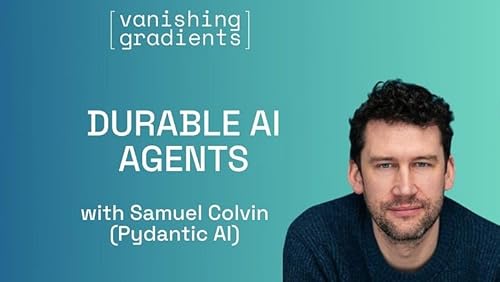
  • Episode 71: Durable Agents - How to Build AI Systems That Survive a Crash with Samuel Colvin
    Feb 18 2026
    Our thesis is that AI is still just engineering… those people who tell us for fun and profit, that somehow AI is so, so profound, so new, so different from anything that’s gone before that it somehow eclipses the need for good engineering practice are wrong. We need that good engineering practice still, and for the most part, most things are not new. But there are some things that have become more important with AI. One of those is durability.Samuel Colvin, Creator of Pydantic AI, joins Hugo to talk about applying battle-tested software engineering principles to build durable and reliable AI agents.They Discuss:* Production agents require engineering-grade reliability: Unlike messy coding agents, production agents need high constraint, reliability, and the ability to perform hundreds of tasks without drifting into unusual behavior;* Agents are the new “quantum” of AI software: Modern architecture uses discrete “agentlets”: small, specialized building blocks stitched together for sub-tasks within larger, durable systems;* Stop building “chocolate teapot” execution frameworks: Ditch rudimentary snapshotting; use battle-tested durable execution engines like Temporal for robust retry logic and state management;* AI observability will be a native feature: In five years, AI observability will be integrated, with token counts and prompt traces becoming standard features of all observability platforms;* Split agents into deterministic workflows and stochastic activities: Ensure true durability by isolating deterministic workflow logic from stochastic activities (IO, LLM calls) to cache results and prevent redundant model calls;* Type safety is essential for enterprise agents: Sacrificing type safety for flexible graphs leads to unmaintainable software; professional AI engineering demands strict type definitions for parallel node execution and state recovery;* Standardize on OpenTelemetry for portability: Use OpenTelemetry (OTel) to ensure agent traces and logs are portable, preventing vendor lock-in and integrating seamlessly into existing enterprise monitoring.You can also find the full episode on Spotify, Apple Podcasts, and YouTube.👉 Want to learn more about Building AI-Powered Software? Check out our Building AI Applications course. It’s a live cohort with hands on exercises and office hours. Here is a 25% discount code for listeners. 👈LINKS* Samuel Colvin on LinkedIn* Pydantic* Pydantic Stack Demo repo* Deep research example code* Temporal* DBOS (Postgres alternative to Temporal)* Upcoming Events on Luma* Vanishing Gradients on YouTube* Watch the podcast video on YouTube👉Want to learn more about Building AI-Powered Software? Check out our Building AI Applications course. It’s a live cohort with hands on exercises and office hours. Our final cohort starts March 10, 2026. Here is a 25% discount code for listeners.👈https://maven.com/hugo-stefan/building-ai-apps-ds-and-swe-from-first-principles?promoCode=vgfs This is a public episode. If you would like to discuss this with other subscribers or get access to bonus episodes, visit hugobowne.substack.com
    Más Menos
    51 m
  • Episode 70: 1,400 Production AI Deployments
    Feb 12 2026
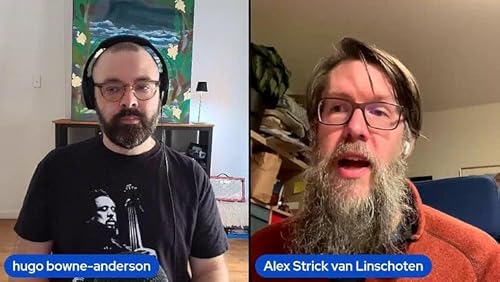
    There’s a company who spent almost $50,000 because an agent went into an infinite loop and they forgot about it for a month.It had no failures and I guess no one was monitoring these costs. It’s nice that people do write about that in the database as well. After it happened, they said: watch out for infinite loops. Watch out for cascading tool failures. Watch out for silent failures where the agent reports it has succeeded when it didn’t!We Discuss:* Why the most successful teams are ripping out and rebuilding their agent systems every few weeks as models improve, and why over-engineering now creates technical debt you can’t afford later;* The $50,000 infinite loop disaster and why “silent failures” are the biggest risk in production: agents confidently report success while spiraling into expensive mistakes;* How ELIOS built emergency voice agents with sub-400ms response times by aggressively throwing away context every few seconds, and why these extreme patterns are becoming standard practice;* Why DoorDash uses a three-tier agent architecture (manager, progress tracker, and specialists) with a persistent workspace that lets agents collaborate across hours or days;* Why simple text files and markdown are emerging as the best “continual learning” layer: human-readable memory that persists across sessions without fine-tuning models;* The 100-to-1 problem: for every useful output, tool-calling agents generate 100 tokens of noise, and the three tactics (reduce, offload, isolate) teams use to manage it;* Why companies are choosing Gemini Flash for document processing and Opus for long reasoning chains, and how to match models to your actual usage patterns;* The debate over vector databases versus simple grep and cat, and why giving agents standard command-line tools often beats complex APIs;* What “re-architect” as a job title reveals about the shift from 70% scaffolding / 30% model to 90% model / 10% scaffolding, and why knowing when to rip things out is the may be the most important skill today.You can also find the full episode on Spotify, Apple Podcasts, and YouTube.You can also interact directly with the transcript here in NotebookLM: If you do so, let us know anything you find in the comments!👉 Want to learn more about Building AI-Powered Software? Check out our Building AI Applications course. It’s a live cohort with hands on exercises and office hours. Our final cohort starts March 10, 2026. Here is a 25% discount code for readers. 👈Show Notes Links* Alex Strick van Linschoten on LinkedIn* Alex Strick van Linschoten on Twitter/X* LLMOps Database* LLMOps Database Dataset on Hugging Face* Hugo’s MCP Server for LLMOps Database* Alex’s Blog: What 1,200+ Production Deployments Reveal About LLMOps in 2025* Previous Episode: Practical Lessons from 750 Real-World LLM Deployments* Previous Episode: Tales from 400 LLM Deployments* Context Rot Research by Chroma* Hugo’s Post: AI Agent Harness - 3 Principles for Context Engineering* Hugo’s Post: The Rise of Agentic Search* Episode with Nick Moy: The Post-Coding Era* Hugo’s Personal Podcast Prep Skill Gist* Claude Tool Search Documentation* Gastown on GitHub (Steve Yegge)* Welcome to Gastown by Steve Yegge* ZenML - Open Source MLOps & LLMOps Framework* Upcoming Events on Luma* Vanishing Gradients on YouTube* Watch the podcast livestream on YouTube* Join the final cohort of our Building AI Applications course in March, 2026 (25% off for listeners)👉 Want to learn more about Building AI-Powered Software? Check out our Building AI Applications course. It’s a live cohort with hands on exercises and office hours. Our final cohort starts March 10, 2026. Here is a 25% discount code for readers. 👈 This is a public episode. If you would like to discuss this with other subscribers or get access to bonus episodes, visit hugobowne.substack.com
    Más Menos
    1 h y 10 m
  • Episode 69: Python is Dead. Long Live Python! With the Creators of pandas & Parquet
    Feb 3 2026
    > It’s the agent writing the code. And it’s the development loop of writing the code, building testing, write the code, build test and iterating. And so I do think we’ll see for many types of software, a shift away from Python towards other programming languages. I think Go is probably the best language for those like other types of software projects. And like I said, I haven’t written a line of Go code in my life.– Wes McKinney (creator of pandas Principal Architect at Posit),Wes McKinney, Marcel Kornacker, and Alison Hill join Hugo to talk about the architectural shift for multimodal AI, the rise of “agent ergonomics,” and the evolving role of developers in an AI-generated future.We Discuss:* Agent Ergonomics: Optimize for agent iteration speed, shifting from human coding to fast test environments, potentially favoring languages like Go;* Adversarial Code Review: Deploy diverse AI models to peer-review agent-generated code, catching subtle bugs humans miss;* Multimodal Data Verbs: Make operations like resizing and rotating native to your database to eliminate data-plumbing bottlenecks;* Taste as Differentiator: Value “taste”—the ability to curate and refine the best output from countless AI-generated options—over sheer execution speed;* 100x Software Volume: Embrace ephemeral, just-in-time software; prioritize aggressive generation and adversarial testing over careful planning for quality.You can also find the full episode on Spotify, Apple Podcasts, and YouTube.You can also interact directly with the transcript of the workshop & fireside chat here in NotebookLM: If you do so, let us know anything you find in the comments!👉 Want to learn more about Building AI-Powered Software? Check out our Building AI Applications course. It’s a live cohort with hands on exercises and office hours. Here is a discount code for readers. 👈This was a fireside chat at the end of a livestreamed workshop we did on building multimodal AI systems with Pixeltable. Check out the full workshop below (all code here on Github):Links and Resources* Wes McKinney on LinkedIn* Marcel Kornacker on LinkedIn* Alison Hill on LinkedIn* Spicy Takes* Palmer Penguins* Pixeltable* Posit* Positron* Building Multimodal AI Systems Workshop Repository* Pixeltable Docs: LLM Tool Calling with MCP Servers* Pixeltable Docs: Working with Pydantic* Upcoming Events on Luma* Vanishing Gradients on YouTube* Watch the podcast video on YouTube* Join the final cohort of our Building AI Applications course in March, 2026 (25% off for listeners)https://maven.com/hugo-stefan/building-ai-apps-ds-and-swe-from-first-principles?promoCode=vgfsWhat people said during the workshop“I think the interface looks amazing/simple. Strong work! 🦾” — @goldentribe“This is quite amazing. Watching this I felt the same way when I first leant pandas, NumPy and scikit and how well i was able to manipulate and wrangle data. PixelTable feels seamless and looks as good as those legendary frameworks but for Multimodal Data.” — @vinod7“This is all extremely cool to see, I love the API and the approach.” — @steveb4191“Thanks so much, Hugo! That was very insightful! Great work Alison and Marcel!” — @vinod7“Just wrapped up watching a replay of the Pixeltable workshop. So cool!! Love the notebooks and working examples. The important parts were covered and worked beautifully 🕺” — @therobbrennan👉 Want to learn more about Building AI-Powered Software? Check out our Building AI Applications course. It’s a live cohort with hands on exercises and office hours. Here is a discount code for readers. 👈 This is a public episode. If you would like to discuss this with other subscribers or get access to bonus episodes, visit hugobowne.substack.com
    Más Menos
    55 m
Todavía no hay opiniones