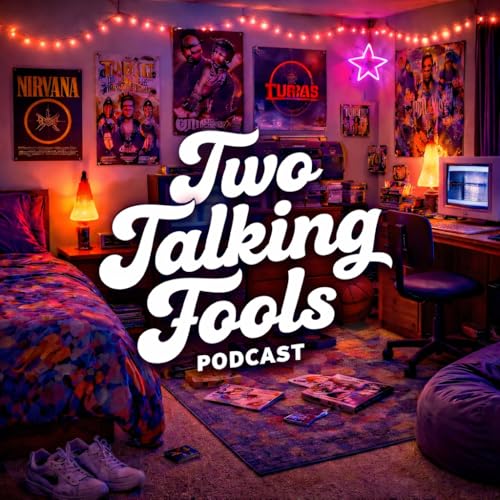
Two Talking Fools Podcast Por Two Talking Fools Podcast arte de portada

Two Talking Fools

Two Talking Fools

De: Two Talking Fools Podcast
Escúchala gratis

Meet the Two Talking Fools — two friends diving headfirst into the relatable chaos of everyday life. From overthinking and relationships to pop culture, awkward moments, and the random thoughts we all pretend we don’t have, nothing is off-limits. If it’s on our minds, chances are it’s been on yours too. Expect honest conversations, unfiltered humor, and the occasional guest who jumps in to stir things up. It’s like sitting on the couch with your funniest friends — real talk, real laughs, no pretending. Just two fools, hanging out and chatting about life as we actually live it.

Two Talking Fools Podcast
Ciencias Sociales
Episodios
  • Where Did the Mall Go? The End of an American Hangout
    Mar 3 2026

    In this episode, the hosts dive deep into the rise, fall, and possible reinvention of the American mall — once the heartbeat of suburban life and now a symbol of the retail apocalypse. From the post–World War II boom and the golden age of shopping malls in the 1980s and 1990s to today’s empty corridors, shuttered anchor stores, and the explosion of e-commerce, we break down how we got here.

    We explore the cultural history of malls as social hubs, teen hangouts, and economic engines — and examine how online shopping, Amazon, changing consumer behavior, and the COVID-19 pandemic accelerated the decline of traditional retail. What happened to department stores like Sears and JCPenney? Why are so many “dead malls” spreading across America? And are mixed-use developments, experiential retail, and community-driven spaces the future?

    Blending nostalgia, local stories, economic trends, and retail industry statistics, this episode asks a bigger question: What replaces the mall as a modern gathering place? And what does the future of brick-and-mortar retail really look like?

    If you’re interested in shopping mall history, suburban development, retail trends, e-commerce disruption, or the future of community spaces in America — this episode is for you.

    Más Menos
    14 m
  • Did 90s Video Games Rewire Our Brains?
    Feb 27 2026

    On this episode of The Two Talking Fools Podcast, we take a deep dive into how 90s video games may have shaped an entire generation’s brain — and whether those early gaming experiences influenced cognitive development in ways we’re only now beginning to understand.

    From classic console titles on Nintendo 64, Sega Genesis, and early PlayStation to the trial-and-error nature of arcade culture, we explore how 1990s video games required persistence, patience, memory retention, and true problem-solving. There were no constant tutorials, no auto-save every thirty seconds, and no step-by-step hand-holding. If you failed, you started over. If you got stuck, you figured it out — or you didn’t move forward. That challenge-driven design may have helped build mental endurance, delayed gratification, and resilience in ways that contrast sharply with modern gaming systems.

    We also examine the psychology behind retro gaming versus today’s digital landscape. How did unstructured downtime, limited internet access, and offline multiplayer experiences affect creativity and focus? Did growing up without constant notifications and algorithm-driven content train 90s kids to tolerate boredom differently — and think more independently?

    Then we shift to modern gaming culture: high-speed graphics, open-world environments, online multiplayer ecosystems, streaming platforms, and mobile gaming accessibility. Today’s games offer instant feedback, auto-saves, tutorials, and social connectivity — but does that reduce frustration tolerance? Or does it simply develop a different set of cognitive strengths, like rapid multitasking, digital communication skills, and adaptive thinking?

    This episode explores generational differences between Millennials, Gen Z, and Gen Alpha through the lens of video game design, brain development, dopamine response cycles, and behavioral psychology. We discuss research on gaming and neuroplasticity, the impact of challenge-based learning, and how reward systems have evolved from cartridge consoles to cloud gaming.

    Ultimately, we ask: Is one era “better,” or have we simply trained our brains differently? And what could the future of gaming look like if developers intentionally blended the resilience-building structure of 90s games with the innovation and connectivity of modern platforms?

    If you grew up blowing into cartridges, memorizing cheat codes, or grinding levels without a save point — this conversation will hit home. And if you’re raising kids in a world of auto-save and Wi-Fi — this episode might make you think twice about how digital environments shape cognitive habits.

    This is a thoughtful, nostalgic, and research-driven conversation about video games, brain development, generational psychology, and the evolution of digital culture — only on The Two Talking Fools.

    Más Menos
    17 m
  • From Auto City to Water Crisis: Flint’s Long Road to Recovery
    Feb 26 2026

    In this episode of the Two Talking Fools Podcast, we take a deep dive into the Flint, Michigan water crisis — one of the most significant public health disasters in modern American history. From Flint’s rise as the birthplace of General Motors and its identity as “Vehicle City,” to the economic decline that reshaped the community, we trace the full timeline that led to the catastrophic 2014 decision to switch the city’s water supply to the Flint River.

    We break down how cost-cutting measures, aging infrastructure, and failures in government oversight resulted in widespread lead contamination, exposing thousands of residents — including children — to dangerous drinking water. This episode explains the science behind lead poisoning, corrosion control failures, and how contaminated water impacts long-term health, especially in vulnerable populations.

    We also highlight the role of community activists, local doctors, independent researchers, and journalists who brought national attention to the crisis when officials initially dismissed residents’ concerns. From lawsuits and criminal charges to state and federal investigations, we explore the legal accountability efforts and the billions of dollars allocated for pipe replacement, medical monitoring, and infrastructure repair.

    Most importantly, we examine where Flint stands today — the progress made in replacing lead service lines, ongoing public health monitoring, and the broader lessons about environmental justice, government transparency, and infrastructure investment in American cities.

    If you’re interested in environmental policy, public health, government accountability, infrastructure reform, or the long-term impact of industrial decline in the Midwest, this episode provides a comprehensive and accessible overview of the Flint water crisis — from Auto City to water emergency, and the fight to rebuild trust.

    Más Menos
    12 m
Todavía no hay opiniones