Topic Lens - Headlines explained Podcast Por Topic Lens arte de portada

Topic Lens - Headlines explained

Topic Lens - Headlines explained

De: Topic Lens
Escúchala gratis

The Topic Lens Podcast gives you context to the news shaping our world - helping you understand where people come from and how perspectives are formed.


🔍 Transparency

This podcast uses AI-generated dialogue (NotebookLM). The voices may sound real - they are not. The goal is not to simulate humans, but to communicate ideas clearly.


🎯 Why it exists

We use AI tools (ChatGPT, Claude, Gemini) and other sources to research, compare perspectives, and turn that into structured audio you can listen to while commuting or doing everyday chores.


⚠️ Note This content is AI-assisted and based on aggregated sources. It should be used as a starting point for understanding — not as a substitute for primary sources or expert analysis.

Hosted on Acast. See acast.com/privacy for more information.

Topic Lens
Episodios
  • Rings of Power - 130 Years of Unity & Conflict
    Apr 6 2026

    The modern Olympic Games began in Athens on April 6, 1896—but the story stretches far beyond a single event.

    In this episode, we go back to the very beginning: a marble stadium, a handful of nations, and an ambitious idea—to unite the world through sport. Inspired by ancient Greece and driven by the vision of Pierre de Coubertin, the first Olympics were both a revival of the past and a product of their time, shaped by nationalism, class, and emerging global connections.

    We explore what the Games actually looked like in 1896—who competed, which sports were included, and what the Olympic ethos meant in practice. We also examine the deeper historical links to antiquity, and how elements like the marathon and Olympic symbolism were consciously designed to create a sense of continuity.

    From there, the episode traces the transformation of the Olympics over the past 130 years: from a modest competition to a global spectacle watched by billions. Along the way, the Games have become a powerful symbol—sometimes of unity, sometimes of division—reflecting the political, cultural, and economic forces of each era.

    We also return to Athens in 2004, when the Olympics came “home,” reconnecting the modern movement with both its ancient origins and its 1896 rebirth.

    This is the story of how the Olympics became more than sport—how they became a mirror of the modern world.

    This episode features AI-generated dialogue (NotebookLM), based on extensive research across multiple sources.

    It is meant to provide structured context — not replace primary sources or expert analysis.

    Hosted on Acast. See acast.com/privacy for more information.

    Más Menos
    32 m
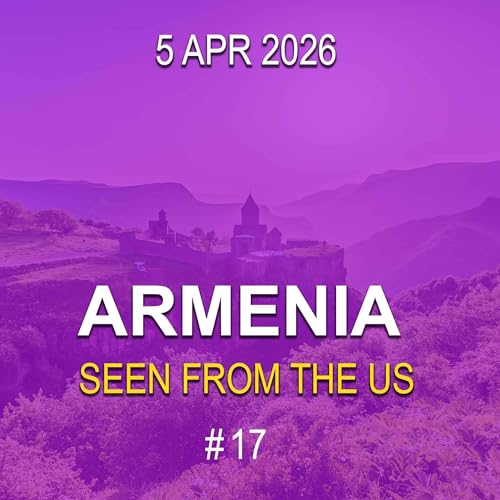
  • Armenia - Seen From the US
    Apr 5 2026

    What if the word many Americans use for “white” actually comes from a place they can’t find on a map?


    In this episode, we explore Armenia—a small, landlocked country in the Caucasus that sits at the crossroads of Europe, the Middle East, and Eurasia. It’s about the size of Maryland, with a population under 3 million—but its global footprint is far bigger than its borders.


    Armenia is one of the oldest civilizations on earth, the first nation to adopt Christianity, and home to a language and alphabet unlike anything else in Europe. But it’s also a country shaped by conflict, displacement, and survival. After the Armenian Genocide, millions left—creating a powerful global diaspora, especially in the United States.

    That’s where the story turns back on America.


    From Los Angeles to Washington, Armenian-Americans have shaped culture, politics, and business. And in a strange twist of history, even the word “Caucasian”—still widely used across the U.S.—comes from this region, based on a now-discredited 18th-century theory by Johann Friedrich Blumenbach.


    Today, Armenia is navigating a tense geopolitical reality, caught between Russia, Europe, Iran, and ongoing tensions with Azerbaijan. At the same time, it’s building a modern economy driven by tech, education, and diaspora ties.


    This episode isn’t a travel guide—it’s a deeper look at how history, geography, and identity intersect. And for American listeners, it reveals something unexpected:

    A country you may not know… that has quietly shaped the way you see the world.

    This episode features AI-generated dialogue (NotebookLM), based on extensive research across multiple sources.

    It is meant to provide structured context — not replace primary sources or expert analysis.

    Hosted on Acast. See acast.com/privacy for more information.

    Más Menos
    39 m
  • NATO Crisis - America vs. Its Allies
    Apr 4 2026

    It's April 4, the 77th Birthday of NATO.

    In this episode, we dive deep into the geopolitical earthquake of April 2026: the ongoing US-Iran conflict and the unprecedented existential crisis within NATO.


    Despite the Trump administration's claims that Iran's nuclear threat was "totally obliterated" during the 12-day war in 2025, the reality on the ground tells a far more dangerous story. With the Strait of Hormuz blocked by Iran, triggering a global energy shock, and Iranian underground nuclear facilities like "Pickaxe Mountain" remaining uninspected and intact, the strategic outcome of the war remains highly uncertain. We unpack why military force may have merely delayed—rather than destroyed—Iran's nuclear ambitions.

    We also explore the severe transatlantic rift caused by the preemptive US and Israeli strikes. When Washington demanded European naval support to reopen the Strait of Hormuz, European allies largely refused. We explain the historical and legal reasons behind this refusal: NATO is strictly a defensive alliance. Article 5 was designed for self-defense—famously invoked after 9/11, when over a thousand European soldiers died in Afghanistan to defend America—not for offensive wars of choice initiated without allied consultation.

    Finally, we address the ultimate question: Will the US leave NATO? We break down the constitutional hurdles preventing a unilateral presidential withdrawal, including the 2024 National Defense Authorization Act. However, we also reveal how a president can hollow out the security guarantee from within, creating a "zombie alliance" by simply withholding troop deployments and operational credibility. As the US accelerates its pivot towards Asia and China, we discuss whether this crisis is the painful catalyst Europe needs to finally build its own strategic autonomy, nuclear deterrence, and independent defense industry.


    Key Topics Covered in This Episode:

    • The 2025/2026 US-Iran War: Why the "neutralized" nuclear threat is an illusion and how the conflict interrupted active diplomacy.
    • The Hormuz Chokepoint: How Iran turned the Strait of Hormuz into a strategic weapon, affecting global economies.
    • The Article 5 Misconception: Why Trump’s criticism of NATO allies over Iran misinterprets the alliance’s foundational treaty and the legacy of 9/11.
    • The Legal Battle Over NATO: Can the US legally withdraw? We look at the legislative roadblocks and the immense power of the Commander in Chief.
    • Europe’s Defense Awakening: The monumental $1 trillion cost of replacing US military capabilities and the push for a fully "Europeanized" defense ecosystem

    This episode features AI-generated dialogue (NotebookLM), based on extensive research across multiple sources.

    It is meant to provide structured context — not replace primary sources or expert analysis.

    Hosted on Acast. See acast.com/privacy for more information.

    Más Menos
    19 m
Todavía no hay opiniones