Wonder Cabinet Podcast Por Wonder Cabinet Productions arte de portada

Wonder Cabinet

Wonder Cabinet

De: Wonder Cabinet Productions
Escúchala gratis

Wonder Cabinet is an independent podcast from Anne Strainchamps and Steve Paulson, Peabody Award-winning creators of public radio's To The Best Of Our Knowledge. For 35 years, that show brought long-form conversations to 200+ stations nationwide; its interviews are now archived in the Library of Congress.


Episodes feature intimate, long-form conversations with scientists, philosophers, writers, and artists who are re-imagining our relationship with the planet. Some study black holes or quantum entanglement; others map mycelial networks or count ancient tree rings. And some explore dream worlds, myths, and fairy tales to revive ways of knowing that challenge what we think we understand about the nature of reality.


The name references Enlightenment-era cabinets of curiosities—private collections of shells, fossils, astronomical instruments, and saints' relics that existed at a moment when the scientific revolution was still in conversation with older ways of knowing the world. Today, another shift is taking place, as mechanistic models give way to more holistic, relational understandings of life on a sentient planet. Wonder Cabinet lives at that threshold.


About the hosts

Anne Strainchamps and Steve Paulson co-founded To The Best Of Our Knowledge. Steve hosts Luminous, a podcast about the science and philosophy of psychedelics, and is the author of Atoms and Eden.


Learn more at wondercabinetproductions.com.

Copyright 2026 by Wonder Cabinet Productions
Ciencias Sociales Filosofía
Episodios
  • Dekila Chungyalpa on the Sacred Feminine and the Living Earth
    Apr 11 2026

    Imagine growing up believing that at the heart of existence is a Primordial Mother—and that She is the Earth.

    For Dekila Chungyalpa, that idea is not metaphor. It’s inheritance.

    In Tibetan Buddhism, the feminine divine appears as Prajnaparamita, or Yum Chenmo—the “Mother of All Buddhas.” As the daughter and granddaughter of nuns, Dekila was raised in a world where spiritual teaching and healing was often female, and where land itself—especially the sacred Himalayan landscape of Sikkim—was alive with presence, meaning, and obligation.

    Today, she is a global conservationist and founding director of the Loka Initiative, building unlikely partnerships between climate scientists and religious leaders across traditions—from Buddhist monastics to Catholic clergy, Indigenous elders to Muslim clerics and Evangelical pastors. Her work suggests that the climate crisis is not only scientific or political—but spiritual.

    • UW: About the Loka Initiative
    • Loka Initiative website
    • Center for Humans and Nature: Dekila on ecology and the Buddhist concept of interdependence


    0:00 Introduction
    4:05 Sacred Mountains of Sikkim
    10:20 The Sacred Feminine
    16:30 Rituals and the Land
    21:25 Scientist by Day, Buddhist by Night
    28:25 Bridging Faith and Science

    Wonder Cabinet is hosted by Anne Strainchamps and Steve Paulson. Find out more about the show at https://wondercabinetproductions.com, where you can subscribe to the podcast and our newsletter.
    Más Menos
    39 m
  • Manvir Singh: Was Shamanism the First Religion?
    Apr 4 2026

    Shamanism may be humanity’s oldest religion – a tradition found across cultures, where healers slip into unseen realms, speak with spirits, and bring back knowledge from beyond the visible world. But in a modern, scientific age, these practices can seem like little more than superstition. But what if they reveal something deeper in human experience?

    Anthropologist Manvir Singh set out in search of answers. On a remote island in Indonesia, he lived with the Mentawai people, watching as their shamans — the sikerie — drummed, danced and entered trance, their tattooed bodies painted in turmeric. In these altered states, they appeared to move between worlds.

    How does an empirically-minded scientist make sense of such experiences? Singh combines immersive fieldwork with cross-cultural research into shamanic traditions, past and present. He calls shamanism a “timeless religion,” one that may go back to our earliest ancestors — and still lives on in the world’s major religions.

    Along the way, he asks a provocative question: Was Jesus a shaman?

    • Manvir’s book, Shamanism
    • Manvir’s article in The Guardian on the debate over the history of psychedelics in indigenous cultures

    0:00 The Macumba Exorcism in Brazil
    4:35 Meeting the Sikerei of Siberut
    8:30 Inside a Shamanic Healing Ceremony
    17:05 Psychedelics and Altered States
    22:10 Shamanism as the First Religion
    29:25 Was Jesus a Shaman?

    Wonder Cabinet is hosted by Anne Strainchamps and Steve Paulson. Find out more about the show at https://wondercabinetproductions.com, where you can subscribe to the podcast and our newsletter.
    Más Menos
    34 m
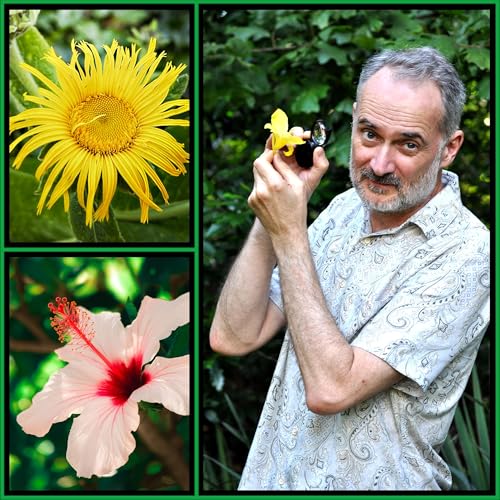
  • David George Haskell: Flowers and the Revolutionary Power of Beauty
    Mar 28 2026

    For thousands of years, flowers have threaded themselves through human life—into our rituals, our art, our language, even our names. We decorate our homes and altars with them, distill their scents, celebrate them in poetry and song. But what if we’ve misunderstood them entirely?

    In How Flowers Made the World, biologist and writer David George Haskell invites us to see flowers not as delicate embellishments, but as one of the most powerful forces in Earth’s history. When flowering plants emerged more than 200 million years ago, they didn’t just adapt to the world—they transformed it. Through strategies of beauty, attraction, and reciprocity, they turned rivals into partners, reshaping ecosystems and making possible the rich diversity of life we know today.

    In a lyrical, science-rich conversation, we explore:

    — Why Haskell calls flowers “nature’s revolutionaries”
    — How beauty, pleasure, and desire function as evolutionary strategies
    — The deep interdependence between flowers, animals, and humans
    — What flowers can teach us about resilience in a time of ecological crisis
    — How re-centering flowers might change the story we tell about life on Earth

    We live on a floral planet, Haskell says—and more than that, we are a floral species, utterly dependent on flowering plants for food, habitat, and survival. The lessons flowers offer—about creativity, cooperation, and transformation—may be exactly what we need to navigate a rapidly changing world.

    What would it mean to tell the story of life not through predators and conquest, but through seduction, partnership and bloom?

    • David's book: How Flowers Made Our World: The Story of Nature’s Revolutionaries
    • To the Best of Our Knowledge (2020): David George Haskell on the forest unseen
    • To the Best of Our Knowledge feature (2021): Listening to trees as fellow citizens

    00:00:00 Introduction
    00:03:50 Flowers Remade the World
    00:12:40 The Scent of Ancient Flowers
    00:22:00 The Language of Perfume
    00:30:30 Belonging to the Living World

    Wonder Cabinet is hosted by Anne Strainchamps and Steve Paulson. Find out more about the show at https://wondercabinetproductions.com, where you can subscribe to the podcast and our newsletter.
    Más Menos
    42 m
Todavía no hay opiniones