

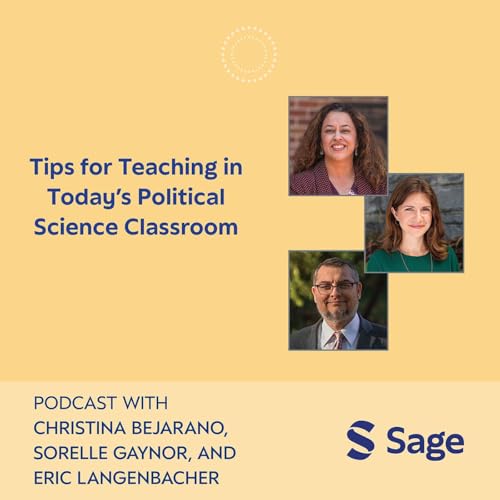
Tips for Teaching in Today's Political Science Classroom
No se pudo agregar al carrito
Add to Cart failed.
Error al Agregar a Lista de Deseos.
Error al eliminar de la lista de deseos.
Error al añadir a tu biblioteca
Error al seguir el podcast
Error al dejar de seguir el podcast

Tips for Teaching in Today's Political Science Classroom
-
Narrado por:
-
De:
Curious how others are teaching Political Science in today’s divisive environment? Three experienced instructors discuss real strategies for turning today's polarization and misinformation into opportunities for richer, more effective learning.
Summary
Teaching political science in today’s dynamic and polarized environment presents unique challenges and opportunities. In this roundtable discussion, three distinguished Sage authors explore strategies for navigating these complexities. From addressing misinformation to fostering respectful dialogue, this episode offers practical insights for educators and students alike.
Whether you’re an instructor looking to inspire critical thinking or a student eager to engage meaningfully with the political landscape, this conversation provides tools to adapt and thrive in an ever-changing field.
What We Talk About
Here’s what’s covered in the episode:
- Creating Respectful Classroom Environments:
- Establishing ground rules and encouraging diverse perspectives.
- Addressing the politics of language and challenging assumptions about students’ backgrounds.
- Engaging Constructively with Students:
- Reinforcing critical thinking and fact-based arguments.
- Using historical and comparative examples to de-escalate controversial topics.
- Combating Misinformation:
- Teaching fact-checking and data analysis skills.
- Exploring foundational concepts like democracy and authoritarianism to contextualize current events.
- The Role of AI in Education:
- Balancing the use of AI for research with the importance of original thought and skill development.
- Rethinking assignments to promote critical analysis over AI-generated content.
- Fostering Trust and Credibility:
- Encouraging students to place current issues in historical perspective.
- Highlighting the importance of diverse demographics in understanding political systems.
- Adapting to Evolving Political Landscapes:
- Structuring curricula to cover foundational knowledge before addressing current examples.
- Using historical parallels and international perspectives to connect with contemporary issues.
About the Authors
Dr. Christina Bejarano
Dr. Bejarano is a Professor of Political Science at Texas Women’s University and coauthor of The Enduring Democracy. Her research focuses on the intersection of gender, race, and political behavior in the U.S., with a particular emphasis on the contributions of women and ethnic minorities.
Dr. SoRelle Gaynor
Dr. Gaynor is an Assistant Professor at the University of Virginia’s Frank Batten School of Leadership and Public Policy and coauthor of Congress Explained: Representation and Lawmaking in the First Branch. With experience on Capitol Hill and expertise in congressional leadership and institutional reform, she brings a wealth of knowledge to the classroom.
Eric Langenbacher
Eric is a Teaching Professor and Director of the Honors Program at Georgetown University, as well as the author of Comparative Politics: Mapping Institutions, Power, and Legitimacy. His global perspective and extensive teaching experience enrich his approach to political science education.
This episode brought to you by Sage Vantage. Learn more at collegepublishing.sagepub.com/vantage.