• Trust, Education & Writing as Resistance w/ AL KENNEDY - Highlights
    Mar 3 2026

    "The thing that puzzled him was why people don't agree to be fully expressed while they're alive. Why does it only happen in their last moment? Why wouldn't you live being fully expressed?"

    My guest today is AL Kennedy. She is one of Britain’s most acclaimed and versatile literary voices, a writer who can inhabit the internal life of a soldier in a POW camp, as she did in her Costa Book Award-winning novel Day, as easily as she can navigate the "professional lying" of a modern civil servant.

    Her latest novel, Alive in the Merciful Country, takes place during the 2020 lockdown. It tells the story of a primary school teacher who receives a confession from an undercover police officer who infiltrated her life decades earlier. It’s a provocative investigation into state power, the "Spy Cops" scandal and the search for mercy in an age of surveillance. It’s a book about the breakdown of trust. We talk about her life, her activism, and why she believes fiction is the only way to tell the truth when the facts are forbidden and how she balances the truth of her novels with the relief of stand-up comedy.

    (0:00) Finding Your Voice

    On the Alfred Wolfsohn voice method and the power of being fully expressed

    (2:30) Reading from Alive in the Merciful Country

    Kennedy shares a passage from her latest novel, exploring hope and resilience in dark times.

    (4:43) The Myth of Shrinking Attention Spans

    Challenging the narrative that modern audiences cannot focus, and the importance of engaging storytelling.

    (6:22) Education and the Foundation of Democracy

    The dangers of dismantling education and how critical thinking protects us from fascism.

    (10:26) The Spy Cop Scandal and State Surveillance

    Unpacking the reality of undercover police infiltrating peaceful protests and intimate lives.

    (13:59) Lockdown: A Global Pause and the Inrush of Empathy

    The fleeting moment of unified humanity during the pandemic and how it was ultimately betrayed.

    (17:34) Writing Without Theft: The Ethics of Character Creation

    Kennedy explains her imaginative process and why she refuses to steal details from real people's lives.

    (28:16) AI, Digital Slop, and the Loss of Trust

    Reflections on artificial intelligence as an unstable plagiarism machine and its impact on truth.

    (30:03) Nature, Spirituality, and the Merciful Country

    Finding healing in the natural world and navigating the future with love and awareness.

    Episode Website

    www.creativeprocess.info/pod

    Instagram:@creativeprocesspodcast

    Más Menos
    34 m
  • Theatre as a Pathway to Writing, Creative & Political Expression with AL KENNEDY
    Mar 3 2026

    What happens when the state infiltrates your most intimate relationships? How do we protect the innocence and imagination of children in an increasingly authoritarian world? “"If you have love, eventually you're going to win. It's not that people aren't going to die. It's not terrible things aren't going to happen. But if you stay with that and you stay centered in that, you'll get through and you will not have turned into a monster in order to overcome monsters.”

    My guest today is AL Kennedy. She is one of Britain’s most acclaimed and versatile literary voices, a writer who can inhabit the internal life of a soldier in a POW camp, as she did in her Costa Book Award-winning novel Day, as easily as she can navigate the "professional lying" of a modern civil servant.

    Her latest novel, Alive in the Merciful Country, takes place during the 2020 lockdown. It tells the story of a primary school teacher who receives a confession from an undercover police officer who infiltrated her life decades earlier. It’s a provocative investigation into state power, the "Spy Cops" scandal and the search for mercy in an age of surveillance. It’s a book about the breakdown of trust. We talk about her life, her activism, and why she believes fiction is the only way to tell the truth when the facts are forbidden and how she balances the truth of her novels with the relief of stand-up comedy.

    (0:00) Finding Your Voice
    On the Alfred Wolfsohn voice method and the power of being fully expressed

    (2:17) Education and the Foundation of Democracy
    The dangers of dismantling education and how critical thinking protects us from fascism.

    (5:14) The Myth of Shrinking Attention Spans
    Challenging the narrative that modern audiences cannot focus, and the importance of engaging storytelling.

    (8:23) Reading from Alive in the Merciful Country
    Kennedy shares a passage from her latest novel, exploring hope and resilience in dark times.

    (17:45) The Spy Cop Scandal and State Surveillance
    Unpacking the reality of undercover police infiltrating peaceful protests and intimate lives.

    (22:07) AI, Digital Slop, and the Loss of Trust
    Reflections on artificial intelligence as an unstable plagiarism machine and its impact on truth.

    (28:29) The Power of the Powerless: Radical Whimsy
    How absurdity, humor, and inflatable costumes can disrupt authoritarian mindsets and potential violence.

    (33:13) Lockdown: A Global Pause and the Inrush of Empathy
    The fleeting moment of unified humanity during the pandemic and how it was ultimately betrayed.

    (42:53) Writing Without Theft: The Ethics of Character Creation
    Kennedy explains her imaginative process and why she refuses to steal details from real people's lives.

    (1:29:40) Nature, Spirituality, and the Merciful Country
    Finding healing in the natural world and navigating the future with love and awareness.

    Episode Website

    www.creativeprocess.info/pod

    Instagram:@creativeprocesspodcast

    Más Menos
    1 h y 36 m
  • Writers on Memory, Language & the Power of the Unconscious
    Dec 12 2025
    How can we use negative spaces in fiction to engage with readers’ imaginations? How are memory and trauma passed onto us through language? How do we become more than the stories we tell ourselves?KATIE KITAMURA (Author, Audition, Intimacies) emphasizes that a book is created in collaboration with the reader, using negative spaces in the narrative structure to allow for reader interpretation, paralleling the space between audience and actor in performance.PAUL LYNCH (Booker Prize-winning Novelist, Prophet Song) discusses the richness and slipperiness of the English language in Ireland, shaped by the overlay of English onto Irish grammatical constructions, resulting in unique phrasing and a capacity to create new constructions.DANIEL PEARLE (Screenwriter, Playwright, The Beast in Me) shares that audiences are fascinated by the unfettered, uncensored ID in characters, reflecting the universal fantasy of acting without consequences. He advises writers to put people who deeply irritate them into a play, as those characters often become the audience's favorites.HALA ALYAN (Novelist, Poet, I’ll Tell You When I’m Home: A Memoir) describes her work as an excavation of the darkest hours and intergenerational trauma carried by her lineage, which has endured repeated exile. She links exile from the body to the larger patterns of not having a place in the world.T.C. BOYLE(Novelist, Short Story Writer, Environmentalist) shares that the creative process involves a magic in reaching for the unconscious and the surprise of the creative process. He emphasizes that art and nature are our salvations, over money. He advocates for solitude in nature—alone on a beach or in the woods—to connect with the natural world.ADAM ALTER (Author of Anatomy of a Breakthrough) discusses the axioms of creativity, noting that being around more people, even those who are "deeply incompetent," is generally beneficial for creativity by providing diversity of opinion and information, preceding the necessary time for solitary focus.SHEHAN KARUNATILAKA (Booker Prize-winning Author of The Seven Moons of Maali Almeida) explains his decision to write in the second person as a way of exploring the spiritual dimension of the internal voice. He posits that the "you" could be a spirit whispering thoughts, leading people (and nations) astray.DANIEL HANDLER A.K.A LEMONY SNICKET (Author, A Series of Unfortunate Events) argues that his books for children and adults are not fundamentally different and says everyone's childhood is full of powerful emotions derived from ordinary injustices, noting that we cry hardest over hurt feelings, not global catastrophes.ADA LIMÓN (24th U.S. Poet Laureate, Startlement, The Carrying) talks about her responsibility as a writer to honor her ancestors, specifically her grandfather, who had to sublimate his creative spirit for safety and belonging, leading her to prioritize grace and freedom in her own writing.To hear more from each guest, listen to their full interviews.Episode Websitewww.creativeprocess.info/podInstagram:@creativeprocesspodcast
    Más Menos
    12 m
  • The Beast in Me starring CLAIRE DANES - Behind the Scenes w/ HOWARD GORDON & DANIEL PEARLE
    Nov 9 2025

    “And I think there's also just something about an unfettered or uncensored id that is so captivating. We all have that fantasy of doing exactly what we want with no consequences and sort of letting that go. I think when you see an athlete at the peak of their game, doing that embodied thing and living that dream, or when someone has actually done horrible things that you would never allow yourself to do, there is a fascination there. I had one teacher who said, "Anyone who drives you crazy or that you just cannot stand in life, put them in a play or put them in a scene, and the audience will love them." If someone has really gotten under your skin and you just cannot stand them, and you have a visceral reaction—like, "I just hate this person"—make them a character, and the audience will make them everyone's favorite character. There is something to that.” - Daniel Pearle

    Today, we explore the dark psychology of obsession, guilt, and the thin line between predator and victim. Our guests are two of television's most accomplished architects of high-stakes drama and moral ambiguity: Howard Gordon, the showrunner and executive producer whose work defined a generation of thrillers with 24 and the multi-award-winning Homeland; and Daniel Pearle, an executive producer and writer who brings a distinct, penetrating depth from his background as a celebrated playwright and his work on series like Accused and American Crime Story..

    Episode Website

    www.creativeprocess.info/pod

    Instagram:@creativeprocesspodcast

    Más Menos
    46 m
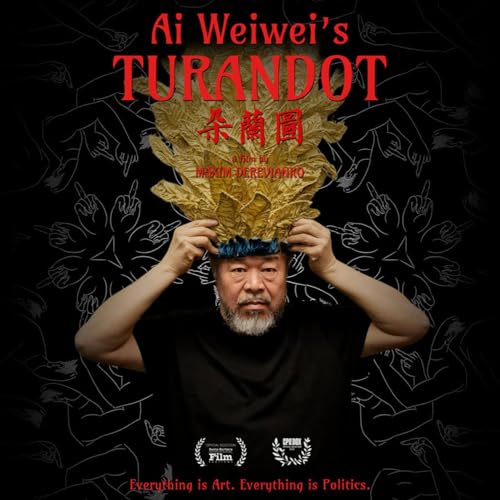
  • "Everything is Art. Everything is Politics." AI WEIWEI'S TURANDOT Dir. MAXIM DEREVIANKO - Highlights
    Oct 22 2025

    “So when we decided to do a documentary to follow Ai Weiwei, we knew, of course, it wouldn't be just a simple opera, and we knew he would bring his own very special and original vision. Because, of course, he is not an opera director. From his point of view, it's a challenge, but from another perspective, it’s probably an enrichment for the opera audience because he doesn't follow the rules of opera. And, of course, once you decide to do a documentary about Ai Weiwei, it's in his DNA to be political. Once I started to follow him, the political issues and topics came into the documentary by themselves.”

    The renowned artist and activist Ai Weiwei has used sculpture, photography, documentaries, and large-scale installations to challenge authoritarian power for decades. But his project at the Rome Opera House, directing Puccini’s final opera, Turandot, may be his most powerful fusion of art and politics yet. Puccini’s original is a fairy tale set in ancient China about a princess whose riddle game costs failed suitors their lives. But Ai Weiwei transformed this story into a stark reflection of the present, weaving in footage of refugee crises, COVID hospitals, and the Ukraine war—a production that became an urgent act of resistance for its Ukrainian conductor and cast. The opera and documentary are a living document of our turbulent times, embodying Ai Weiwei’s belief that 'Everything is Art. Everything is Politics.'

    The new documentary, Ai Weiwei's Turandot, goes behind the curtain to capture the artistic struggle and emotional weight of making this work—a process that began with one vision and was fundamentally changed by a global pandemic and a major war.

    My guest is the documentary’s director, Maxim Derevianko. He grew up in a family with deep ties to the Rome Opera House, and he offers a deeply personal, intimate look at how in Ai Weiwei’s words, “art competes with reality, but art will have the last word.”

    Episode Website

    www.creativeprocess.info/pod

    Instagram:@creativeprocesspodcast

    Más Menos
    Menos de 1 minuto
  • AI WEIWEI'S TURANDOT
    Oct 22 2025

    “Everything is Art. Everything is Politics.
    I think art competes with reality. And art will give you the last words.” –Ai Weiwei

    The renowned artist and activist Ai Weiwei has used sculpture, photography, documentaries, and large-scale installations to challenge authoritarian power for decades. But his project at the Rome Opera House, directing Puccini’s final opera, Turandot, may be his most powerful fusion of art and politics yet. Puccini’s original is a fairy tale set in ancient China about a princess whose riddle game costs failed suitors their lives. But Ai Weiwei transformed this story into a stark reflection of the present, weaving in footage of refugee crises, COVID hospitals, and the Ukraine war—a production that became an urgent act of resistance for its Ukrainian conductor and cast. The opera and documentary are a living document of our turbulent times, embodying Ai Weiwei’s belief that 'Everything is Art. Everything is Politics.'

    The new documentary, Ai Weiwei's Turandot, goes behind the curtain to capture the artistic struggle and emotional weight of making this work—a process that began with one vision and was fundamentally changed by a global pandemic and a major war.

    My guest is the documentary’s director, Maxim Derevianko. He grew up in a family with deep ties to the Rome Opera House, and he offers a deeply personal, intimate look at how in Ai Weiwei’s words, “art competes with reality, but art will have the last word.”

    Episode Website

    www.creativeprocess.info/pod

    Instagram:@creativeprocesspodcast

    Más Menos
    1 h
  • Art, Empathy & Resilience with CADY McCLAIN, Actor, Director, Writer, Artist, Musician - Highlights
    Aug 1 2025

    “I had to become the father of my family very young because my parents divorced when I was 12. My situation was a little bit unusual in that my father kind of disappeared, and I had been making a fair amount of money as a kid, doing commercials and television and film. We needed money, and I kind of became the breadwinner. But I had this amazing world that I had access to, which was the world of the entertainment industry. My mom was supportive of my taking over and saying, "This is, I think, what we need to do." She liked the idea of moving to New York, so we moved to New York when I was 17 with a play that I had gotten. Then she got cancer and became really sick, so I had to take care of her full time. That lasted for about eight years, and then she died when I was 25. That was a rough go. At the same time, I had an amazing other world, and my other world was the world of make-believe and pretend, which I got to participate in on the soaps, with happy families and Christmases, Easters, miracles, love, weddings, and children. The pretend world that I spent a large amount of time in became a great way to balance what was sort of tragic in my real life.”

    Our guest today is Cady McClain. You probably know her from her long and celebrated career in daytime television. She is a three-time Emmy® Award-winning actress. She plays Pamela Curtis on CBS’ Beyond the Gates, and is the Artistic Director of Axial Theatre, and her directorial work includes the documentary, Seeing is Believing: Women Direct, a fascinating look at the challenges and triumphs of women behind the camera. Her memoir, Murdering My Youth, is an honest and sometimes difficult book about growing up as a child actor in the spotlight. Her work across all these different art forms—acting, directing, writing, art, and music—all seems to be connected by a commitment to telling true stories, no matter how complicated.

    www.creativeprocess.info/pod

    Instagram:@creativeprocesspodcast

    Más Menos
    11 m
  • A Life in Acting with Emmy Award-winning Actor, Director, Writer CADY McCLAIN
    Jul 31 2025

    “I won my first Emmy when I was 21, which was the result of absolutely devoting myself day and night for two years to doing all the scene work. I attended classes simultaneously and did plays until my mother died. I studied with Michael Howard for eight years. Even when I was so tired I couldn't get up to do a scene, he would say, "Get up and do a poem." It helped me enormously; it saved me.

    The way I was trained and how I train others is that you know when you’re in the zone. Oh God, it feels so good. It feels like flying. And that's what you want. You want to be so unselfaware that you're on liftoff?

    I had to become the father of my family very young because my parents divorced when I was 12. My situation was a little bit unusual in that my father kind of disappeared, and I had been making a fair amount of money as a kid, doing commercials and television and film. We needed money, and I kind of became the breadwinner. But I had this amazing world that I had access to, which was the world of the entertainment industry. My mom was supportive of my taking over and saying, "This is, I think, what we need to do." She liked the idea of moving to New York, so we moved to New York when I was 17 with a play that I had gotten. Then she got cancer and became really sick, so I had to take care of her full time. That lasted for about eight years, and then she died when I was 25. That was a rough go. At the same time, I had an amazing other world, and my other world was the world of make-believe and pretend, which I got to participate in on the soaps, with happy families and Christmases, Easters, miracles, love, weddings, and children. The pretend world that I spent a large amount of time in became a great way to balance what was sort of tragic in my real life.”

    Our guest today is Cady McClain. You probably know her from her long and celebrated career in daytime television. She is a three-time Emmy® Award-winning actress. She plays Pamela Curtis on CBS’ Beyond the Gates, and is the Artistic Director of Axial Theatre, and her directorial work includes the documentary, Seeing is Believing: Women Direct, a fascinating look at the challenges and triumphs of women behind the camera. Her memoir, Murdering My Youth, is an honest and sometimes difficult book about growing up as a child actor in the spotlight. Her work across all these different art forms—acting, directing, writing, art, and music—all seems to be connected by a commitment to telling true stories, no matter how complicated.

    Episode Website

    www.creativeprocess.info/pod

    Instagram:@creativeprocesspodcast

    Más Menos
    1 h y 6 m