Episodios

  • Brenda Rubenstein: Storage and Computing with Small Molecules: A Tutorial
    Nov 12 2020

    For our first event, Brenda Rubenstein has presented a tutorial on her lab's approach to storage and computation, making use of the chemical properties of a variety of types of small molecules. This was a real tour-de-force, and is worth a watch. Be sure to listen to our subsequent Q&A session in a couple episodes time!

    Abstract: As transistors near the size of molecules, computer engineers are increasingly finding themselves asking a once idle question: how can we store information in and compute using chemistry? While molecular storage and computation have traditionally leveraged the sequence diversity of polymers such as DNA, our team has recently demonstrated that vast amounts of information can also be stored in unordered mixtures of small molecules. In this tutorial, I will begin by explaining this new, more general molecular storage paradigm and how polymers fit into it. I will then describe how our team has married combinatorial chemical synthesis with high resolution spectrometry to experimentally realize this paradigm and store GBs of information in small molecules and metabolites. Lastly, I will end with a discussion of how these storage principles can be combined with machine learning techniques to realize fully molecular neural networks for pattern recognition and image processing. The new paradigm discussed in this tutorial will lend itself to new means of increasing molecular storage capacity and interpreting the many small molecule chemistries that underlie "computing" within the body.

    ---
    Find more information at the episode page here:
    https://podcast.molpi.gs/media/rubenstein-b-2b86de754345/

    Más Menos
    1 h y 4 m
  • Q&A with Brenda Rubenstein, on Storage and Computing with Small Molecules
    Nov 21 2020

    Following on from Brenda's fantastic tutorial, we chatted with her to get answers to many questions, find out more about her lab's work, and get her thoughts on the future direction of this approach!

    ---
    Find more information at the episode page here:
    https://podcast.molpi.gs/media/rubenstein-b-2b86de754345/

    Más Menos
    33 m
  • Rebecca Schulman
    Nov 18 2020

    Join us for the first of our 'Meet the Molecular Programmer' series, in which we talk with seasoned academics in our field about their journey and life experiences. In this episode, we chatted with Prof. Rebecca Schulman.

    We briefly talked with Rebecca about her work from her early PhD journey to more recent work coming from her lab. We heard about her stories, the challenges, fun and exciting memories she had and lessons she learned during graduate school, and her wisdom about running her own lab. Rebecca provided valuable advice to students surviving and thriving graduate school and suggestions regarding working in a lab. We also had wonderful discussion about the interdisciplinary property of our field. Hope you enjoy the conversation! We certainly had a lot of fun!

    ---
    Find more information at the episode page here:
    https://podcast.molpi.gs/media/schulman-r-7ffb8c72c09d6d9b/

    Más Menos
    1 h y 10 m
  • Dominic Scalise
    Dec 4 2020

    Join us for the first of our ‘Lab Pigs’ series, in which we talk with early career researchers on their research and journey within our field. In this episode, we chatted with Dominic Scalise. We talked a lot with Dominic about his work towards building a stored program chemical computer.

    Dominic Scalise is a postdoctoral scholar in Lulu Qian’s lab at Caltech. He earned his PhD in chemical and biomolecular engineering from Johns Hopkins, advised by Rebecca Schulman, and his B.S. in mechanical engineering from UC Berkeley. His work focuses on developing a stored program chemical computer, and powering circuits using DNA buffer reactions.

    Abstract: Molecular programming extends computer science beyond electronics into chemistry, and lets humans directly program physical matter. However, chemical circuits remain arduous to program, often requiring months or years to design, implement, and debug even a single program. In stark contrast, we program modern electronics with much less effort. A critical step in simplifying electronic programming was the invention of “software” in the 1940s. I will outline how similar concepts of “chemical software”, in which programs are stored in memory rather than hard coded into the connections of chemical reaction networks, could dramatically simplify the task of chemical programming. I will then discuss some reaction motifs in development which may be useful for implementing chemical software.

    In this podcast, we found out that current chemical computers are just like the electronic computers from the 1940s, in that a computer program requires rewiring the hardware. They are small in size, error-prone, and take a long time to build. A stored program chemical computer may tackle these problems by being a robust universal circuit capable of running arbitrary algorithms, with the exact algorithm of a given computation depending on which instructions (software) are given.

    Dominic then discussed his approach—building a chemical memory and then a chemical processor, possible challenges in doing so, and his vision for the future. We also talked a bit about his experiences in academia.

    Dominic made a special announcement for molpigs members at the end about a grassroots project: a Molecular Programming textbook to drive the field through a collaborative approach. Stay tuned on our newsletter for more information!

    ---
    Find more information at the episode page here:
    https://podcast.molpi.gs/media/scalise-d-5cbae63946bde0c4/

    Más Menos
    1 h y 9 m
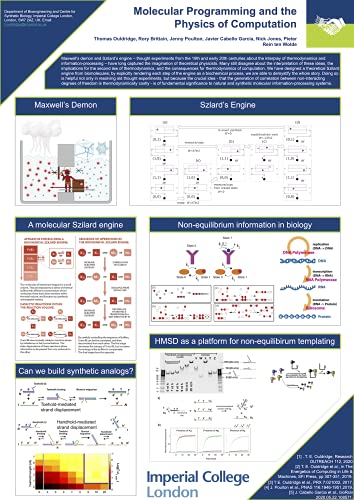
  • Tom Ouldridge: Molecular Programming and the Physics of Computation
    Jan 9 2021

    Join us this week for a long and interesting conversation with Tom Ouldridge of Imperial College London on Maxwell’s demon, Szilard’s engine, what people get wrong about thermodynamics and information theory, how this all relates to biology, and how his lab is using these ideas to develop exciting new approaches to molecular programming.

    Tom Ouldridge is a Royal Society University Research Fellow in the Bioengineering Department, where he leads the “Principles of Biomolecular Systems” group. His group probes the fundamental principles underlying complex biochemical systems through theoretical modelling, simulation and experiment. In particular, they focus on the interplay between the detailed biochemistry and the overall output of a process such as sensing, replication or self-assembly. They are inspired by natural systems, and aim to explore the possibilities of engineering artificial analogs.

    We start by discussing Maxwell’s demon and Szilard’s engine—thought experiments from the 19th and early 20th centuries about the interplay of thermodynamics and information-processing. These have long captured the imagination of theoretical physicists. There is renewed interest in these thought experiments due our increasing ability to control systems at the molecular level. Many still disagree about the interpretation of these ideas, the implications for the second law of thermodynamics, and the consequences for thermodynamics of computation.

    Szilard’s engine is a simpler version of Maxwell’s thought experiment, but which is mathematically tractable, considering only a single particle separated by a divider attached to a weight. If the particle and the weight are on the same side, then the particle can bounce against the divider and lift the weight, doing work. By resetting the divider, this step can be repeated to extract more work. Tom talks about how this seeming paradox may be resolved.

    Tom discusses how his group has implemented a theoretical Szilard engine in biomolecules; by explicitly rendering each step of the engine as a biochemical process (using cell surface receptors). This helps demystify the whole process by rendering all “information theoretic” steps as concrete, real, processes. Doing so is helpful not only in resolving old thought experiments, but because the crucial idea—that the generation of correlation between non-interacting degrees of freedom is thermodynamically costly—is of fundamental significance to natural and synthetic molecular information-processing systems.

    ---
    Find more information at the episode page here:
    https://podcast.molpi.gs/media/ouldridge-t-4007264116dd3097/

    Más Menos
    1 h y 25 m
  • Josie Kishi
    Jan 14 2021

    In the second episode of our 'Lab Pigs' series, which highlights the research and journeys of early career researchers in our field, we talked with Josie Kishi. Josie was instrumental in developing the Primer Exchange Reaction (PER) synthesis method and the related imaging method, SABER. As well as talking about these, we found out what excites her about molecular programming, how she got into the field, and where she things it's going to go.

    ---
    Find more information at the episode page here:
    https://podcast.molpi.gs/media/kishi-j-db823daf0f863ab6/

    Más Menos
    44 m
  • Yuan-Jyue Chen: Random Access and Similarity Search in DNA Data Storage
    Jan 26 2021

    In this episode we talked with Yuan-Jyue Chen, of Microsoft Research and the University of Washington, on some of his research into DNA Data Storage. Yuan focussed on two topics: random access of data, and the accompanying issues with stochasticity and errors, and an application of DNA storage for efficiently searching a large database of images by similarity.

    Please note: The views expressed by Yuan in this podcast do not necessarily represent the views of Microsoft.

    ---
    Find more information at the episode page here:
    https://podcast.molpi.gs/media/chen-yj-0e6debec064e5f0d/

    Más Menos
    47 m
  • Erik Poppleton
    Feb 28 2021

    In the third episode of our ‘Lab Pigs’ series, which highlights the research and journeys of early career researchers in our field, we talked with Erik Poppleton, of the Biodesign Institute at Arizona State University. Erik researches the use of computational modeling in informing the design of molecular machines. As part of this, he also develops general-use analysis tools for oxDNA, and conversion tools to integrate the various design and simulation tools in the nucleic acid nanotechnology ecosystem. We talked about his research, his experience writing academic software, and the relationship between geology and molecular programming.

    Core Simulation Tools
    - Main oxDNA documentation: https://dna.physics.ox.ac.uk/index.php/Main_Page
    - Current stable release (being retired soon): https://sourceforge.net/projects/oxdna/files/
    - Bleeding edge release (has Python bindings!): https://github.com/lorenzo-rovigatti/oxDNA
    - The model is also available as part of LAMMPS, documentation can be found here: https://lammps.sandia.gov/doc/Packages_details.html#pkg-user-cgdna

    Useful tutorials
    - A textbook chapter covering how to relax and simulate origamis: https://arxiv.org/pdf/2004.05052.pdf
    - A textbook chapter covering the details of molecular simulation: https://www.public.asu.edu/~psulc/myimages/chapter.pdf
    - Example input files: https://github.com/sulcgroup/oxdna_analysis_tools/tree/master/example_input_files

    Useful tools
    - TacoxDNA, converters from design software to oxDNA: http://tacoxdna.sissa.it/
    - oxView, a visualizer and editor for oxDNA: https://sulcgroup.github.io/oxdna-viewer/
    - oxView documentation: https://github.com/sulcgroup/oxdna-viewer
    - oxdna_analysis_tools, a library of python scripts for basic simulation analysis: https://github.com/sulcgroup/oxdna_analysis_tools
    - oxdna.org, a public webserver for running simulations: oxdna.org
    - ox-serve, run interactive simulations in your web browser using a Google Colab GPU: https://colab.research.google.com/drive/1nFC9zy-wEwwl8vlJZAbQZZofavP4PXvL#scrollTo=C_8TB2t5gxDg

    Of course, if you find these tools useful, please remember to cite us! The citations for each tool can be found in its documentation (oxdna.org paper coming soon!)

    ---
    Find more information at the episode page here:
    https://podcast.molpi.gs/media/poppleton-e-d83cc0825a805d2e/

    Más Menos
    53 m
adbl_web_global_use_to_activate_DT_webcro_1694_expandible_banner_T1