Episodios

  • 130: A Double Fugue & A Second Manuscript
    Apr 14 2026

    Remember this image from the E-flat Major Prelude and Fugue epsiode, where Bach puts a double fugue at the half within the half?

    Bach does it once more in today’s episode. We’ve arrived at the other double fugue in this collection, BWV 864 in A major. Bach begins the prelude by juggling three ideas:

    The ordering of these ideas will switch. A few bars later we see the same three ideas shifted around:

    Bach presents the same ideas a total of six times in the prelude. Whereas we logicians would love to see all six combinations (ABC, ACB, BAC, BCA, CBA, CAB,) Bach gives us four of the possible orderings. The final one with the syncopation on bottom is particularly nice:

    Feed the Contrapunctus:

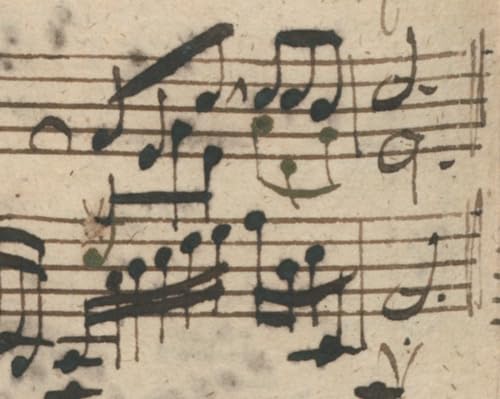
    Now the fugue: This is the correction I got all excited about. This is from Anna Magdalena’s copy (called the Müller Manuscript) where we clearly see a revision that may improve on P 415. Look closely at the note which is whited out, this is the G-sharp that is found in Bach’s autograph, here, corrected to an E.

    After playing this measure as we know it, I can’t help but feel that this little gem hidden within Anna Magdalena’s copy reflects the latest thinking of the composer.

    You can view the Müller Manuscript here: https://www.bach-digital.de/receive/BachDigitalSource_source_00001076

    Interesting how the shapes in the first of the subjects in the double fugues of The Well-Tempered Clavier have similar rising perfect fourths:

    Similar shapes in the E-flat major pair:

    And finally, here is the charming work of the young WF, copying out one of his father’s cantatas at a young age. See the little attempt at making a mirror monogram, WFB? Wonderful! Schweitzer beautifully recounts this scene.

    We Rely Exclusively on Paid Substack Subscriptions! Help WTF Bach endure:

    We encourage our listeners to join at wtfbach.substack.comThis is the best place to leave comments.You can also make a one-time donation here:

    https://www.paypal.me/wtfbachhttps://venmo.com/wtfbach

    Thank you for your help!

    Concepts Covered:

    J.S. Bach’s A major, book one, Well-Tempered Clavier, Anna Magdalena’s copy, also known as the Müller Manuscript (not to be confused with the Möller Manuscript,) Double fugue writing, juggling three contrapuntal ideas in the prelude. We also paint the scene for how Bach’s cantatas were assembled. A beautiful picture of WF Bach, CPE Bach and Bach’s nephew, JH Bach.


    Get full access to W.T.F. Bach? at wtfbach.substack.com/subscribe
    Más Menos
    56 m
  • 129: I Got Rid Of All My Books (11 Years Ago...)
    Apr 7 2026
    Back to Bach next week! In the meantime, I thought you’d appreciate a story I wrote after I ‘discarded’ the majority of my possessions— mostly books. Whereas I easily tossed things like clothes, artwork, komono, plates, pens, et cetera, getting rid of my massive library took months and was an emotional rollercoaster. I haven’t ever looked back! …mostly. Sans Eyes, Sans Books, Sans EverythingIf you go home with somebody and they don’t have any books, don’t f*** ‘em!-Not so old aphorismLast scene of all,That ends this strange eventful history,Is second childishness and mere oblivion;Sans teeth, sans eyes, sans taste, sans everything.-As You Like It, 2:7-for Marie Kondo (and Rachel)At eighteen years old, I moved to New York City with five books: a Mozart biography, a Bach biography, a Beethoven biography, a book about Beethoven’s piano sonatas, and a Bible. My sheet music library (which was already massive) and any other books (which were insubstantial) I left with my parents. All I valued at that time was playing the piano and any reading dealing with that. After a year, my personal Pentateuch had grown four times in size, but was humble still.Eleven years later I had one-thousand nine hundred and thirty two books.Books bought, books found, books stolen, books given, books I printed: any way one could get a book, I got books. I dreamed of creating a library that resembled my teacher Lowenthal’s: wall to wall books, books falling out of books, books used as bookshelves themselves, pages on the ground from who knows which books, books with missing covers, covers with missing books, books rapidly-read-horizontally-stacked-under-coffee-cups books, books under-the-piano-to-muffle-the sound books, books piled-on-top-of-the-piano-to-complete-a-cliche books, the divine image of the godhead seen in books spinning endlessly out from the library walls.“I always imagined heaven to be a kind of library.”That was the first sentence by Borges I ever read, and Lowenthal’s study was the closest to paradise I had been.—I lived in seven different apartments in New York, and with each move at least 75% of the boxes were books, and with books come their doomed counterparts: bookcases (so help us god.) Many a reader may commiserate. Once the first small white case was filled, (Ikea, 2007) there needed to be a match (Ikea, 2008.) By 2009, I had two crumbling, completely useless, bookcases.I called the poet Ron Price, who, though he owned less books than Lowenthal, seemed to have given more thought to their casing. I discussed a sleek white Ikea bookshelf I had seen online:“Oh! Don’t buy a f***ing BILLY!” he shouted.He knew the make. …Everybody knew the make. Little did I know, the crumbling pieces of piecemeal that already housed my books bore the same name.“Buy some nice wood. Make some sturdy shelves.”“Hmm… You’ve been down this road it seems.”He chuckled.“The… shelves are even more important than the books?” I went so far as suggesting“I don’t know about that.” he muttered.In a month, I had, at only a few times the cost of escaping Billy’s curse, three black bookcases, two inches thick per shelf. Unbendable.My East Harlem studio was immensely stylish: I dreamed I would see reconstructions of it in museums as I had seen reconstructions of Proust’s bedroom. Two tall cases stood side by side, and a third half-case, tastefully empty, was stacked horizontally on the other two. It created one giant fifteen foot wide wall, ten feet tall. It was like a tree for inanimate objects.And then, many a reader may commiserate, I tasted the rainbow: a design magazine with a bookshelf arranged by color. I didn’t do anything else for two weeks.I spent every day agonizing over the color of books and where on the new color coordinated shelves they would go. I grouped by color, but then realized my groupings were random. I needed the spectrum: a clean sweep from infrared to ultraviolet. I needed a circle? No, but, this was disastrous. Is color a circle? No, color is a triangle, right? The primary colors are only three… After two months of switching books around, I hit upon the solution: Primary colors would outline a triangle marking the top and the lowest corners. Then, the secondary colors would form the inverted triangle pointed at the bottom. It was so obvious. The only choice then was which of the primary colors to put at the top. In my collection, it made sense that blue should be the crown. Hence: orange went to the bottom, green and purple at the shoulders, therefore yellow and red at the... damn! That looks amazing!But what of all these books without color? Whereas I had previously banished them to the edges, now the black and white spines fit brilliantly into the middle. A zero in the middle of all the brilliance. Quickly, no matter how beloved the content, brown, tan, and off-white, gray books, these were imposters. I stuffed them here or there where they wouldn’t...
    Más Menos
    24 m
  • 128: Donald Francis Tovey's Well-Tempered
    Mar 24 2026

    I don’t blame us for preferring our rather clean, modern Bach editions to this:

    But are we so confident in our own interpretations that we can throw out the likes of Hans Bischoff, Carl Czerny, Ferruccio Busoni (pictured) and Donald Francis Tovey? These heavily annotated performance editions, while, yes, they should be read alongside a ‘cleaner’ modern edition, can certainly still teach us some beautiful musicianship.

    In this episode, I let Sir Donald Francis Tovey’s remarks on the g-sharp minor prelude and fugue, BWV 863, lead us through an analysis of the work.

    Some more from Busoni (the previous prelude and fugue,) his footnotes and ossias are exciting:

    Most of these editions are in the public domain on IMSLP. Have a look:

    https://imslp.org/wiki/Das_wohltemperierte_Klavier_I,_BWV_846-869_(Bach,_Johann_Sebastian)

    Finally, here is the source of confusion about the Picardy third at the end of the g-sharp minor fugue. At first glance, it certainly looks like B natural in the alto voice. (Soprano clef)

    But look closer. (Sorry for the resolution.) This is not Bach’s normal natural sign. It has a slash (maybe two slashes?) through it:

    Here are few of Bach’s natural signs. Upon comparison, the above sign certainly is modified with extra strokes to form a sharp:

    We Rely On Listener Support! How to Donate to this Podcast:

    The best way to support this podcast, is to become a paid Substack subscriber at wtfbach.substack.com

    Enough paid subscribers = exclusive content, monthly merchandise giveaways!

    You can also make a one-time donation here:

    https://www.paypal.me/wtfbach

    https://venmo.com/wtfbach

    Thank you for listening! Thank you for your support.

    Concepts Covered:

    An analysis of BWV 863 exploring the four-voice fugue, the two counter-subjects, the invention of the prelude with its inversions — guided by Sir Donald Francis Tovey's annotated Well-Tempered Clavier edition. We mention Busoni, Czerny, and Bartok’s edition as well. What do these historic performance editions still have to teach us? Why a modern urtext editions won’t tell the whole story, and finally the confusion at the end of the prelude and fugue: the Picardy third in the alto voice at the finale.


    Get full access to W.T.F. Bach? at wtfbach.substack.com/subscribe
    Más Menos
    41 m
  • Bach's Birthday is Today, Not March 31st.
    Mar 21 2026
    Happy Birthday Johann. Today, March 21st, not March 31st.Let me repeat that for those of you feeling clever or citing google without thinking:Happy Birthday Johann. Today, March 21st, not March 31st.Why are people confused about this? How did this become a thing? And what extremely boring person got so frustrated with a toccata they started tampering with Bach’s wikipedia page?There were two main calendars in Europe at the time: the Julian and the Gregorian. We are currently on the Gregorian, but it took a while to get everyone on board. Greece held out until 1923 even, and Protestant Germany was holding back in 1685, when Bach was born.But you know, you gotta get with the times, man! Gotta catch up to the modern world! It’s gonna be 1700 pretty soon! We’re gonna have mercury thermometers and calculus… You’re living in the past! …ten days in the past!So in 1700, Germany did indeed make the jump from Julian to Gregorian. In the year 1700, they jumped from February 18, to March 1. No one died, no one was born between Feb 18th and March 1st, 1700 in protestant Germany. (No one even used the toilet.)Germany joined the Gregorian calendar when Bach was 15 years old, with the legal stipulation that all prior dates would remain valid. A legal stipulation, in fact, protecting the old dates from being overridden, and converted to the new calendar.So, come on people, let’s not try to override this actual legal stipulation. (Here’s my gentle reminder that saying Bach was born on March 31st is illegal.) We can’t go about dismissing ecclesiastical records in favor of our modern abstractions just because we’re feeling smug about hybrid cars and vegan smoothies. It’s not like the Gregorian calendar represents some objective truth that the Julian calendar was failing to capture.Bach was Born on March 21st. The next person I hear whispering in the bar, “well, technically he was born on March 31st…” is getting a mordent —to the face.Are you that person who’s trying to switch Bach’s birthday to the 31st? Wow. Can’t wait to hang out with you on Christmas: “Actually, statistically speaking, the odds that Jesus was born on the 25th of December are practically zero! Did you know that in Judea, shepherds typically watched their flocks by night from Spring to early Autumn?” Yeah, yeah, yeah. Get a life.Maybe you know about Shakespeare and Cervantes? That they died on the same day? Or rather, the same date. It’s the same thing: Protestant England, on the Julian calendar, and Catholic Spain, on the Gregorian. It created this beautifully poetic coincidence. The greatest writers of their generations both died on April 23, 1616— 10 days apart.Now, we’re not going to switch the date on which Shakespeare died, are we?! No. That’d be asinine. Which is exactly what shifting Bach’s birthday to March 31st is, asinine. March 21st is also Early Music Day in Europe— for this very reason, and we’re not going to move early music day are we? No, that’d be asinine.March 21st is also, nicely, International Poetry Day, …and World Puppetry Day, …and World Day for Glaciers— if you ask me we have too many days, but sure, why not. In fact, why not make a puppet of Bach reading a poem and dance him around on some ice cubes today.Today is also Harmony Day in Australia, beautiful! The immortal god of harmony, that he should share Harmony Day in Australia. I pictured everyone leaning into triads and flat-nines down unda’ but this day happens to be about racial harmony, but still! Still. Let’s sing four-part chorales with everyone we know.Bach’s birthday is March 21st. It always was March 21st. You know who was born on March 31st? Haydn. Who? Exactly. Never heard of him. If anyone wishes me a happy birthday Bach in 10 days, I’m blocking you.Dig Out Your Inner Ear:Enjoying your contrapuntal journey? Here’s how you can help:We encourage our listeners to become a paid subscriber atwtfbach.substack.comFree subscriptions are also beneficial for our numbers.You can make a one-time donation here. We run a 501(c)3, so let us know if you want a tax deduction:https://www.paypal.me/wtfbachhttps://venmo.com/wtfbachSupporting this show ensures its longevity. Thank you for your support! Get full access to W.T.F. Bach? at wtfbach.substack.com/subscribe
    Más Menos
    6 m
  • 127: How I Memorize Bach (By Ear)
    Mar 17 2026

    I was always jealous of jazz musicians, simply learning music off recordings— no sheet music necessary. Why couldn’t I do that? Why don’t classical musicians have this skill? It seems like all musical cultures in the world learn this way, so what was I missing?

    About 12 years ago I decided I wanted to be part of this tradition. After some trial and error, I hit upon a method that allowed me to learn Bach (or any other composer) by ear. And more than just being glad for having developed the skill of transcribing, the method is extremely efficient: I find that pieces are usually memorized faster than when using sheet music.

    Here is the method as explained in the episode:

    -Record, slowly with the score, up to 60 seconds of music (or even 10 seconds if you like.)-Put away the score and play ‘call and response’ with the recording, relying on your ears.-Once learned, re-record the music as you've heard it, now learned aurally.-Re-open the music, play the new recording, checking for inaccuracies, missing details, &c.-Repeat…

    Stretch the Octave:

    Now, once something is memorized, you may want to keep it memorized. So you’re up against the ol’ Ebbinghaus Forgetting Curve: the speed at which your mind forgets without conscious review. We all have our own curves, but my rule has been roughly:

    Play the newly memorized music twice on the first day,Review the music on the second day,… three days after learning,… one week after learning,… two weeks after learning,… one month after learning,… three months after learning,… six months after learning,… one year after learning,…two years after learning.

    You can even put dates in your calendar saying, “You learned fugue X three months ago: Review it today.” With this practice, you’re sure to have some counterpoint written into your DNA.

    W.T.F. Bach wants YOU to learn a fugue by ear:

    The Pakistani musician I mentioned is the immortal, Nusrat Fateh Ali Khan. Listen to his extraordinary live concerts where he and his band achieve the heights (while sitting on the floor.) In my next life I’d like to be one of the guys in back clapping only quarter notes.

    Want to help this resource? Here’s how:

    We encourage our listeners to become a paid subscriber atwtfbach.substack.comFree subscriptions are also beneficial for our stats. You can make a one-time donation:

    https://www.paypal.me/wtfbachhttps://venmo.com/wtfbach

    Supporting this show ensures its longevity. Thank you for your support!


    Get full access to W.T.F. Bach? at wtfbach.substack.com/subscribe
    Más Menos
    30 m
  • 126: What The Instrument Tells You About The Music
    Mar 10 2026

    Analysis starts at 17 minutes. Sorry, I got carried away talking about the possible peculiar paradox of being a pianist. Just before making this episode, my harpsichord forced upon me a change of interpretation, so I started thinking about how and why this happens. I spoke about the way classical musicians are ‘bred,’ asking the following questions:

    How can we spend our lives playing music from the 18th century without any contact with the instruments used then? Can we know objective aspects of older music while playing on a single model of an instrument developed toward the end of the 19th century? Do pianists exist in a vacuum, where a musical interpretation is guided by a sort of subjective vision— is it even vanity or self-flattery?

    Certainly there are pianists who know the Steinway’s predecessors, but on the whole, I feel there is a real ignorance of the instruments on which our repertoire is founded. Perhaps, though, we are in the midst of a revolution of touch and interpretation: I’ve recently seen more pianists playing fortepianos, owning clavichords, et al. This can only lead to a more text-based reading of the music.

    But— mind you!— is that a good thing? Do we want to push the art of keyboard playing in a direction away from self expression and toward people claiming the ‘truth’ is on their side? That sounds awful! Even if pianism indeed exists a vacuum, it certainly produces rare visions of the music only accessible through such an art.

    Enough musing. While playing the A-flat major Prelude BWV 862 on my double manual harpsichord, the instrument, in a word, told me about the music. There was something about the limited palette of the instrument that forced upon me a new approach. This sort of radical adjustment to one’s playing is typical of playing on historic instruments. On the modern grand piano, possibilities are endless, but on older instruments, the sound tends to constrain the range of possible interpretations.

    Spread the Fugue.

    The prelude BWV 862 saw some lovely revisions between the earliest conception of the piece and the version we know. For starters, take the lovely line of the concertino solo in BWV 862a:

    How different is the revision!

    Now bars 22-27 in the earliest version:

    Revised to the more evenly shaped:

    Want to support W.T.F Bach? Here’s how:

    The best way is to become a paid subscriber atwtfbach.substack.comYou can also make a one-time donation:

    https://www.paypal.me/wtfbachhttps://venmo.com/wtfbach

    Supporting this show ensures its longevity. Thank you for your support!

    Concepts Covered:

    J.S. Bach’s Well-Tempered Clavier, Book 1, Das Wohltemperierte Clavier, As Dur, BWV 862, The concerto style of the prelude, between two manuals in the prelude, Fugal analysis, early versions of WTK 1, BWV 862a, and the possible ‘vacuum of pianism’ creating subjective art vs. seeking objective facts about the music. Historic instruments leading to a text-based interpretation, using knowledge of older instruments to inform modern piano playing et cetera.


    Get full access to W.T.F. Bach? at wtfbach.substack.com/subscribe
    Más Menos
    59 m
  • 125: What Is An Ornament?
    Mar 3 2026

    “The discontent of being between two notes; the urge to break free of a single note.”-Lionel Party (Paraphrased ca. 2005)

    What an opening:

    In this episode we listen to at least 14 different interpreters play this expressive trill. Such a simple idea, but how many different ways this idea can be realized! At an even speed or speeding up? With a turn at the end or a turn at the beginning or no turn at all? Crescendo all the way through or perhaps even diminuendo?

    Between earliest version and the fair copy, Bach seems to smooth out the rhythm in the solo voices. This is a rare case where the earliest version is rhythmically more nuanced than the revision.

    Bar 6. The last beat is more varied in the early version:

    It is smoothed out in revision:

    Bar 9. The top two voices sing in different rhythms in the early version:

    In revision, Bach makes them consistent:

    Penultimate bar. Note the 64th notes in the early version:

    Everything is more uniform in revision:

    WTF Bach survives exclusively on listener support! Thanks for your help.

    As we progress through Book One of The Well-Tempered Clavier, our fugal themes become increasingly complex and chromatic. Here, the fugue’s subject is angular, modern even:

    The subjects come in an memorable stretto toward the end:

    Want to help this resource stick around? Here’s how:

    We encourage our listeners to become a paid subscriber atwtfbach.substack.comFree subscriptions are also beneficial for our numbers.

    You can make a one-time donation:

    https://www.paypal.me/wtfbachhttps://venmo.com/wtfbach

    Supporting this show ensures its longevity. Thank you for your support!

    Topics Covered in this episode:J.S. Bach Well-Tempered Clavier Book One, BWV 861 prelude and fugue analysis, also Baroque ornamentation and how to play a trill, performance practice. We examine Bach’s manuscript sources in the early vs late versions of this pair. A general discussion of Baroque keyboard music, harpsichord vs piano performance, fugue structure and form, and Bach’s counterpoint.


    Get full access to W.T.F. Bach? at wtfbach.substack.com/subscribe
    Más Menos
    1 h y 6 m
  • (5 Min. Rant) Customer Support Hero
    Feb 24 2026

    “But if thought corrupts language, language can also corrupt thought.”-Politics and the English Language

    Thanks for reading W.T.F. Bach?! This post is public so feel free to share it.

    Enjoying your contrapuntal journey? Here’s how you can help:

    We encourage our listeners to become a paid subscriber atwtfbach.substack.comFree subscriptions are also beneficial for our numbers.

    You can make a one-time donation here. We run a 501(c)3, so let us know if you want a tax deduction:

    https://www.paypal.me/wtfbachhttps://venmo.com/wtfbach

    Supporting this show ensures its longevity. Thank you for your support!


    Get full access to W.T.F. Bach? at wtfbach.substack.com/subscribe
    Más Menos
    5 m