Episodios

  • Unlocking the Secrets of Successful Negotiation: A Guide for Subcontractors to Secure Better Contracts
    Mar 24 2026

    In episode 135 of The Subcontractors Blueprint podcast, host Jacob Austin , shares practical negotiation strategies tailored for construction subcontractors. He emphasises the importance of thorough preparation, understanding both your own and the main contractor’s priorities, and negotiating beyond just price—considering terms like retention, program, and contract amendments. Haile highlights the value of face-to-face discussions, building trust, and ensuring you’re dealing with decision-makers. By adopting a collaborative and well-prepared approach, subcontractors can protect their margins, secure cash flow, and avoid costly contractual pitfalls in every negotiation.

    KEY TAKEAWAYS:

    • Negotiation in subcontracting is a skill that goes far beyond just haggling over price—it involves every commercial term and can be learned and improved.
    • The most successful negotiators focus on trust, value, time, and people, not just contracts and profit.
    • Preparation is critical: know your costs, risks, red lines, and the authority of everyone involved before you start negotiating.
    • Negotiating on multiple variables—like payment terms, retention, and amendments—creates more room for collaboration and better deals.
    • Building trust through honest, evidence-based communication and face-to-face meetings leads to stronger relationships and better outcomes.
    • Every negotiation is unique, so stay flexible, curious, and adapt your approach to each new deal.

    BEST MOMENTS:

    "Negotiation is not what happens when the main contractor chips your price at the end of the tender period—that’s capitulation with a conversation attached to it."

    "Most negotiators say they want collaboration, but they behave defensively."

    "Trust isn’t a soft and fluffy concept; high-trust negotiations produce significantly more value for both parties."

    Preparation is the absolute biggest issue—five minutes and a quick skim isn’t enough."

    "Negotiation isn’t just about price—expand the variables and you expand your options."

    "Face to face is the most effective; what email correspondence drags out for weeks, a meeting can resolve in an hour."

    HOST BIO: Meet Jacob Austin, a Chartered Quantity Surveyor with a rich background at construction industry giants Balfour Beatty, Kier, and Vistry Group. With extensive involvement in education, health, and residential projects spanning various scales, from £1000s to over £100M in concurrent developments, Jacob brings a unique perspective. Having collaborated with numerous small businesses, he's now committed to sharing his expertise to drive their success. Join Jacob on his podcast, where he blends his profound insights and personable approach to offer guidance, industry secrets, and inspirational stories.

    LinkedIn - www.linkedin.com/in/jacob-austin/

    Instagram - www.instagram.com/qs.zone/

    www.qs.zone/all-links

    Más Menos
    26 m
  • Building Hope: The Band of Builders Story
    Mar 17 2026

    In this special episode, number 134 of The Subcontractors Blueprint, recorded as part of Podcasthon — a global initiative uniting over 1,500 podcasters across 40 countries in a simultaneous wave of charity awareness content — Jacob dedicates the mic entirely to Band of Builders. Founded when tradesman Addam Smith put out a simple social media call to help his terminally ill friend Keith, what began as one act of solidarity has grown into a national charity. With project delivery now exceeding two million pounds in value, and upcoming builds for people like Jay — a builder diagnosed with spinal cancer mid-renovation — the charity proves that the construction industry looks after its own.

    In this episode, Jacob tells the Band of Builders story, shines a light on their current and upcoming projects, and lays out exactly how tradespeople and supporters can get involved — whether that's picking up tools on a volunteer project, donating, or simply spreading the word. Because sometimes the most important thing we can build isn't a structure — it's a community.

    IMPORTANT LINKS:

    Band of Builders Website: www.bandofbuilders.org

    To get involved in upcoming projects: www.bandofbuilders.org/upcoming-projects

    To volunteer your time: www.bandofbuilders.org/volunteering

    To donate: www.bandofbuilders.org/donate

    KEY TAKEAWAYS:

    • This episode spotlights Band of Builders, a charity supporting tradespeople and their families facing serious illness, disability, or hardship.
    • The charity began when volunteers rallied to help a terminally ill construction worker, transforming his home and inspiring a nationwide movement.
    • Band of Builders provides practical construction support, emergency grants, and wellbeing services to those in need within the industry.

    BEST MOMENTS:

    "What happened next was extraordinary. Construction workers came from all over the UK. They didn't know Keith. Some of them had never even met Addam. But they showed up with tools, materials, no invoice to follow."

    "That response, that instinct to show up for one of your own, became the foundation of Band of Builders."

    "It's not just bricks and mortar to the people that live there. It's giving people back their dignity, independence, their quality of life."

    "That's the kind of person this industry produces and the kind that deserves your support."

    "It's proof that this industry has a soul, that it cares, that beneath the contracts and the cash flow and the program, there are good people who genuinely care about each other."

    "The motto of Band of Builders is Stronger Together, and I think that says everything."

    HOST BIO: Meet Jacob Austin, a Chartered Quantity Surveyor with a rich background at construction industry giants Balfour Beatty, Kier, and Vistry Group. With extensive involvement in education, health, and residential projects spanning various scales, from £1000s to over £100M in concurrent developments, Jacob brings a unique perspective. Having collaborated with numerous small businesses, he's now committed to sharing his expertise to drive their success. Join Jacob on his podcast, where he blends his profound insights and personable approach to offer guidance, industry secrets, and inspirational stories.

    LinkedIn - www.linkedin.com/in/jacob-austin/

    Instagram - www.instagram.com/qs.zone/

    www.qs.zone/all-links

    Más Menos
    17 m
  • JCT Mini-Series: Dangerous Amendments - Ten Common Amendments That Threaten Your Profitability
    Mar 10 2026

    In episode 133 of The Subcontractors Blueprint podcast, host Jacob Austin continues his mini-series on JCT subcontracts. He details the ten most dangerous amendments main contractors often add to JCT subcontracts, explaining their risks and how subcontractors can protect themselves. Jacob stresses the importance of reviewing and negotiating contract terms before starting work to avoid severe financial pitfalls. The episode aims to educate subcontractors on managing contractual risks, ensuring profitability, and safeguarding their businesses by understanding and challenging unfavourable amendments.

    KEY TAKEAWAYS:

    • Main contractors often amend JCT subcontracts, stripping out standard protections and shifting significant risk onto subcontractors.
    • The episode highlights the ten most dangerous amendments, including pay when paid clauses, extended payment periods, and removal of suspension rights.
    • Other key risks include shortened claim notice periods, main contract liquidated damages passing down, and linking practical completion and retention to the main contract.
    • Amendments can also delete relevant events for extensions of time and transfer unforeseen ground risk entirely to the subcontractor.
    • Subcontractors are urged to always compare amendments against the unamended standard form before signing and to negotiate or price in any added risk.
    • Starting work without reviewing and challenging amendments can mean you are legally bound by highly unfavourable terms.

    BEST MOMENTS:

    "What's left looks like JCT on the cover, and it reads like something completely different in the clauses that matter."

    "If you start on site before you've read and understand every amendment to that subcontract, you may be deemed to have accepted those terms by your conduct."

    Some lists of amendments are as long as the subcontract started itself and effectively completely rewrite it in a no clause left untouched fashion."

    "If your subcontract starts tying your payment in any way to an upstream event, then get it reviewed."

    "Every invoice you raise becomes exposed to deductions that have no defined ceiling."

    "Your delay, real or alleged, becomes exposure to a liability calculated by reference to a contract that you've probably never seen against a completion date you've got no hand in setting."

    HOST BIO: Meet Jacob Austin, a Chartered Quantity Surveyor with a rich background at construction industry giants Balfour Beatty, Kier, and Vistry Group. With extensive involvement in education, health, and residential projects spanning various scales, from £1000s to over £100M in concurrent developments, Jacob brings a unique perspective. Having collaborated with numerous small businesses, he's now committed to sharing his expertise to drive their success. Join Jacob on his podcast, where he blends his profound insights and personable approach to offer guidance, industry secrets, and inspirational stories.

    LinkedIn - www.linkedin.com/in/jacob-austin/

    Instagram - www.instagram.com/qs.zone/

    www.qs.zone/all-links

    Más Menos
    25 m
  • JCT Mini Series: Final Account Do’s and Don’ts for Subcontractors
    Mar 3 2026

    In episode 132 of The Subcontractors Blueprint podcast, host Jacob Austin continues his JCT Subcontract mini-series breaking down 10 Do’s and Don’ts for mastering the final account process under the JCT 2024 standard subcontract. He outlines ten common mistakes and ten best practices for subcontractors to secure full payment, avoid costly deductions, and strengthen their negotiating position. Jacob emphasises proactive management of variations, documentation, and defect resolution, along with building strong relationships with contractors.

    KEY TAKEAWAYS:

    • Common mistakes and proactive steps to secure payment.
    • Jacob stresses the importance of building your final account as you go, not just at the end of a project.
    • Collecting evidence, pricing variations promptly, and submitting a clear, structured final account are essential for success.
    • Subcontractors should protect their time, challenge unjust deductions, and never let paperwork or defects become reasons for withheld payments.
    • The final account is best won through ongoing discipline, communication, and documentation—not last-minute negotiations.
    • Ultimately, proactive management throughout the project ensures a smoother, more profitable final account process.

    BEST MOMENTS:

    "If you don't, somebody else is rolling the dice with your margin."

    "The commercial truth behind this is that a small design output can control the performance of an expensive system."

    "If you submit information late, you've loaded their gun with ammo."

    "Your document is a tangible output and it looks like design. It quacks like design. So it's a design."

    "Treat it like dynamite, because if your PI cover is written on a reasonable skill and care basis, then a fitness for purpose promise can put you outside the policy."

    "We're no longer in a place where you can make things up on site, bodge the paperwork later, and get away with it."

    HOST BIO: Meet Jacob Austin, a Chartered Quantity Surveyor with a rich background at construction industry giants Balfour Beatty, Kier, and Vistry Group. With extensive involvement in education, health, and residential projects spanning various scales, from £1000s to over £100M in concurrent developments, Jacob brings a unique perspective. Having collaborated with numerous small businesses, he's now committed to sharing his expertise to drive their success. Join Jacob on his podcast, where he blends his profound insights and personable approach to offer guidance, industry secrets, and inspirational stories.

    LinkedIn - www.linkedin.com/in/jacob-austin/

    Instagram - www.instagram.com/qs.zone/

    www.qs.zone/all-links

    Más Menos
    27 m
  • JCT Mini Series: Design Dilemmas- How Small Details Can Lead to Big Trouble
    Feb 24 2026

    In episode 131 of The Subcontractors Blueprint podcast, host Jacob Austin continues his JCT Subcontract mini-series breaking down subcontractor design risks under the JCT 2024 framework. He highlights how small design details can lead to major liabilities, the importance of clear design submissions, and why approvals don’t shift responsibility. Jacob covers managing design scope, understanding collateral warranties and copyright, and the critical role of accurate as-built drawings. He emphasises thorough record-keeping as essential protection against disputes, offering practical strategies for subcontractors to safeguard profitability, improve cash flow, and grow their businesses while avoiding costly design pitfalls.

    KEY TAKEAWAYS:

    • Small design details in subcontracts can create significant commercial and liability risks, far beyond their apparent scale.
    • Under JCT 2024 subcontracts, following design submission and approval procedures is critical, as starting early or missing steps can expose subcontractors to claims and withheld payments.
    • Collateral warranties and third-party rights can multiply who can pursue claims against you, so these should be negotiated before contract signature.
    • Approval of design by the contractor does not transfer risk or responsibility; subcontractors remain liable for meeting original requirements.
    • As-built drawings are increasingly essential for project completion and payment, and should be clearly scoped and priced.
    • Keeping thorough records and clarifying design scope, interfaces, and responsibilities is the best defence against future disputes and commercial risks.

    BEST MOMENTS:

    "If you don't, somebody else is rolling the dice with your margin."

    "The commercial truth behind this is that a small design output can control the performance of an expensive system."

    "If you submit information late, you've loaded their gun with ammo."

    "Your document is a tangible output and it looks like design. It quacks like design. So it's a design."

    "Treat it like dynamite, because if your PI cover is written on a reasonable skill and care basis, then a fitness for purpose promise can put you outside the policy."

    "We're no longer in a place where you can make things up on site, bodge the paperwork later, and get away with it."

    HOST BIO: Meet Jacob Austin, a Chartered Quantity Surveyor with a rich background at construction industry giants Balfour Beatty, Kier, and Vistry Group. With extensive involvement in education, health, and residential projects spanning various scales, from £1000s to over £100M in concurrent developments, Jacob brings a unique perspective. Having collaborated with numerous small businesses, he's now committed to sharing his expertise to drive their success. Join Jacob on his podcast, where he blends his profound insights and personable approach to offer guidance, industry secrets, and inspirational stories.

    LinkedIn - www.linkedin.com/in/jacob-austin/

    Instagram - www.instagram.com/qs.zone/

    www.qs.zone/all-links

    Más Menos
    24 m
  • JCT Mini-Series: Managing Change and Variations. Handling Instructions & Valuing Change Correctly
    Feb 17 2026

    In episode 130 of The Subcontractors Blueprint podcast, host Jacob Austin continues his JCT Subcontract mini-series focusing on managing change processes and variations. He explains how to handle instructions, value changes correctly, and protect margins through clear documentation and communication. Jacob highlights the importance of written confirmations, proper use of Schedule Two quotations, and including preliminaries in variation pricing. He also shares practical tips, such as maintaining a variation register, to help subcontractors avoid common pitfalls, ensure fair payment, and maintain control over project changes. This episode offers actionable advice for construction business owners.

    KEY TAKEAWAYS:

    • Most subcontractors lose margin through small, unmanaged changes rather than major disasters.
    • Understanding and following the JCT change process is crucial to securing payment and protecting your margin.
    • Always confirm verbal instructions in writing to create a clear record and avoid disputes over variations.
    • Use the correct valuation hierarchy and include all associated costs, such as prelims and supervision, in your variation pricing.
    • Maintain a variation register to track every change and its status, ensuring nothing gets missed or forgotten.
    • Don’t wait for agreement before acting on instructions—prompt action and proper documentation are key to maintaining leverage and cash flow.

    BEST MOMENTS:

    "On most live jobs, you won't lose margin because of big dramatic disasters. You'll lose it in small changes that happen every week."

    "The change process is, of course, admin. But it's not just admin. It's where your leverage lies."

    "This is the simplest way to protect yourself from non-payment for things you've been told to do, just not in writing."

    "A mistake a lot of subcontractors make is trying to treat all changes as if the schedule two applies, because acting like a price agreement is a prerequisite for action is going to get you in trouble."

    "If the change increases the number of visits, the setup, the supervision or time on site, then your valuation of the change needs to reflect that reality."

    "The detail you put into this quote protects you, and it helps you to justify the price that you're charging."

    HOST BIO: Meet Jacob Austin, a Chartered Quantity Surveyor with a rich background at construction industry giants Balfour Beatty, Kier, and Vistry Group. With extensive involvement in education, health, and residential projects spanning various scales, from £1000s to over £100M in concurrent developments, Jacob brings a unique perspective. Having collaborated with numerous small businesses, he's now committed to sharing his expertise to drive their success. Join Jacob on his podcast, where he blends his profound insights and personable approach to offer guidance, industry secrets, and inspirational stories.

    LinkedIn - www.linkedin.com/in/jacob-austin/

    Instagram - www.instagram.com/qs.zone/

    www.qs.zone/all-links

    Más Menos
    28 m
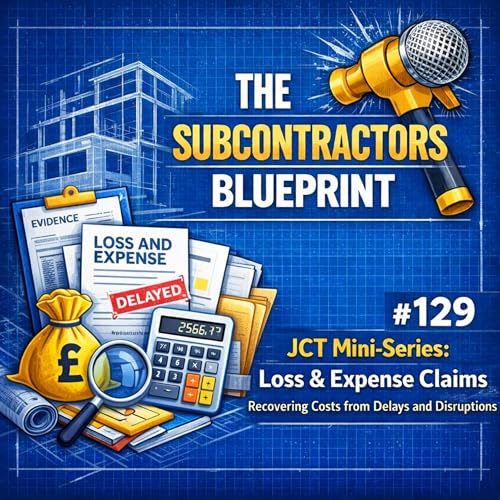
  • JCT Mini Series- Stop Funding Jobs for Free: Mastering Loss and Expense Claims
    Feb 10 2026

    In episode 129 of The Subcontractors Blueprint podcast, host Jacob Austin continues his JCT Subcontract mini-series guiding you through the essentials of loss and expense claims under 2024 JCT subcontracts. He explains when and how subcontractors can recover costs from delays and disruptions, outlines a practical five-step claims process, and highlights common pitfalls to avoid. Jacob emphasises the importance of early notice, thorough documentation, and structured claims to protect margins and cash flow. The episode includes a real-world case study and actionable advice, empowering subcontractors to manage contracts more effectively and safeguard their profitability.

    KEY TAKEAWAYS:

    • The episode explains how subcontractors can effectively claim loss and expense under JCT subcontracts to recover costs from delays and disruptions.
    • It highlights the difference between time-related (extension of time) and cost-related (loss and expense) claims, and the importance of understanding "relevant matters."
    • Jacob outlines common pitfalls in loss and expense claims, such as lack of evidence, late notifications, and double counting costs.
    • The episode provides a practical, step-by-step approach to structuring and evidencing a strong loss and expense claim.
    • Listeners are advised to issue early notices, keep detailed records, and avoid leaving claims until the project's end.
    • The importance of clear communication, proper documentation, and commercial awareness is emphasised to protect subcontractor margins.

    BEST MOMENTS:

    "If you don't claim loss and expense properly, then you're funding the job for free."

    "The difference between being right and being paid is almost certainly evidence and structure to what you're doing."

    "A proper loss and expense claim needs to be built out like a case showing cause, effect, and the resultant cost."

    "Loss and expense needs to be claimed on the basis of actual costs incurred—that means showing the contractor invoices, timesheets, payroll records if necessary."

    "Acceleration costs money… If the contractor isn’t willing to do that, then that tells you they want the benefit of the acceleration without putting their hand in their pocket."

    "The worst thing you can do with loss and expense is to leave it all to the end and submit it as a parting shot just before you submit your final account."

    HOST BIO: Meet Jacob Austin, a Chartered Quantity Surveyor with a rich background at construction industry giants Balfour Beatty, Kier, and Vistry Group. With extensive involvement in education, health, and residential projects spanning various scales, from £1000s to over £100M in concurrent developments, Jacob brings a unique perspective. Having collaborated with numerous small businesses, he's now committed to sharing his expertise to drive their success. Join Jacob on his podcast, where he blends his profound insights and personable approach to offer guidance, industry secrets, and inspirational stories.

    LinkedIn - www.linkedin.com/in/jacob-austin/

    Instagram - www.instagram.com/qs.zone/

    www.qs.zone/all-links

    Más Menos
    23 m
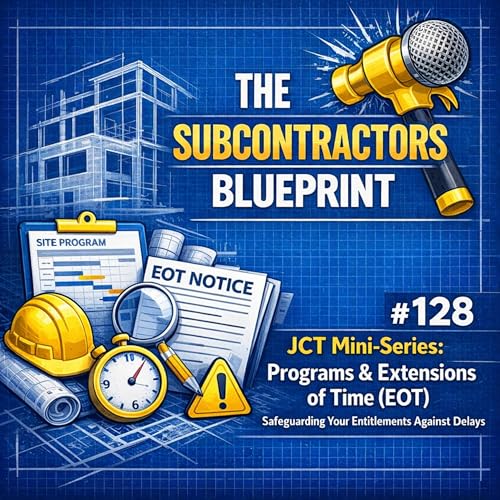
  • JCT Mini Series: Don’t Let Delays Derail Your Profits: Mastering Extensions of Time (EOT) and Claims
    Feb 3 2026

    In episode 128 of The Subcontractors Blueprint podcast, host Jacob Austin continues his JCT Subcontract mini-series offering practical guidance on managing JCT subcontracts, focusing on programs and extensions of time (EOT). He explains how EOT provisions protect subcontractors from unfair delay risks, highlights the importance of timely notices and thorough documentation, and distinguishes between time extensions and loss and expense claims. Jacob shares actionable tips for handling delays, acceleration, and disruption costs, empowering subcontractors to safeguard their profit margins and ensure fair compensation under JCT terms. The episode aims to help subcontractors protect their commercial interests and avoid common contractual pitfalls.

    KEY TAKEAWAYS:

    • The episode explores the importance of program clauses and extensions of time (EOT) in JCT subcontracts, highlighting how they protect subcontractors' margins and manage delay risks.
    • Jacob explains that delays must be formally notified and evidenced; otherwise, subcontractors risk being unfairly blamed and incurring costs for delays outside their control.
    • Time (EOT) and money (loss and expense) are separate contractual tracks—securing more time doesn’t automatically entitle you to compensation for disruption.
    • Common pitfalls include vague or late notices, relying on flawed recovery programs, and failing to keep clear records of delays and their impacts.
    • Jacob emphasises the need for consistent administration: keeping simple logs, issuing timely notices, and substantiating claims with clear evidence.
    • The episode concludes that good record-keeping and proactive communication are key to safeguarding both time and cost entitlements under JCT subcontracts.

    BEST MOMENTS:

    "Contracts don't run on what people can see. They run on black and white—what's been notified, evidenced and complied with."

    "You can be busy on site, work till you're blue in the face and still lose the job commercially."

    "The extension of time protects the program and your margin, and prevents main contractors from pushing delay risk down to you quietly when you don't expect it."

    "If your paperwork doesn't answer those two questions and do it clearly, then the contractor can keep arguing about entitlement forever and delay the only thing that you really want, which is commercial closure."

    "Acceleration costs money… If the contractor isn’t willing to do that, then that tells you they want the benefit of the acceleration without putting their hand in their pocket."

    "These kind of documents—they’re not just paperwork. These are records. These are leverage."

    HOST BIO: Meet Jacob Austin, a Chartered Quantity Surveyor with a rich background at construction industry giants Balfour Beatty, Kier, and Vistry Group. With extensive involvement in education, health, and residential projects spanning various scales, from £1000s to over £100M in concurrent developments, Jacob brings a unique perspective. Having collaborated with numerous small businesses, he's now committed to sharing his expertise to drive their success. Join Jacob on his podcast, where he blends his profound insights and personable approach to offer guidance, industry secrets, and inspirational stories.

    LinkedIn - www.linkedin.com/in/jacob-austin/

    Instagram - www.instagram.com/qs.zone/

    www.qs.zone/all-links

    Más Menos
    23 m