Episodios

  • Episode 151 – The Streetlamp Trap – The Harder Question
    Apr 13 2026

    Send us Fan Mail

    Is there a lesson we can learn from the demise of Encyclopaedia Britannica on how organisations should deal with AI?

    Since its first publication in 1768, until the early 1990s, Britannica ruled the encyclopaedia market. A 32-volume set, sold door-to-door by a salesforce of over 100,000 people at $1,500 to $2,200 a set. Each salesperson earned $500 to $600 in commission per sale.

    Then Microsoft released Encarta in 1993, a CD-ROM encyclopaedia priced at $99, later bundled free with computers. By any editorial measure, Britannica was the better product by far.

    But their response was a masterclass on the mistake we can make when we bolt-on new technology onto an old business model.

    When they finally produced their own CD-ROM, they priced it at $995, ten times Encarta. Why? Because a $99 product could not generate the $500 commission a door-to-door salesperson needed to survive. So Britannica protected the salesforce and made the product uncompetitive.

    The technology existed. The content was superior. But the organisation was not redesigned around the new technology. The salesforce, a human infrastructure built for a different era, was left intact. And it strangled the new product before it could breathe.

    By 1994, print sales had halved. By 1995, the company was up for sale.
    The technology did not fail Britannica. It was the management decision to protect an existing structure rather than redesign around what the new technology demanded. There is surely a lesson here on the successful adoption of AI. Listen on.


    For more #storiesatwork do have a look the playlists of stories on our website - https://bit.ly/SW_Stories
    Your friends and family can join our WhatsApp group to get copies of our videos. https://bit.ly/SW_WA_11

    Our website has a video version of this story. https://storyworks.in/storybanks/

    Follow me on LinkedIn -->linkedin.com/in/i-am-ic

    Más Menos
    7 m
  • Episode 150 – Consequence Gets Compliance – The Yo-Yo Test
    Apr 6 2026

    Send us Fan Mail

    I was talking to Joy Bhattacharjya yesterday about today's story, and it triggered one from his own memory bank.
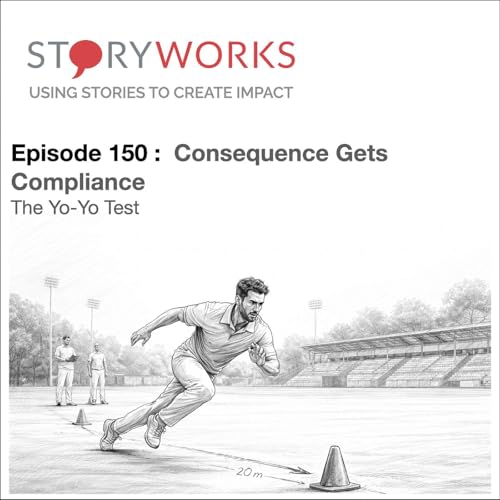
    This was around 2008, when Joy was the Team Director of the Kolkata Knight Riders. A recurring problem had emerged: some of the senior cricketers weren't making it to the team bus on time, the one that took players from the hotel to the ground for practice. Someone suggested a monetary fine. But that was never going to work with seniors earning in crores during the IPL. So coach John Buchanan devised a system that had an immediate impact.

    If a senior player was late, the rest of the team, on reaching the ground, would have to run 5 laps or do 20 push-ups. The defaulter couldn't join in the punishment. He had to stand and watch. Oh, and he also had to be the one to choose, laps or push-ups.

    You can imagine what happened next. Once you've made your entire team suffer for your tardiness, you don't do it again. No one was late for the bus after that.

    This story is about creativity, yes, but it's really about something deeper: without consequence, you can't get compliance.

    Today's story explores this same lesson and continues our theme of Indian Cricket.


    For more #storiesatwork do have a look the playlists of stories on our website - https://bit.ly/SW_Stories
    Your friends and family can join our WhatsApp group to get copies of our videos. https://bit.ly/SW_WA_11

    Our website has a video version of this story. https://storyworks.in/storybanks/

    Follow me on LinkedIn -->linkedin.com/in/i-am-ic

    Más Menos
    6 m
  • Episode 149 – The Doctor Who Prescribed Parakeets – Purpose Changes Behaviour
    Mar 30 2026

    Send us Fan Mail

    During my years in the corporate world, a question that had often been on my mind was what makes people want to bring more of themselves to work?

    Disengagement at work does not always look dramatic.

    People do not always rebel. They do not argue. They do not resign in protest. More often, they simply retreat into the minimum. They do what is required, avoid what is optional, and leave the rest of themselves outside the workplace.

    Many leaders respond to this with tighter reviews, sharper targets, better dashboards, and more frequent check-ins. All of which may have a role, but they alone don’t solve the problem.

    What does?

    Purpose. But not the kind that fits on a strategy slide.
    The kind that makes someone feel that showing up today matters — to something larger than a quarterly number, and larger than themselves.

    I came across a story recently, set in a nursing home of all places, that is the most vivid illustration of this I’ve ever found. A leader walked into a broken system, tried the conventional fix, watched it fail, and then did something so unconventional that management asked him if he’d lost his mind.
    What followed was one of the more remarkable turnarounds I’ve encountered in years of collecting leadership stories.

    If you lead a team, at any level, I think you’ll find it worth 6:32 minutes of your time.

    For more #storiesatwork do have a look the playlists of stories on our website - https://bit.ly/SW_Stories
    Your friends and family can join our WhatsApp group to get copies of our videos. https://bit.ly/SW_WA_11

    Our website has a video version of this story. https://storyworks.in/storybanks/

    Follow me on LinkedIn -->linkedin.com/in/i-am-ic

    Más Menos
    6 m
  • Episode 148 – The Meter in the Basement – What Gets Measured Gets Managed
    Mar 23 2026

    Send us Fan Mail

    “What gets measured gets managed”, has been one of my steadfast beliefs in both my personal and professional life.

    Good intentions and goals are not enough on their own. They have to be measured regularly to see if we are indeed on track to deliver.

    Today’s story is a beautiful illustration of what happens when we not only measure, but make the measure visible on a regular basis.

    One caveat though, we must make sure that we are measuring the right thing.

    Let me know what you think.


    For more #storiesatwork do have a look the playlists of stories on our website - https://bit.ly/SW_Stories
    Your friends and family can join our WhatsApp group to get copies of our videos. https://bit.ly/SW_WA_11


    Our website has a video version of this story. https://storyworks.in/storybanks/

    Follow me on LinkedIn -->linkedin.com/in/i-am-ic

    Más Menos
    6 m
  • Episode 147 – Zoom In. Zoom Out. – When Details Aren’t Enough
    Mar 16 2026

    Send us Fan Mail

    When people ask me about my success mantras, my answer is simple: luck, discipline, hard work and attention to detail. Attention to detail is a strength I have always been proud of.

    But early in my career, a boss gave me a piece of advice that stayed with me. During an annual feedback session he said, “I really admire your attention to detail. But I want you to develop another skill.”
    He called it “hand in the mud and head in the clouds.” The image instantly made me smile.

    But over the years I have realised how important and how elusive that skill really is.
    Because leadership often demands two very different abilities at the same time: to dive deep into the details and to step back and see the bigger picture.

    Today’s story is a powerful reminder of why we need both.

    For more #storiesatwork do have a look the playlists of stories on our website - https://bit.ly/SW_Stories
    Your friends and family can join our WhatsApp group to get copies of our videos. https://bit.ly/SW_WA_11

    Our website has a video version of this story. https://storyworks.in/storybanks/

    Follow me on LinkedIn -->linkedin.com/in/i-am-ic

    Más Menos
    6 m
  • Episode 146 - Six Feet of Land – The Wisdom of Knowing When to Stop
    Mar 9 2026

    Send us Fan Mail

    Sometimes hidden behind the cloak of ambition is something we rarely name, and that is greed. A goalpost that keeps shifting. Because if we can achieve more, then why not?

    That's when the team stops celebrating wins and starts dreading anything less than the last record they broke. And somewhere in that cycle of achievement, a quiet question stops getting asked:
    Is this still worth it?

    Not "can we do it?" because that's never been the problem. The problem is forgetting to ask whether you should.
    The best leaders understand something counterintuitive: enough is a strategy. Knowing when to stop pushing, not from weakness but from wisdom, is what separates sustainable excellence from burnout dressed up as ambition.

    Today's story can teach us that lesson.

    For more #storiesatwork do have a look the playlists of stories on our website - https://bit.ly/SW_Stories
    Your friends and family can join our WhatsApp group to get copies of our videos. https://bit.ly/SW_WA_11

    Our website has a video version of this story. https://storyworks.in/storybanks/

    Follow me on LinkedIn -->linkedin.com/in/i-am-ic

    Más Menos
    6 m
  • Episode 145 – The Dunning-Kruger Effect – Unskilled, and unaware of it
    Mar 2 2026

    Send us Fan Mail

    What if you're too incompetent to realise your incompetence? We explore this in today's story.

    We now live in a world where crafting a question takes much longer than getting an answer.

    You type a prompt and get a polished answer. If it all ended there then all would be good. But it doesn't. You often walk away feeling like you have learnt something, you are now more knowledgable.

    But have you really? Or are we borrowing someone else's fluency and calling it your own.

    I often ask myself, when using Al to generate an answer, whether I am falling into the Dunning-Kruger trap.

    In today's story | talk about the Dunning-Kruger effect - a cognitive bias where people who are very bad at something are often too bad at it to realise they are bad at it.

    To know that you're making mistakes, you need enough knowledge to recognise what a mistake looks like.

    The everyday version of this is that friend who took one economics class and now has strong opinions about monetary policy, while your friend with an actual holds a PhD in economics says "it's complicated" to everything.

    The issue isn't Al itself, it's how we engage with it. Learning to recognise the distance between feeling knowledgeable and actually being knowledgeable, maybe one of the most valuable skills we can develop, especially in this age of Al.

    For more #storiesatwork do have a look the playlists of stories on our website - https://bit.ly/SW_Stories

    Your friends and family can join our WhatsApp group to get copies of our videos. https://bit.ly/SW_WA_11

    Our website has a video version of this story. https://storyworks.in/storybanks/

    Follow me on LinkedIn -->linkedin.com/in/i-am-ic

    Más Menos
    7 m
  • Episode 144 – Upstream
    Mar 2 2026

    Send us Fan Mail

    Have you been in a situation where after tirelessly trying to address a crisis you realised that you were addressing the symptoms rather than the problem itself?

    In today’s episode I will move away from my usual approach of sharing a real story to sharing a parable that has a significant lesson for both business and life. I first read this story in the book ‘Upstream’ by Dan Heath. Dan Heath along with his brother Chip wrote my all-time favourite book on communication - ‘Made to Stick.’

    Listen here…


    For more #storiesatwork do subscribe to our YouTube channel which has two playlists -
    #StoryBank https://bit.ly/WStoryB and
    #LeaderSpeak https://bit.ly/WLeaderS
    You can also join our WhatsApp group to get copies of our videos. https://bit.ly/SW_WA_11

    Our website has a video version of this story. https://storyworks.in/storybanks/

    Follow me on LinkedIn -->linkedin.com/in/i-am-ic

    Más Menos
    3 m