Episodios

  • Episode 14: Babies, Books, and Brilliance with Salley King Edwards
    Mar 24 2026

    🎧 Episode Summary

    In this episode of the Reading Symphony Podcast, I sit down with early childhood educator Salley King Edwards, whose 25+ year career spans classrooms, coaching, and national literacy work through Cox Campus.

    We explore how language, knowledge, and everyday interactions lay the foundation for reading long before formal instruction begins.

    Salley shares her personal journey as both an educator and a parent navigating reading challenges, including the early signs she noticed, what she missed, and what she wishes more families understood.

    This conversation is both deeply practical and incredibly reassuring: reading development doesn’t start in kindergarten—it starts from birth. And there is so much families can do, in simple and meaningful ways, to support it.

    🔗 Resources Mentioned

    • Cox Campus (free courses for families and educators)
    • Brilliance of Babies (Salley’s book series and resources)
    • "How Knowledge Helps" (Willingham)
    Más Menos
    24 m
  • Episode 13: Books, Bonds, and Beyond with Kindred Obas
    Mar 18 2026

    In this special live episode of The Reading Symphony Podcast, Katie sits down with colleague and friend Kindred Obas for a conversation about joyful reading culture, complex texts, identity, and the kinds of classroom experiences that help children see themselves as readers.

    Together, Katie and Kindred discuss:

    • how to build a classroom culture where reading feels joyful, social, and meaningful
    • why classroom libraries should include both mirrors and windows
    • what Kindred learned from watching students move from books like Dog Man to much more complex texts over time
    • how her sixth grade Jane Austen book club is helping students grow as readers, thinkers, and community members
    • why exposure to complex text, paired with support and belonging, can strengthen comprehension and confidence
    • how families can talk with children about harder histories with honesty, empathy, and care
    • why it matters to offer books about children of color that are not only rooted in struggle, but also in joy, curiosity, and possibility
    • Kindred’s next chapter at Stanford, where she will study curriculum, teaching, race, language, and healing-centered approaches to teaching hard history

    This episode is a beautiful reminder that reading growth is not just about skill. It is also about identity, access, belonging, and the communities we build around books.


    Katie Megrian | 10:15 AM (0 minutes ago) | |
    to me

    Fundraiser by Kindred Obas : Fund Our Journey to Jane Austen's England https://www.gofundme.com/f/fund-our-journey-to-jane-austens-england https://www.gofundme.com/f/fund-our-journey-to-jane-austens-england?attribution_id=sl:e9fcfcf6-52f6-4666-8406-5c5cc968e35a&lang=en_US&ts=1773612248&utm_campaign=man_sharesheet_dash&utm_content=amp17_tb-amp20_t2&utm_medium=customer&utm_source=copy_link

    Books and Texts Kindred Discusses

    • Kindred by Octavia Butler
    • Emma by Jane Austen
    • A Wind in the Door by Madeleine L’Engle
    • A Wrinkle in Time by Madeleine L’Engle
    • Persuasion by Jane Austen
    • Northanger Abbey by Jane Austen
    • One Crazy Summer by Rita Williams-Garcia
    • Ada Twist, Scientist by Andrea Beaty
    • The Youngest Marcher by Cynthia Levinson and Vanessa Brantley-Newton
    • Love Is by Diane Adams
    • The Great Cake Mystery by Alexander McCall Smith
    • The Breakfast Club Adventures series by Marcus Rashford
    • The Joy Luck Club by Amy Tan
    • Millicent Min, Girl Genius by Lisa Yee
    • Stanford Wong Flunks Big-Time by Lisa Yee
    Más Menos
    28 m
  • Episode 12: Balancing Trust and Urgency in Early Reading with John Bennetts
    Mar 7 2026
    Episode Show Notes

    In this episode of The Reading Symphony Podcast, Katie sits down with national literacy consultant John Bennetts to discuss what reading development actually looks like in real classrooms and real families.

    John shares how an unexpected start in education led him to work alongside renowned literacy expert Linda Farrell early in his career, shaping his approach to evidence-based reading instruction.

    Together, Katie and John explore a question many parents quietly carry:
    How do we know if a child is progressing normally in reading?

    Their conversation unpacks the difference between healthy developmental variation and signs that a child may need additional support. They also discuss how screening data should be used by schools, how parents can ask better follow-up questions, and why strong literacy systems depend on coherence across instruction and intervention.

    The episode also highlights the powerful early literacy work of Reach Out and Read, a national program that partners with pediatricians to help families build read-aloud routines from birth.

    Whether you're a parent trying to understand reading benchmarks or an educator working to build stronger systems, this conversation offers clarity, compassion, and practical guidance.

    Resources Mentioned
    • Reach Out and Read
    • Research on phases of reading development (Linnea Ehri)
    • Stephanie Stollar’s work on MTSS
    Más Menos
    31 m
  • Episode 11: Decodables, Advocacy, and Supporting Teachers with Elise Lovejoy
    Mar 4 2026

    Episode Summary

    In this episode, Katie sits down with literacy advocate and author Elise Lovejoy, creator of Express Readers and founder of The Teacher’s Table. Elise shares her journey into the science of reading, explains the critical difference between leveled readers and decodable books, and offers practical guidance for parents supporting early readers at home. She also discusses the importance of research-aligned instruction in schools and how The Teacher’s Table is helping teachers access credible, evidence-based resources.

    In This Episode, We Discuss:

    • How Elise began writing decodable books to make early reading both effective and joyful
    • The difference between leveled readers and decodable texts — and why it matters
    • Why guessing words from pictures can undermine long-term reading development
    • What makes a strong decodable book
    • A simple, low-stress routine parents can use when decodables come home
    • The importance of repeated practice and building automaticity
    • How parents can advocate for science-aligned reading instruction
    • Signs that a school is moving toward (or away from) evidence-based literacy practices
    • Why ongoing teacher professional learning is essential
    • The mission behind The Teacher’s Table and how it supports teachers with research-backed resources

    Key Takeaways for Parents

    • Decodable books align directly with the phonics skills children have been taught.
    • It’s okay to help with tricky words — reading practice should feel supportive, not stressful.
    • Re-reading builds fluency and confidence.
    • Asking thoughtful questions is one of the most powerful advocacy tools parents have.
    • Supporting teachers ultimately supports all children.

    Resources Mentioned

    • Express Readers – Decodable book series
      👉 expressreaders.org
    • The Teacher’s Table – Research-aligned literacy membership for educators
      👉 theteacherstable.org
    • To set up a gift subscription to The Teacher’s Table, email contact@theteacherstable.org!


    Más Menos
    26 m
  • Episode 10: Insights on Literacy and Policy with Chad Aldeman
    Feb 24 2026

    Katie Megrian speaks with education policy expert Chad Aldeman, founder of Aldeman Education LLC and creator of ReadNotGuess.com, about early reading development, intervention, and broader K–12 trends.

    Chad shares that his son’s kindergarten experience during COVID revealed that his son had not been taught to decode and was guessing words. That realization led him to create Read Not Guess, a free, sequential, parent-facing resource with Levels 1–3, a “daily-ish decodable” program, and an optional app to support sound practice at home.

    They discuss declines in national achievement that began around 2013–2015, with the largest drops among lower-performing students. Chad explores possible contributors, including shifts in accountability policy, increased screen time, declining independent reading, and reduced emphasis on foundational skills. The conversation also highlights systems such as Mississippi, Louisiana, DoDEA schools, and England that have emphasized phonics and knowledge-rich instruction.

    Chad explains why rising per-pupil spending has not translated into comparable teacher salary growth, citing increased benefit costs and staffing shifts, and discusses alternative staffing and compensation models.

    The episode closes with guidance for families: look for high standards paired with high support, seek objective indicators of progress, and do not wait to intervene when a child is struggling.

    Resources:
    ReadNotGuess.com
    chadaldeman.com

    https://www.chadaldeman.com/p/do-not-wait

    https://www.the74million.org/article/these-schools-are-beating-the-odds-in-teaching-kids-to-read/

    Más Menos
    32 m
  • Episode 9: Escape Velocity: Helping Kids Crack the Reading Code Faster with Dr. Marnie Ginsberg
    Feb 20 2026

    Episode Summary

    In this episode, Katie talks with Dr. Marnie Ginsberg about what helps kids learn to read and why so many teachers were never given the tools to fix word-reading problems. Dr. Ginsberg shares the story that launched her career: sixth-grade students reading years below grade level and a breakthrough approach that helped them make dramatic gains in a single spring.

    Together they unpack the research-to-practice gap (and why effective interventions still “sit on a shelf”), and then get very practical: Marnie explains how Reading Simplified teaches phonics without over-relying on rules, using the brain’s pattern detection (statistical learning) plus carefully designed contrast (sit/sat, mat/map/mop) to accelerate decoding.

    You’ll also hear a clear explanation of phonemic awareness vs. phonics, why separating them often creates inefficiency, and how Marnie integrates them through simple routines like Build It and Switch It—activities that feel like games but powerfully build the alphabetic principle.

    Finally, Marnie and Katie talk state curriculum lists, why implementation details matter, and what parents can advocate for during literacy reform—plus Marnie’s direct call to limit screens and protect attention.

    Key Takeaways

    • Many struggling readers don’t need “more exposure”—they need explicit instruction that helps them attend to the inside parts of words.
    • The research-to-practice gap isn’t only about evidence. It’s also about incentives, funding streams, and the skillset of dissemination.
    • “Good phonics” doesn’t have to mean a heavy diet of rules. Pattern-based learning can be explicit and still leverage kids’ natural ability to detect patterns.
    • Keeping kids in “short-vowel land” too long can starve them of the data they need to reach reading “escape velocity.”
    • Integrating phonemic awareness and phonics—rather than teaching them in separate lanes—can unlock the alphabetic principle faster.
    • Parents should push for early identification and support (including dyslexia screening and services) and for true expertise in curriculum decision-making.
    • Reading grows in a home environment that protects attention: limit screens, read aloud longer than you think, and listen to kids read longer than you think.

    Topics We Cover

    • Marnie’s path from sixth-grade teacher → tutor → researcher → founder of Reading Simplified
    • Why whole language/balanced literacy didn’t solve decoding struggles
    • What TRI is and how it connects to Reading Simplified
    • The “17-year research-to-practice gap” and why it persists
    • Linguistic phonics / speech-to-print and organizing the code by sound
    • Statistical learning, contrast, and “set for variability” (without turning into guessing)
    • Why context is part of reading—but print must be primary for beginners
    • Phonemic awareness vs phonics: what they are, why both matter

    Try This at Home / In the Classroom

    Switch It (5 minutes, feels like a game):
    Use letter tiles/cards to build a simple word (mop). Then “switch” one sound at a time to make a new word (mop → map → sap → sip). The magic is in the contrast and the attention to each sound position.

    Free resources and demo videos: readingsimplified.com/switch-it

    Connect with Dr. Marnie Ginsberg

    Website: ReadingSimplified.com
    Free Switch It resources: ReadingSimplified.com/switch-it
    Instagram: @readingsimplified

    Connect with Katie / The Reading Symphony

    Substack: katiemegrian.substack.com
    Instagram: @thereadingsymphony

    Más Menos
    49 m
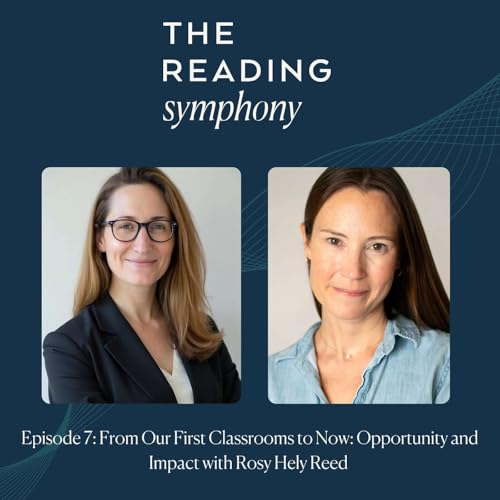
  • Episode 7: From Our First Classrooms to Now: Opportunity and Impact with Rosy Hely Reed
    Feb 11 2026

    Rosy Hely Reed. Rosy is a Director, Academics at TNTP - a non-profit organization that brings research, policy, and consulting together to reimagine America's K-12 public education system. She has been at TNTP since 2016, and currently leads the execution of academic reviews in schools and districts across the country, providing data and insights on students' and teachers' access to the resources that matter most. Prior to TNTP, Rosy was a literacy teacher and instructional coach in New York City and Washington, D.C., public schools, and then oversaw district-wide teacher-leader and instructional-coaching programs for Pittsburgh Public Schools. She loves driving change-making work within (usually messy) school systems at all levels.

    About This Episode

    In this conversation, Katie sits down with one of her closest friends and longtime education thought partner, Rosy Reed, a Director of Academics at TNTP. We trace our shared beginnings as brand-new teachers in the South Bronx and explore how those early classroom experiences shaped our understanding of curriculum, instruction, and equity.

    Rosie shares what she has learned through her work at TNTP about the conditions that most powerfully drive student achievement, drawing on insights from The Opportunity Myth and the Opportunity Makers research. We also talk candidly about dyslexia, advocacy, and how parents can partner with schools to build coherent, research-aligned reading instruction.

    This episode is both a deep dive into literacy and a personal conversation about teaching, friendship, and the long arc of learning.

    In This Episode We Discuss

    TNTP’s research: What actually drives student achievement

    Rosy explains the findings from TNTP’s landmark research, based on 4,000+ students across diverse schools and districts.

    Four key resources that dramatically impact achievement:

    1. Grade-appropriate assignments
    2. Strong instruction
    3. Deep student engagement
    4. High teacher expectations

    We also discuss:

    Three core practices of “trajectory-changing” schools:

    • A strong culture of belonging
    • Consistent access to grade-level instruction
    • A coherent instructional program

    We explore:

    • Alignment across grades, classrooms, and interventions
    • The importance of knowledge-building curriculum
    • Why teacher planning time and professional learning matter
    • How schools can better align instruction between general education and intervention
    Más Menos
    40 m
  • Episode 8: Insights on IEPs and Student Success with Gaby Diller
    Feb 9 2026

    In this episode of the Reading Symphony Podcast, host Katie Megrian engages in a comprehensive conversation with Gaby Diller, founder of Lotus Advocacy. Launched in 2020, Lotus Advocacy aims to support special education departments, families, and students by centering families as essential members of the special education team. Gaby shares insights on her personal journey with learning challenges and her extensive experience as a special education teacher and administrator. She offers practical advice on creating effective IEPs, the importance of specific and strength-based goals, the necessity of multi-tiered systems of support (MTSS), and the benefits and limitations of private evaluations. Gaby also emphasizes the role of collaboration and transparency in advocating for students' needs. This episode provides valuable insights for families, educators, and advocates striving to support children with special needs in their reading and overall educational journey.

    00:00 Introduction to the Reading Symphony Podcast

    00:27 Meet Gaby Diller: Founder of Lotus Advocacy

    01:23 Gaby's Personal Journey and Professional Path

    04:21 Understanding and Supporting Students with IEPs

    07:53 Navigating Evaluations and School Responsibilities

    12:57 Effective IEP Goals and Interventions

    18:01 Creative Collaboration and Advocacy Strategies

    22:41 Closing Thoughts and Resources


    Where to find Gaby?

    https://www.lotusadvocacy.com/
    https://www.instagram.com/lotusadvocacy/

    https://www.linkedin.com/in/gabriela-diller-8b056230/

    Más Menos
    24 m