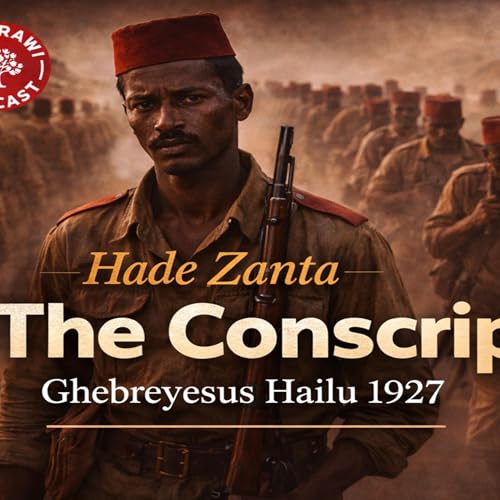
The Other Side of Eritrea Podcast Por Eritrawi arte de portada

The Other Side of Eritrea

The Other Side of Eritrea

De: Eritrawi
Escúchala gratis

History built from archives, not myths. This channel explores Eritrea and the Northern Horn of Africa through research, primary sources, and forgotten records from early printed texts to private letters and overlooked moments in global history. Beyond propaganda. Beyond stereotypes. Reconstructing the past through what people actually wrote, built, and lived.Eritrawi Política y Gobierno
Episodios
  • Hade Zanta – The Conscript: Rewriting the Foundations of African Literature
    Apr 12 2026

    This episode of the Eritrawi Podcast begins a three part series on one of the earliest and most overlooked works of African literature, Hade Zanta The Conscript, written in 1927 by Ghebreyesus Hailu in Tigrinya and later translated into English.

    Predating and challenging the commonly accepted timeline of African literature, this novel was long overlooked by Western academia. It follows an Eritrean ascari forced to fight for the Italian colonial army in Libya, not just as a victim of empire, but as someone made to function within it.

    This episode examines how Hailu exposes the deeper logic of colonialism, a system that does not only dominate from the outside, but reshapes the inner world of the oppressed, turning survival into complicity.

    Blending modernist prose with traditional oral poetry, The Conscript breaks away from linear Western storytelling, creating a recursive, layered narrative rooted in African verbal traditions. The result is not just a story, but a structural critique, a novel that rewires the form itself to reveal the mechanics of power.

    This is not simply forgotten literature.
    This is early African intellectual resistance.

    #Eritrea #AfricanLiterature #TheConscript #HadeZanta #DecolonizeKnowledge #History #Podcast #EritrawiPodcast #Colonialism #AfricanHistory

    Más Menos
    20 m
  • Amelia Earhart’s Red Sea Transit: Massawa to Assab (1937 World Flight)
    Apr 5 2026

    In 1937, Amelia Earhart attempted one of the most ambitious journeys in aviation history, a flight around the world along the equator.This episode of Eritrawi Podcast follows a rarely discussed segment of that journey: her transit along the Red Sea coast, from Massawa to Assab in Eritrea. Drawing on archival records from Purdue University, historical flight itineraries, and press bulletins, we reconstruct the route, the conditions, and the technical realities faced by Earhart and her navigator Fred Noonan.Beyond the headlines, this is a story of navigation under pressure, fuel management across remote regions, and the global network of colonial-era airfields that made such a journey possible. This is not just the story of a disappearance.It’s the story of the journey that led there.#AmeliaEarhart #AviationHistory #Eritrea #RedSea #WW2History #History #AfricaHistory #FlightHistory

    Más Menos
    20 m
  • Recovering Eritrea’s Lost Printed Past
    Mar 29 2026

    This episode on Eritrawi Podcast explores the evolution of literacy and print culture in Eritrea through the lens of early printed materials, private letters, and recent preservation efforts.


    Drawing on the work of historian Dr. Massimo Zaccaria and the Research and Documentation Center in Asmara, we examine a major digitization project that documented over 750 local titles printed between 1867 and 1941. Using a self-reliant, low-tech approach, this initiative demonstrates how cultural heritage can be preserved without dependence on external funding.


    The episode also traces a critical shift in written culture during the early 20th century. Military service in Libya exposed Eritrean askaris to new forms of communication, accelerating the use of private letters and photography. For the first time, individuals from subordinate social groups began documenting personal experiences in their own voices.


    These letters and printed materials mark a transition away from purely religious and administrative texts toward a more personal, lived archive one that allows us to reconstruct everyday life, emotion, and social dynamics in colonial Eritrea.


    Together, these sources reveal how fragile documents, often produced on cheap materials and nearly lost to time, have become essential tools for understanding the social and cultural history of Eritrea

    Más Menos
    25 m
Todavía no hay opiniones