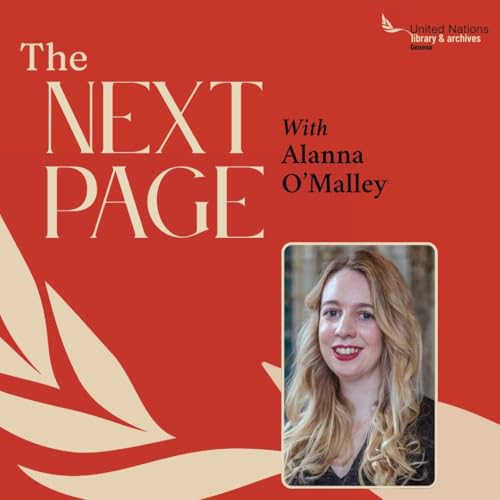
The Next Page Podcast Por United Nations Library & Archives Geneva arte de portada

The Next Page

The Next Page

De: United Nations Library & Archives Geneva
Escúchala gratis

Are you curious about the power of international cooperation? And how it affects our future? Then tune in to the #NextPagePod, the podcast designed to advance the conversation on multilateralism!Copyright 2019 All rights reserved. Ciencia Política Política y Gobierno
Episodios
  • Open Science: How Sharing Knowledge Can Save the Planet
    Jan 31 2026

    In this episode we speak with Jean-Claude Burgelman about what open science means, why it accelerates innovation, and why we need it now.

    Jean-Claude Burgelman discusses practical benefits for businesses and NGOs, barriers like paywalled publishing and academic incentives, and the urgent need to make publicly funded data usable.

    Jean-Claude argues for multilateral infrastructure—a global open science cloud—and a new social contract for science, drawing on insights from this year's Frontiers Science House at Davos.

    The episode closes with a call to rethink institutions and governance so open science can drive faster, fairer solutions to global challenges.

    Resources: Ask a Librarian!

    Frontiers Planet Prize: https://www.frontiersplanetprize.org/

    Where to listen to this episode

    • Apple podcasts: https://podcasts.apple.com/us/podcast/the-next-page/id1469021154
    • Spotify: https://open.spotify.com/show/10fp8ROoVdve0el88KyFLy
    • YouTube: https://youtu.be/

    Content

    Guest: Jean-Claude Burgelman

    Hosts: Amy Smith and Wouter Schallier

    Production and editing: UN Library & Archives Geneva

    Recorded & produced at the United Nations Library & Archives Geneva

    Más Menos
    40 m
  • AIxMultilateralism: Public AI - The New Multilateralism? with Jacob Taylor & Joshua Tan
    Jan 26 2026

    This is AI x Multilateralism, a mini-series on The Next Page, where experts help us unpack the many ideas at the nexus of AI and international cooperation. Today, the majority of AI development and deployment is controlled by a small number of powerful firms. If this path continues, the next generation of digital infrastructure underpinning our societies will be privately owned and unaccountable to the public interest. Is there another way, one where where AI serves the common good? In this episode, Jacob Taylor (Fellow at the Brookings Institution’s Center for Sustainable Development and a 2025 Public AI Fellow) and Joshua Tan (Co-Founder and Research Director at Metagov) make the case for Public AI: shared, open AI infrastructure (much like highways, electricity grids, and public broadcasting), that is publicly responsible and harnessed to solve collective problems. Drawing on their article Public AI is the New Multilateralism and Metagov's Public AI White Paper, they argue that building public AI infrastructure can become a new form of multilateralism, where states, academia and civil society co‑create accessible, accountable AI systems that can be shared and re-purposed to meet a range of local, regional and global needs. They share real‑world examples of Public AI already emerging, explain why middle powers have the strongest incentives to lead Public AI, and outline an “Airbus for AI” model to close capability gaps, reduce the world's dependency on a few private platforms, and solve cross‑border problems.

    Resources mentioned:

    • The Public AI Inference Utility - publicai.co
    • Public AI - https://publicai.network/

    Production:

    Guests: Jacob Taylor and Joshua Tan Host, production and editing: Natalie Alexander Julien Recorded & produced at the Commons, United Nations Library & Archives Geneva

    Podcast Music credits: Sequence: https://uppbeat.io/track/img/sequence Music from Uppbeat (free for Creators!): https://uppbeat.io/t/img/sequence License code: 6ZFT9GJWASPTQZL0 #AI #Multilateralism #PublicAI #AIInfrastructure

    Más Menos
    36 m
  • U Thant: Peacemaker
    Dec 19 2025

    Our final episode of the year invites listeners into the life and legacy of U Thant, the longest‑serving Secretary‑General of the United Nations and a quiet architect of peace during some of the most dangerous moments of the Cold War.

    Drawing on the perspective of historian Thant Myint‑U, his grandson, the conversation revisits U Thant’s role in crises such as the Cuban Missile Crisis and the Congo, showing how his calm, principled diplomacy helped steer the world away from catastrophe.

    Grounded in Buddhist ethics and a deep belief in multilateral cooperation, U Thant’s leadership connected decolonization, social justice, and environmental concern long before these agendas were widely recognized on the global stage. Through archival stories and family memories, the episode explores how his example can inform efforts today to organize peace and renew trust in international institutions, as we reimagine the UN’s potential in a fractured world.

    Resources: Ask a Librarian!

    Myint-U, T. (2025). Peacemaker: U Thant and the Forgotten Quest for a Just World. W. W. Norton & Company.

    https://www.thantmyintu.com/peacemaker

    Where to listen to this episode

    • Apple podcasts: https://podcasts.apple.com/us/podcast/the-next-page/id1469021154
    • Spotify: https://open.spotify.com/show/10fp8ROoVdve0el88KyFLy
    • YouTube: https://youtu.be/UJRXUC80BSc

    Content

    Guest: Dr. Thant Myint-U

    Host, production and editing: Amy Smith, UN Library & Archives Geneva

    Recorded & produced at the United Nations Library & Archives Geneva

    Más Menos
    35 m
Todavía no hay opiniones