

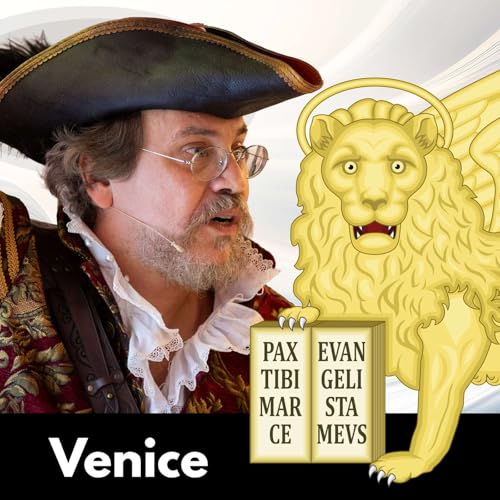
The Most Serene Republic of Venice
No se pudo agregar al carrito
Solo puedes tener X títulos en el carrito para realizar el pago.
Add to Cart failed.
Por favor prueba de nuevo más tarde
Error al Agregar a Lista de Deseos.
Por favor prueba de nuevo más tarde
Error al eliminar de la lista de deseos.
Por favor prueba de nuevo más tarde
Error al añadir a tu biblioteca
Por favor intenta de nuevo
Error al seguir el podcast
Intenta nuevamente
Error al dejar de seguir el podcast
Intenta nuevamente

The Most Serene Republic of Venice
-
Narrado por:
-
De:
Venice was not founded in a moment, but across centuries of collapse, migration, and improvisation. In this lecture, Dr. Roy traces how the fall of the Western Roman Empire, repeated invasions, and the strange geography of the Venetian Lagoon produced one of the most durable republics in human history. Dr. Roy explores how refugees, merchants, and sailors gradually built a civilization in an impossible place, asking what kind of state Venice would become, and why it ultimately chose commerce, adaptability, and republican governance over monarchy or conquest.
Takeaways
- Venice emerged gradually as waves of refugees fled invasions during the collapse of the Western Roman Empire.
- Geography shaped everything. The lagoon offered protection, isolation, and opportunity, but at enormous cost.
- Early Venetians were simultaneously merchants, nobles, and warriors, with no hard class boundaries between them.
- Repeated sacks of Roman capitals pushed populations into the lagoon as an act of resistance against Germanic rule.
- The survival of Roman authority in the lagoon made Venice the last western outpost of the Roman Empire.
- Political violence marked early leadership, with assassinations, exile, and blinding shaping the Dogeship.
- Venice constantly balanced three factions: pro-Roman, pro-Lombard, and independence movements.
- The decision to move the capital to the Rialto was a defining moment that centralized power and defense.
- Engineering the city itself was an unprecedented act of state-building, requiring massive labor and coordination.
- Venice’s long survival came from asking fundamental questions about identity, power, commerce, and governance.
Resources & References:
- Diocletian and the Tetrarchy
- The Visigoth Sack of Rome
- Attila the Hun
- The Ostrogothic Kingdom of Italy
- The First Doges of Venice
- The Pax Nicephori (803)
- Charlemagne and the Holy Roman Empire
- The Venetian Lagoon
Beyond the podcast:
- Want to watch this lecture? Check out the full video.
- Want to support the show? Buy Dr. Roy a coffee!
This lecture was originally recorded at the Museum of the Future for the series Lessons from the Past (2025).
Todavía no hay opiniones