Episodios

  • Why Risky Bets Are Rational in a Housing Crisis
    Feb 11 2026

    Your 20s: risky bets, crypto hype, and meme stocks. 🎲 Sabrina Maddeaux and Mike Moffatt explain why being priced out of a home is turning saving into gambling — and why young men are taking the biggest swings.

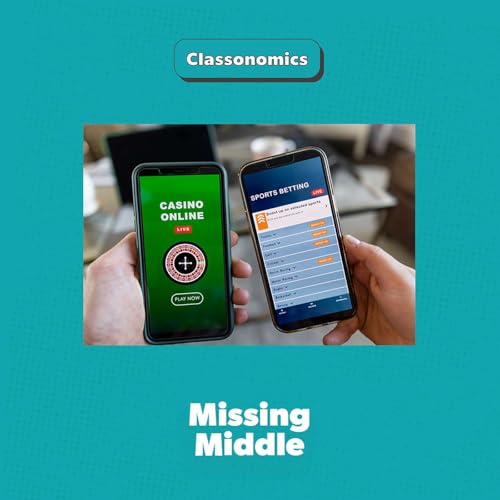
    In this episode of The Missing Middle – Classonomics, we unpack why a generation priced out of housing is turning to meme stocks, crypto, and online sports betting instead of traditional saving. Mike and Sabrina explore how the “gamification” of investing on your phone blurs the line between investing and gambling, why young men dominate high-risk trading, and what research tells us about the link between gambling, crypto, and financial stress.

    The conversation introduces the idea of “financial nihilism” — when homeownership feels impossible, big bets can start to seem rational. They also debate solutions, from tighter gambling advertising rules to better financial education and, most importantly, fixing housing affordability. Is this risky behavior a cultural problem, a policy failure, or both? Watch to find out — and tell us in the comments if you’ve ever placed a big bet with your money.


    Chapters:

    00:00 Introduction

    01:10 The high-risk landscape

    02:15 Personal experience with risk

    03:00 Demographics of gamblers and investors

    04:35 Gambling vs investing

    05:30 The Risks of sports gambling & prediction markets

    06:52 The difference between zero-sum and negative-sum behaviour

    08:53 The link between gambling & crypto trading

    11:01 How the culture of gambling is hurting young men

    12:22 How the housing crisis leads to financial nihilism

    14:22 How big risks start to become rational choices

    15:38 The role of social media

    16:24 YOLO spending and the gendered aspect of risky bets

    17:50 Mike drops a hockey metaphor

    19:23 Solutions: Regulation, education and home ownership


    Research:


    Canada Is Finally Regulating Stablecoins – Here’s Why It Matters

    Cryptocurrency trading, gambling and problem gambling

    "Giving Up": The Impact of Decreasing Housing Affordability on Consumption, Work Effort, and Investment

    Newsletter Sabrina mentions:

    1 big thing: Gen Z plays the economy like a casino

    Are We Ignoring a Generation of Struggling Young Men?

    All Bets Are On: The Rise of Prediction Markets

    The Doom Spenders

    polymarket.com Website Traffic Demographics

    Gambling Statistics Canada 2026 – Unveiling Canada’s Gambling Landscape


    Hosted by Mike Moffatt & Cara Stern & Sabrina Maddeaux

    Produced by Meredith Martin

    This podcast is funded by the Neptis Foundation and brought to you by the Smart Prosperity Institute.

    Más Menos
    23 m
  • AI is Killing Entry-Level Jobs: The 13% Drop Nobody is Talking About
    Feb 6 2026

    Yesterday, Bank of Canada governor Tiff Mackem warned that early evidence shows AI is reducing the number of entry-level jobs available.

    Are we heading toward a future of mass unemployment, or is AI just the latest "calculator" to change how we work? Cara Stern and Mike Moffatt dive deep into the data behind AI's impact on demographics and the workforce.

    While Mike leans into historical optimism, Cara brings the receipts: a recent Stanford study showing a 13% drop in employment for young workers in AI-exposed fields since the release of ChatGPT. We explore which jobs are "AI-proof," why Gen X seems to be winning (again), and what policy changes could help young people get a foot in the door.


    Chapters:

    00:00 Introduction

    00:29 Why Mike is unconcerned about AI taking his job

    01:30 Why Cara is worried about AI

    02:21 Young works AI exposed jobs see 13% drop

    03:52 Examining AI exposed occupations

    04:30 How AI impacts different cohorts of workers

    06:12 Understanding the impact of AI on wages

    06:54 Being well rounded is the best protection

    08:16 Trades, healthcare and education will continue to be in demand

    09:20 Mike shares a story from the olden times

    10:00 Mike’s take on going into the trades

    11:20 Mike on wages

    12:18 Focus on developing skills

    13:17 The role of policymakers and solutions


    Research/links:

    Canaries in the Coal Mine? Six Facts about the Recent Employment Effects of Artificial Intelligence

    Youth in Canada will need help gaining experience in the AI era

    No to being young again; The struggles of Canadian youth employment - CIBC Capital Markets

    Canada must pioneer AI adoption that creates job opportunities: Ryan Khurana in Canadian Affairs | Macdonald-Laurier Institute

    Canaries in the Coal Mine? Six Facts about the Recent Employment Effects of Artificial Intelligence

    Youth in Canada will need help gaining experience in the AI era

    No to being young again; The struggles of Canadian youth employment - CIBC Capital Markets

    Canada must pioneer AI adoption that creates job opportunities: Ryan Khurana in Canadian Affairs | Macdonald-Laurier Institute


    Hosted by Mike Moffatt & Cara Stern & Sabrina Maddeaux

    Produced by Meredith Martin

    This podcast is funded by the Neptis Foundation and brought to you by the Smart Prosperity Institute.

    Más Menos
    20 m
  • Why Condos Are Trapping a Whole Generation
    Feb 4 2026

    Canada’s housing ladder is broken. In this episode of Missing Middle, Sabrina Maddeaux and Mike Moffatt explain why the starter home no longer works and how an entire generation has been locked out of moving up.

    They compare buying a detached home in 2004 for $168,000 with today’s reality, where condos fail as a first step and buyers are trapped with no clear path forward. The conversation explores how this breakdown affects family formation, careers, ambition, and Canada’s economic future.=

    If homeownership feels impossible, this episode explains why and why it matters.

    Do you still believe the starter home works, or has the housing ladder completely collapsed where you live?


    Chapters:

    00:00 — What “Buying Your First Home” Used to Look Like

    00:40 — Mike’s First House: A Brand-New Detached Home… as a “Starter”

    01:47 — Why That Dream Is Gone for Today’s Buyers

    02:29 — What “Starter Home” Means Now vs. Then

    05:23 — “Aging Out” of the Starter Home

    07:03 — Trapped in a Condo

    09:58 — The “Second-Time Buyer Problem” Explained

    11:09 — Housing, Birth Rates, and Canada’s Demographic Crisis

    13:37 — Careers Limited by Real Estate, Not Talent

    18:45 — Why Politicians Are Getting This Wrong

    Research links:

    Teranet Market Insights Q1 2025

    National Bank Housing Affordability Monitor

    CMHC Housing Market Outlook 2025

    CMHC Housing Supply Report 2025

    Royal LePage House Price Survey and Market Forecast

    Statistics Canada - Homeownership and Mortgage Debt of Tax Filers

    CIBC Economics - Housing Affordability Reports


    Hosted by Mike Moffatt & Cara Stern & Sabrina Maddeaux

    Produced by Meredith Martin

    This podcast is funded by the Neptis Foundation and brought to you by the Smart Prosperity Institute.

    Más Menos
    25 m
  • Canada’s Demographic Time Bomb: What Boom, Bust & Echo Got Right
    Jan 30 2026

    Canada’s housing crisis. Youth unemployment. Immigration debates. A broken healthcare system.

    What if we told you a book published in 1996 predicted almost all of it?

    In this episode of The Missing Middle, Cara Stern and Mike Moffatt revisit the Canadian classic Boom, Bust & Echo to explore how demographics, especially the aging of the baby boomers, reshaped Canada’s economy, housing market, job prospects, and public policy.

    We break down:

    • Why youth unemployment was a policy choice

    • How demographics quietly drive housing prices

    • What governments got right — and very wrong

    • Why immigration policy, real estate, and healthcare are deeply connected

    • And how Canada ended up with a generational economic imbalance

    This isn’t just history. It explains why life is harder for young Canadians today and what choices led us here.

    If you care about housing affordability, jobs, immigration, public policy, and Canada’s economic future, this episode is for you.

    Chapters:

    00:00 Introduction

    00:49 Why Boom, Bust, and Echo (BBE) still matters

    03:00 What the book got right and wrong

    04:25 Prediction about the rise of home health care

    06: 06 Policy dilemma: high demand for PSWs & balancing budgets

    08:12 Immigration policy advice from Boom, Bust and Echo

    09:03 Governments didn’t take the advice

    10:55 BBE real estate prediction

    11:45 Housing market predictions: what went wrong

    15:10 Boomers, Millennials & real estate

    16:40 BBE prediction on future changes to taxation policy

    17:13 The politics of moving taxation from income to capital

    19:50 Real estate prediction for aging boomers

    20:34 Naturally occurring retirement communities

    23:40 Following where people actually live

    24:47 Demographics are facts that help us understand the future

    Research/links:


    Boom, Bust & Echo: How to Profit from the Coming Demographic Shift

    https://www.amazon.ca/Boom-bust-echo-profit-demographic/dp/0921912978


    David Foot on Aging Society & Youth

    https://www.youtube.com/watch?v=Gy7y2w9i_aA


    What David Foot didn't tell us

    https://www.theglobeandmail.com/life/what-david-foot-didnt-tell-us/article784233/


    Finding Naturally Occurring Retirement Communities - Agenda segment

    https://www.youtube.com/watch?v=Ynlwpsye2c0


    Hosted by Mike Moffatt & Cara Stern & Sabrina Maddeaux

    Produced by Meredith Martin

    This podcast is funded by the Neptis Foundation and brought to you by the Smart Prosperity Institute.

    Más Menos
    26 m
  • These Changes Can Help Make Homes Affordable for Young People
    Jan 28 2026

    In this episode of The Missing Middle, Mike Moffatt and Sabrina Maddeaux dig into why homeownership for Canadians under 40 has fallen off a cliff. Spoiler: it’s not just zoning, NIMBYs, or avocado toast. The federal government plays a much bigger role in today’s housing mess than it likes to admit.


    They break down how rapid population growth collided with a massive slowdown in building family-sized homes, why “dog-crate condos” became the default housing plan, and how taxes, development charges, and investors quietly push prices even higher. They also ask the uncomfortable question: do first-time buyer programs actually help young people — or just lock in high prices?


    From down payments that feel impossible, to policies that accidentally reward investors over families, this episode gets into what’s broken, who benefits, and what Ottawa could actually do if it wanted to bring the dream of homeownership back to life.


    If you’ve ever wondered how Canada managed to make buying a home feel impossible — this one’s for you.


    00:00 – Intro: Is the dream of homeownership dead?

    01:08 – The Federal Role: Debunking the "Provincial Responsibility" trope

    01:58 – How Federal immigration and monetary policy impact housing

    04:12 – A Blueprint to Restore Homeownership: The 4 big hurdles

    06:30 – Not All Units are Equal

    10:22 – How Population Growth Affects Supply and Demand

    12:06 – Time to Reduce Taxes on Homes

    14:05 – Making It Easier for First-Time Buyers

    16:14 – Will these Policies just Drive Prices Up?

    17:59 – The "Second-Time Buyer" crisis and downsizing seniors

    21:09 – Incentivizing Seniors to Downsize

    22:00 - Getting investors out of single-family homes: The MURB plan


    Research/Links

    A Blueprint to Restore Homeownership for Young Canadians

    https://www.missingmiddleinitiative.ca/p/a-blueprint-to-restore-homeownership


    The Quiet Death of the Investor Condo? MURBs May Change the Game

    https://www.missingmiddleinitiative.ca/p/the-quiet-death-of-the-investor-condo


    How to get single family homes out of the hands of investors

    https://www.thestar.com/opinion/contributors/this-is-how-the-government-can-get-single-family-homes-out-of-the-hands-of/article_0f92b0f4-e67e-4a84-aa62-2c9316492363.html


    Hosted by Mike Moffatt & Cara Stern & Sabrina Maddeaux

    Produced by Meredith Martin

    This podcast is funded by the Neptis Foundation and brought to you by the Smart Prosperity Institute.

    Más Menos
    25 m
  • You’ll Own Nothing and Be Happy: Is That Our Future?
    Jan 23 2026

    Do you actually own the things you pay for anymore?

    In this episode of the Missing Middle Podcast, economist Mike Moffatt and Cara Stern explore how ownership is quietly disappearing from everyday life—and what that means for consumers, younger generations, and the economy as a whole.

    From streaming services and digital books to video games, cars, exercise bikes, and even housing, more and more products are shifting from one-time purchases to subscription-based access. While these models offer convenience and regular updates, they also raise serious concerns about control, pricing, and long-term access.

    Mike and Cara examine the “illusion of ownership” and more about “constrained optimization,” where economic circumstances make traditional ownership nearly impossible for younger generations. Questioning if we are being pushed into a future where the top 0.001% owns all assets while the middle class is permanently transformed into a generation of renters. Mike and Cara break down the policy choices required to reclaim property rights and protect the Canadian dream of actually owning the things you pay for.

    Is society moving toward a future where access replaces ownership? And what do we give up when that happens?

    👇 Share your thoughts in the comments:
    Are subscriptions worth the convenience, or are we losing something more important?

    📩 Questions or feedback? Email us at missingmiddlepodcast@gmail.com


    Chapters:

    00:00 Introduction

    00:56 What was the best year for music ever?

    02:13 The loss of physical media

    03:30 Millennials and the benefits of digital

    05:37 The illusion of digital ownership and revoked access

    06:40 Digital subscription models

    10:10 Rentier capitalism

    12:35 The benefits and downsides of subscription

    14:04 Two schools of thought on ownership

    15:30 Constrained optimization in housing and cars

    18:07 The future of ownership and rentier capitalism

    19:26 You'll own nothing and be happy

    20:47 A way out: The right to repair


    Research/links:

    https://blog.roonlabs.com/44-days-in-91/


    Welcome to 2030. I own nothing, have no privacy, and life has never been better

    Welcome to 2030. I own nothing, have no privacy, and life has never been better | by World Economic Forum | World Economic Forum | Medium

    https://medium.com/world-economic-forum/welcome-to-2030-i-own-nothing-have-no-privacy-and-life-has-never-been-better-ee2eed62f710


    You'll own nothing and be happy

    https://en.wikipedia.org/wiki/You%27ll_own_nothing_and_be_happy


    Hosted by Mike Moffatt & Cara Stern & Sabrina Maddeaux

    Produced by Meredith Martin

    This podcast is funded by the Neptis Foundation and brought to you by the Smart Prosperity Institute.

    Más Menos
    23 m
  • The Hidden Tax on City Living: How Crime and Disorder Undermine Density
    Jan 21 2026

    From breath mints and car break-ins to bouncers at the Rogers store, urban life is starting to feel a lot more “on alert.” In this episode of The Missing Middle, Mike Moffatt and Sabrina Maddeaux examine the rise of crime and disorder in our cities, as well as the disturbing data behind transit violence. However, this isn’t just about safety; it’s about the future of our neighbourhoods. If people don’t feel safe on the streetcar or the sidewalk, can we ever truly build the dense, walkable, “missing middle” communities Canada so desperately needs?

    This surge in disorder acts as a "hidden tax" on urban living, forcing residents to choose between the convenience of the city and the perceived security of the suburbs. By analyzing these shifts, we uncover how a lack of safety might be the biggest hurdle yet to solving our housing goals.

    Chapters:

    00:00 Introduction: Crime, Disorder, and the Future of Cities

    00:50 Car Break-ins and Security Measures

    04:23 Personal Experiences on the Streetcar

    05:02 By the Numbers: Rising Assaults on Canadian Transit

    07:07 Why Density Requires Public Trust

    09:00 Why Spouting Stats Doesn't Change Minds

    13:58 The Political Disconnect on Urban Safety

    16:49 Finding Solutions: Justice Reform and Mental Health

    18:10 Why "visible progress" matters more than spreadsheets


    Research links:


    Transit violence rising across Canada — in some cities by nearly 300%


    Chris Arnande tweet


    The Slow-Motion Exodus: How GTA Outmigration Became Ontario’s Defining Trend


    The Politics of Safety: Why Bail Reform Is Striking a Chord with Canadians


    Sabrina Maddeaux: Canada’s suburban crime surge is exposing years of national security neglect


    It's Time to Talk About America's Disorder Problem


    Related reading/listening:

    OFF THE RAILS: Data exposes crime, mental illness at TTC’s track level

    More than 70 per cent of Ontarians feel less safe on transit than a year ago, survey suggests

    Homelessness, Social Disorder and Public Transit in Calgary, Canada: Examining perspectives from law enforcement through the lens of critical social theory


    Hosted by Mike Moffatt & Cara Stern & Sabrina Maddeaux

    Produced by Meredith Martin

    This podcast is funded by the Neptis Foundation and brought to you by the Smart Prosperity Institute.

    Más Menos
    23 m
  • How Birth Year Shapes Your Economic Future
    Jan 16 2026

    From avocado toast jokes to accusations of entitlement, every generation seems to get its turn in the stereotype spotlight. In this episode of The Missing Middle, economist Mike Moffatt and journalist Cara Stern dig into where these labels come from — and, more importantly, whether generations really do experience the economy differently.


    They explore how major historical shocks — from the Great Depression and World War II to 9/11, the Great Recession, and the pandemic — shape our values, anxieties, and opportunities. The conversation moves beyond clichés to examine how birth year, cohort size, housing markets, job markets, technology, and public policy combine to create very different economic realities for Boomers, Gen X, Millennials, and Gen Z.


    Chapters:

    00:00 Introduction

    00:37 Avocado toast & generational stereotypes

    03:25 Horriscopes for statistical nerds?

    04:46 The history of grouping people into generations

    06:41 Mike’s genX and Cara’s millennial experiences

    13:24 Understanding generational differences

    15:55 Generation size, power & public Policy

    19:40 Inherited wealth & pulling the ladder up

    22:30 The ethos of DemograFix


    Research/links:

    https://marcuse.faculty.history.ucsb.edu/classes/201/articles/27MannheimGenerations.pdf


    Hosted by Mike Moffatt & Cara Stern & Sabrina Maddeaux

    Produced by Meredith Martin

    This podcast is funded by the Neptis Foundation and brought to you by the Smart Prosperity Institute.

    Más Menos
    24 m