Episodios

  • THE SUBSCRIPTION GAP
    Apr 16 2026
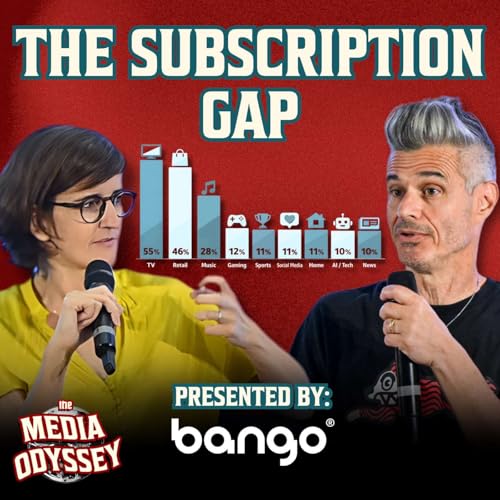
    You have six subscriptions, can't remember what's on any of them, and still can't find something to watch. Welcome to the subscription economy in 2026.Get the full Subscription Signals 2026 report here: https://bango.com/reports/reserve-report/?utm_campaign=2026_Campaigns_SubscriberReport_ReserveReportMOIn this episode, Evan and Marion dig into Bango's Subscription Signals 2026 report: an annual study of subscription attitudes and behaviors across the US and UK. Then they are joined by Giles Tongue, VP of Marketing at Bango, to break down the findings. Bango is a white-label subscription bundling platform that powers the backend infrastructure behind multi-service bundles, allowing mobile operators, retailers, and pay TV providers to offer multiple subscriptions under one bill. The report paints a picture of a subscription economy under real strain: consumers feel they're overspending, they can't remember what they subscribe to or which platform holds what content, and discovery is broken. At the same time, the shift toward third-party bundling is accelerating, and a new generation of "savvy subscribers" is rethinking the entire relationship between cost, ads, and access.Key Takeaways:1. UK Subscribers Spend More Despite Fewer Bundling Traditions UK consumers average 5.7 subscriptions, spending roughly £68 ($90) a month, compared to 5.2 subscriptions and $69 a month in the US. The gap is partly because US pay TV providers like Comcast and Charter bundle broadband, mobile, and TV into a single household bill, making it appear as one subscription rather than several. The UK is catching up, with Sky recently launching a master bundle including Disney, HBO, and Netflix for around £24 a month.2. Consumers Feel Overcharged and Gen Z Is Reaching a Breaking Point Almost 25% of US consumers and nearly a third of UK consumers say they spend more on subscriptions than they can afford. Among Gen Z in the US, that number jumps to 41%. At the same time, attitudes toward ads have shifted dramatically: in 2024, 78% of subscribers strongly opposed ads on paid tiers, but now 36% of Americans say they'd accept double the ad load in exchange for a lower price. Among Gen Z and Millennials, that figure climbs to roughly half. The era of the ad-free subscriber is ending.3. Viewers Are Loyal to Shows and Talent, Not Platforms Nearly 60% of consumers in both the US and UK say they are more loyal to an individual show than to the platform delivering it. The data reinforces this: only 13% of people who watch Severance know it's on Apple TV+, and only 18% correctly identified Game of Thrones as an HBO show. Instead, most attributed it to Netflix. This makes a free tier essential for every streamer: if consumers are going to serial churn, a free ad-supported front porch keeps them in the ecosystem.4. Content Discovery Is Broken and the Industry Is Profiting From the Problem In the US, 30% of subscribers spend 30 minutes or more searching for something to watch. In the UK it's 41%, and among Gen Z it rises to 48% in the US and 56% in the UK. Platforms are actively monetizing this search friction through home screen advertising rather than fixing it. And that will cost them in acquisition, retention, and time spent over the long run. Giles points to AI-powered discovery tools like Liberty Group's Super Search as a glimpse of what the solution could look like.5. Bundling Is the Future Over a third of US subscribers and 39% of UK subscribers now get their subscriptions through third-party bundles via banks, mobile operators, or retailers rather than subscribing directly. That number is only growing year on year. Consumers say they trust mobile operators most to deliver their bundles ahead of pay TV providers. Giles' headline warning for the industry: telcos that don't keep delivering excellent bundled experiences risk having their own customers bundled inside someone else's platform. As he puts it, "bundle or be bundled."Thank you to Giles Tongue for joining the pod!Giles Tongue - https://www.linkedin.com/in/gilestongue/ Bango - https://www.linkedin.com/company/bango/ Interested in sponsorship? https://forms.gle/2LCWfX2HBNT8mtpx8Connect with us on Linkedin:Evan Shapiro - https://www.linkedin.com/in/eshap-media-cartographer/Marion Ranchet - https://www.linkedin.com/in/marionranchet/The Media Odyssey Podcast - https://www.linkedin.com/company/the-media-odyssey-podcast
    Más Menos
    45 m
  • THE MAKING OF A HIT PODCAST
    Apr 9 2026
    He helped create the most listened-to podcasts in history and then walked away from the New York Times to start over from scratch. Welcome to The Media Odyssey Podcast!In this episode, Evan and Marion sit down with Brian Reed, documentary podcaster and co-founder of Placement Theory, whose career spans documentary podcasts This American Life, S-Town, and now Question Everything. The conversation traces the origin story of Serial, which was expected to get a few hundred thousand downloads and ended up with hundreds of millions, all the way through to Brian's decision to leave the New York Times and build something new: Placement Theory, a audio production company built to support journalists and creators. Along the way, the episode digs into a question that runs underneath everything Brian makes: can quality, independent journalism survive? As local newsrooms collapse, public media gets defunded, and audiences feel overwhelmed and burned out, Brian makes the case that the desire for truth is still very much there as a market problem waiting for the right solution.Key Takeaways:1. Serial Was Expected to Get "a Few Hundred Thousand Downloads” Before It Got Hundreds of Millions When Sarah Koenig pitched Serial at This American Life, the team budgeted for a few hundred thousand downloads. It became the most listened-to podcast in the history of the format, redefining audio documentary as a medium, with hundreds of millions of downloads for the first season alone. Brian attributes much of this to the fact that they were reporting the Adnan Syed story in real time, week by week so it was breaking news every episode. It is clear the podcast played a direct role in Adnan's eventual release from prison.2. S-Town Was Designed as an Audio Novel and Released All at Once Brian started reporting S-Town before Serial even existed, after receiving a listener email with the subject line "John B. Macklemore lives in Shit Town, Alabama." When the subject died by suicide in 2015, the story transformed. Brian and editor Julie Snyder used novels as their creative model, labeling the installments chapters instead of episodes and releasing all seven at once. It was one of the first times that had ever happened in podcasting. S-Town now has hundreds of millions of downloads and is in development as a TV show at Apple TV+.3. The Economics of Serious Independent Journalism Are Hard, but People Want TruthBrian is direct about the financial reality of running an independent audio production company: they're still figuring out how to make the show profitable. Their current model blends bespoke sponsorships, listener support through KCRW's public radio fundraising, and eventual subscription offerings. The broader state of journalism is rough with thousands of local newspapers diappearing, public trust in journalists is at historic lows, and signs of media capture happening in the US.But there’s an optimistic conclusion from Brian’s on-the-ground reporting across the country: people do want reliable information. The problem isn't demand, it's discoverability and trust. This as a classic market problem that a journalism business should be positioned to solve.4. Audio Is More Intimate Than Video and That's a Strategic Advantage Worth ProtectingBrian's company Placement Theory is an audio-first production company, and that’s deliberate. Creating video versions of their work would essentially require making a documentary — a completely different and far more expensive enterprise. They experimented with video, found that they weren't posting frequently enough to build a YouTube audience, and redirected their energy to where their audience actually was: Apple Podcasts and NPR. He still sees potential in short-form video as a discovery tool, but doesn't want to sacrifice the intimacy that makes audio narrative work.Thank you to Brian Reed for joining the pod!Brian Reed - https://www.linkedin.com/in/brian-reed-887411166/ Placement Theory - https://www.placementtheory.com/ Question Everything - https://www.kcrw.com/shows/question-everything/all-episodesS-Town - https://podcasts.apple.com/us/podcast/s-town/id1212558767 Interested in sponsorship? https://forms.gle/2LCWfX2HBNT8mtpx8Connect with us on Linkedin:Evan Shapiro - https://www.linkedin.com/in/eshap-media-cartographer/Marion Ranchet - https://www.linkedin.com/in/marionranchet/The Media Odyssey Podcast - https://www.linkedin.com/company/the-media-odyssey-podcast (00:00) - Cancel Culture Cold Open (00:39) - Meet Brian Reed (01:32) - Why Documentary Podcasts Win (03:43) - Podcasting Origins and TV Adaptations (05:54) - Defining Documentary Audio (07:17) - This American Life Apprenticeship (11:12) - How Serial Was Born (17:50) - S-Town and the NYT Era (27:55) - Birmingham Letter Mystery (29:23) - Leaving the Times (29:49) - Building Placement Theory (31:52) - Question Everything Mission (34:04) - Making Podcast Economics Work (37:14) - Journalism in Crisis (44:08) - Creators,...
    Más Menos
    59 m
  • AIVE: EVERYTHING, EVERYWHERE, ALL AT ONCE
    Apr 2 2026
    AI can't replace your editors, but it can do 80% of their most tedious, repetitive work in a fraction of the time. Welcome to The Media Odyssey Podcast!In this episode, Evan and Marion open with the news that OpenAI is shutting down Sora's B2C offering, unpacking what it signals for the AI and media landscape. They welcome Olivier Reynaud, Co-founder and CEO at Aive, a platform Aive built around the central challenge facing every creator and media company today: how do you produce enough high-quality, platform-tailored video content to keep pace with the demands of social video without burning out your team or blowing your budget? Olivier draws on his background co-founding Teads, where the team broadcast billions of videos daily, to explain how the bottleneck was never video creation itself, but large-scale personalization. The conversation explores how Aive is solving that problem through proprietary meta-learning technology, and what that means for the future of creative work.Key Takeaways:1. OpenAI Shutting Down Sora Signals a B2C Dead EndOpenAI announced it is closing down Sora and stepping back from its deal with Disney to refocus on enterprise. The hosts argue that selling AI tools directly to consumers was never a sound business model. As Evan puts it, AI is best understood as "an arrow in your quiver, not the bow."2. The Real Problem Isn't Making Video, It's Personalizing It at ScaleOlivier, who co-founded Teads and has spent 20 years in video, argues the hard problem isn't producing video content; it's tailoring that content for every platform and audience at meaningful scale. Aive is built specifically to solve this: taking a long-form master and generating hundreds of format-adapted clips in days rather than months.Aive Eliminates ~80% of Repetitive Production Tasks3. Using Match Group's Meetic as a case studyOlivier explains that Aive helped produce nearly 300 campaign variants across a full quarter, cutting production costs by roughly 80%, reducing time-to-market from two months to days, and delivering a 50% performance uplift on paid Facebook and Instagram campaigns. The savings were reinvested into more content, bigger media buys, and team training.4. The Technology Is Proprietary and Built for Enterprise SecurityAive runs on in-house meta-learning and is not trained on OpenAI, Google, or Amazon models. For clients sending unreleased films or large campaign assets, data stays within the platform and never trains outside systems. The platform is SOC 2 certified and currently designed for enterprise and mid-size agencies, not individual creators at a consumer price point.5. Netflix's 1.5 Million Trailer Versions Prove Human Editors Can't Keep Up AloneEvan opens with a striking data point: for the final season of Stranger Things, Netflix created 1.5 million different versions of their trailer for YouTube and social — a volume impossible to achieve through human editing alone. This frames the episode's central question: how do media companies and creators scale social video output to the level the market now demands, without AI doing the heavy lifting?Book a meeting with Aive: https://0icjqan647l.typeform.com/AivexTMOpodcastUse Aive’s exclusive code (NS015504) for a FREE Show Floor Pass and join them at NAB, the event redefining the future of media and entertainment: https://invt.io/1exbuo45cd4Thank you to Olivier Reynaud for joining the pod!Olivier Reynaud - https://www.linkedin.com/in/olivierreynaud/ Aive - https://www.linkedin.com/company/aive/ Interested in sponsorship? https://forms.gle/2LCWfX2HBNT8mtpx8Connect with us on Linkedin:Evan Shapiro - https://www.linkedin.com/in/eshap-media-cartographer/Marion Ranchet - https://www.linkedin.com/in/marionranchet/The Media Odyssey Podcast - https://www.linkedin.com/company/the-media-odyssey-podcast (00:00) - Netflix Trailer Explosion (01:35) - OpenAI Shuts Down Sora (02:44) - Why Consumer AI Video Fails (06:44) - Scaling Social Video Challenge (07:50) - Meet Olivier and Aive Mission (16:54) - Aive Platform Demo Reframing and Localization (21:37) - Perfect Platform Formats (22:55) - Creative Score Demo (23:51) - Voice Translation Magic (26:14) - Secret Sauce Video Data (29:03) - Personalization Without Fatigue (33:25) - Security and Who It’s For (39:28) - Industry Moves and Wrap
    Más Menos
    43 m
  • INSIDE THE MIND OF A CREATOR WUNDERKIND
    Mar 27 2026
    244 million followers and a six-month content calendar: Jordan Schwarzenberger explains why showing up daily is the only strategy that matters. Welcome to The Media Odyssey Podcast!In this episode, Evan Shapiro and Marion Ranchet break down the Nielsen/MRC measurement crisis that rocked the US advertising industry, then sit down with Jordan Schwarzenberger, CEO and co-founder of Arcade Media and manager of the Sidemen. The conversation reveals how the entire US advertising market transacted on flawed data for a year, while simultaneously showing how creator-led media companies are building sustainable businesses by thinking like traditional media. Rather than defending old systems, Jordan makes the case for why daily content and ritualistic consistency combined with treating YouTube channels as distinct brands is the only path forward.The episode is a reality check on how broken measurement has become in traditional media, while creator-led companies are professionalizing their operations, building real media plans, and capturing budgets that were previously reserved for legacy broadcasters.Key Takeaways:1. Nielsen and MRC Hid Flawed Measurement Data for Nearly a Year The Media Rating Council discovered problems in Nielsen's methodology almost a year ago but said nothing to the industry. The entire US advertising industry transacted in the Upfront on data they knew was not properly vetted. Sean Cunningham from VAB stated this cost the industry hundreds of millions of dollars.2. BBC Hired Matt Brittin, Ex-President of Google Europe The BBC hired Matt Brittin, former president of Google in Europe, as their new CEO. This represents a shift toward hiring digital natives to lead public service media organizations. Brittin previously worked in traditional broadcasting before a successful career at Google, making him someone who understands both the BBC culture and big tech. 3. The Sidemen Have 244M Followers and a 55-Person Team The Sidemen have 244 million followers across all platforms and employ 55 people in their entertainment team. They plan content six months in advance, which allows them to sell to brand planners who set budgets quarters ahead. Their goal is to be bought like LabBible and Vice were—on media plans with CPMs and economies of scale. Most creators can't access major advertiser budgets because they lack the planning, consistency, and inventory that media planners require.4. Daily Content and Ritualistic Consistency Are Essential for Success Weekly podcasts are no longer enough. Audiences now expect daily content to build ritualistic habits. The Daily Wire built 900,000 paid subscribers at their peak by showing up every day with 20-40 minute shows since 2013-2014. Streamers on Twitch and Kick are "winning the most out of anyone." Getting into people's daily habits is the key to building connection in a decentralized, saturated world.5. YouTube Is Underserved and Users Run Out of Quality ContentYouTube production is hard, time-intensive, and resource-heavy compared to podcasts, so creators default to lower-effort formats. There's a massive lack of consistent, regular, high-quality programming that becomes part of users' daily rituals.6. Netflix and YouTube Combined Create the Strongest Media StrategyJordan states that the combination of Netflix and YouTube together represents the best media strategy. Netflix provides the premium, appointment-viewing content while YouTube delivers daily touchpoints and ritualistic engagement. 7. Individual YouTube Channels Should Be Content-Specific Channel 4's 4.0 made the mistake of aggregating all content on one channel instead of spinning out individual format channels. YouTube wants to find specific audiences over time, so when a viewer watches one video and doesn't watch the next 10 on an aggregated channel, it signals disinterest to YouTube and hurts the entire channel's performance.Thank you to Jordan Schwarzenberger for joining the pod!Jordan Schwarzenberger - https://www.linkedin.com/in/jordanschwarzenberger/ Arcade - https://www.linkedin.com/company/wearearcade/ Interested in sponsorship? https://forms.gle/2LCWfX2HBNT8mtpx8Connect with us on Linkedin:Evan Shapiro - https://www.linkedin.com/in/eshap-media-cartographer/Marion Ranchet - https://www.linkedin.com/in/marionranchet/The Media Odyssey Podcast - https://www.linkedin.com/company/the-media-odyssey-podcast (00:00) - Dropping Out for Vice (00:33) - Podcast Intro and Headlines (00:57) - Nielsen MRC Measurement Scandal (02:41) - Dash Panel Shakes the Gauge (07:33) - Why Panels Fail Today (09:25) - UK Media Leadership Shift (10:09) - BBC Picks Ex Google Boss (13:59) - Meet Jordan Schwarzenberger (15:57) - From Vice to LadBible Rise (26:18) - Building Sidemen Into a Company (32:17) - YouTube Audience Ceiling (32:44) - Netflix Editorial Boost (34:04) - Sidemen Netflix Blueprint (34:41) - Funding Risk and New IP (36:39) - Who Really Gets the Lift (38:01) - Monoculture Is Dead (43:04) - ...
    Más Menos
    1 h y 1 m
  • TWO REPORTS, ONE EPISODE: THE PARAMOUNT INVESTOR DECK & THE STREAM
    Mar 19 2026
    Get The Stream by Tubi!US: https://tubitv.com/thestream?utm_campaign=262713069-The%20Stream%202026&utm_source=influencer&utm_medium=thought%20leader&utm_content=evan%20shapiroInternational: https://app.box.com/shared/static/h0cfoaqw4paub3hoi65pv0qxwdmhexf9.pdfParamount's $110B acquisition projects impossible growth, while Tubi data shows 80% canceling paid services. Welcome to The Media Odyssey Podcast presented by The Stream by Tubi!In this episode, Evan Shapiro and Marion Ranchet dissect two reports: the Paramount investor deck projecting their Warner Brothers Discovery acquisition, and Tubi's "The Stream" report on consumer streaming behavior. The conversation reveals how Paramount's financial projections defy their own recent performance trends, while simultaneously showing why consumers are abandoning paid streaming for free ad-supported options. Rather than finding synergies that make business sense, the hosts expose a deal driven by ego and questionable foreign investment sources, even as consumer data proves the market is moving away from premium paid services.The episode is a reality check on how corporate consolidation in media is disconnected from actual consumer behavior, with streaming fatigue driving audiences toward free platforms at the exact moment media companies are doubling down on expensive acquisitions and debt-heavy strategies.Key Takeaways:1. Paramount's Investor Deck Projects Revenue Growth Despite Years of Decline The investor deck projects combined revenue growing from $66 billion in 2025 to $84 billion by 2030. However, from 2023-2025, combined company revenue actually declined from $71 billion to $66 billion. EBITDA has been flat or down over the last three years, but the deck projects growth starting immediately. The deal includes $8 billion in tech cuts, $6 billion in business services cuts, $4 billion in real estate sales, and $3 billion in enterprise resource planning optimization over five years—yet claims no massive layoffs. Bank of America downgraded Paramount stock from buy at $13 to sell at $11, stating integration will take years and projected synergies won't materialize quickly.2. The Deal Will Create $80+ Billion in Debt With Questionable Funding Sources The $110 billion acquisition will saddle the combined company with over $80 billion in debt. David Ellison claims they'll double motion picture output to 30 films per year, which the hosts note is not logistically possible given film development timelines. For comparison, Disney and Fox combined produced only 19 movies last year (down from Fox's 25 pre-acquisition and Disney's ~15).3. Consumer Data Shows Massive Shift From Paid to Free Streaming According to Tubi's "The Stream" report with Harris Poll: 77% prefer on-demand over scheduled linear streaming (3-to-1 preference). 84% of all audiences and 90% of Gen Z would watch ads for free streaming services. 80% are canceling paid services and signing up for free services to fight rising costs. 76% would rather watch a free platform with ads than pay for a premium platform with an ad tier. 4. European Box Office Is 70% Dependent on US Films, Creating Vulnerability Close to 70% of European box office revenue comes from US movies (in 2024 it was 63% US, 33% European, the rest global). European ticket sales are down 5.5% but revenue is stable due to ticket price increases. The European box office is estimated to generate $10 billion in 2026, a 7% increase. Interested in sponsorship? https://forms.gle/2LCWfX2HBNT8mtpx8Connect with us on Linkedin:Evan Shapiro - https://www.linkedin.com/in/eshap-media-cartographer/Marion Ranchet - https://www.linkedin.com/in/marionranchet/The Media Odyssey Podcast - https://www.linkedin.com/company/the-media-odyssey-podcast (00:00) - Welcome and Episode Setup (01:05) - Tubi Stream Report Highlights (01:24) - Streaming as Social Life (02:41) - Free Streaming and Ad Tolerance (04:37) - Creator Content Meets TV (05:34) - Back to Paramount Deal Deck (06:53) - Deck Assumptions and Synergy Cuts (16:26) - Europe Overlap and Sky Showtime (19:32) - Europe Strategy Doubts (20:54) - Tech Stack Nightmare (22:05) - Branding and Gravitas (22:54) - Pluto FAST Opportunity (24:39) - Discovery Content vs Linear (26:04) - Europe Sports Rights Edge (33:01) - Cinema Reliance and Fears (36:48) - Pushback and Wrap Up
    Más Menos
    41 m
  • THE SIGNAL FROM EUROPE: Q4 EARNINGS
    Mar 12 2026

    Versant spins out with $2B free cash flow, ITV faces Sky acquisition, Banijay grows experiential 18%, and Canal+ hits 42.3M subscribers. Welcome to The Media Odyssey Podcast live!


    In this earnings coverage episode, Marion Ranchet and Evan Shapiro break down results from four companies undergoing major transformations: Versant's spinout from Comcast, ITV's potential acquisition by Sky/Comcast, Banijay's post-Endemol Shine merger performance, and Canal+'s global expansion strategy. The conversation reveals the challenges traditional media companies face as cable declines, the strategic missteps in corporate separations, and how European companies are diversifying revenue streams to survive.


    Rather than celebrating growth, the hosts examine whether these transformations make strategic sense or simply expose dying businesses. The episode is a reality check on how media consolidation and spinouts are reshaping the industry, with some companies finding success through diversification while others struggle to justify their existence as standalone entities.


    Key Takeaways:

    1. Versant (spun out from Comcast)

    Versant generated $2 billion in free cash flow despite total revenue down 5% and net income down 32% year-over-year in 2025. Overall, distribution was down, advertising down, licensing business down but growth came from platforms (Fandango, Rotten Tomatoes, Golf Now, CNBC streaming). Interestingly, Comcast kept Bravo (the most valuable programming brand) with Peacock instead of spinning it out with Versant, showing a lack of strategic thinking.


    2. ITV

    ITV saw subscriptions flat year-over-year with no growth, but digital ad revenue up 12% year-over-year, preventing a worse outcome. Sky + ITV combined would become the #2 TV outlet in the UK, second only to BBC, jumping over YouTube and far surpassing Netflix as the largest ad platform. ITV Studios is a profitable powerhouse with Love Island (the #1 streamed show last year on Peacock) and a growing US arm, yet the acquisition would potentially leave Studios behind.


    3. Banijay

    Experiential business grew 18%+ (still under €400 million but growing fast) and the gaming/sports betting business generated €1.6 billion out of €4.9 billion total revenue (nearly one-third of total revenue), growing 9.5% year-over-year and surprising the hosts. Banijay is now planning €50 million in cost synergies through integration, which means layoffs that will take time in European markets due to labor regulations


    4. Canal+

    Where other platforms saw flat subscriptions, Canal+ grew total subscribers by 8% year-over-year to 42.3 million subscribers with the Multichoice acquisition. Now, the company operates in close to 50 countries across Africa, Asia, and multiple European territories. Their strategy paid off when subscribers under the age of 26 grew 17x since 2019 by building a €20/month package (half the typical price) with no commitment to address the "too expensive" problem.


    Interested in sponsorship? https://forms.gle/2LCWfX2HBNT8mtpx8


    Connect with us on Linkedin:

    Evan Shapiro - https://www.linkedin.com/in/eshap-media-cartographer/

    Marion Ranchet - https://www.linkedin.com/in/marionranchet/

    The Media Odyssey Podcast - https://www.linkedin.com/company/the-media-odyssey-podcast

    • (00:00) - Live Show Kickoff
    • (00:30) - Earnings Agenda Setup
    • (01:01) - Comcast Spinout Overview
    • (02:29) - Why Spin It Out
    • (04:30) - Streaming Pivot Debate
    • (07:31) - What Brands Matter
    • (09:37) - Europe Shift to ITV
    • (12:11) - ITV Deal and Studios Split
    • (19:45) - Banjay and All3 Media
    • (23:41) - Scaling Little Dot Playbook
    • (24:30) - Gaming Revenue Surprise
    • (25:32) - Betting and Experiential Growth
    • (26:47) - Cost Synergies and Layoffs
    • (27:33) - Will Regulators Approve
    • (28:32) - Canal Plus Name Debate
    • (30:15) - Canal Plus Strategy and Growth
    • (34:12) - MultiChoice Deal and Africa
    • (37:47) - Wrap Up Next Episode and Events
    Más Menos
    42 m
  • THE TRANSFORMATION OF ITV STUDIOS
    Mar 5 2026
    Archive content finds new life on YouTube while broadcast TV is officially "a blip in history." Welcome to The Media Odyssey Podcast live from MIP London!In this special live episode from MIP London, Evan Shapiro sits down with Martin Trickey, who runs Zoo 55, ITV Studios' digital distribution arm that launched just over a year ago. The conversation reveals how traditional broadcasters are finally waking up to the massive untapped value in their archives, how YouTube is television for older demographics as well as younger people, and why the broadcast era was just a temporary moment in human storytelling. Rather than defending the traditional TV model, Martin makes a compelling case for why broadcasters must radically transform or become irrelevant. The episode is a reality check on how quickly the media landscape is changing, with 55% of the British population now millennials and younger who never developed traditional broadcast habits. Success now requires mastering social video alongside streaming not instead of it.Key Takeaways:1. Archive Content Unlocks New Value on YouTube ITV's Zoo 55 is finding massive value in archive content that was gathering dust on shelves. Old episodes of shows like Hell's Kitchen and River Monsters are discovering entirely new audiences on YouTube who never saw them during their original broadcast runs. This represents a significant new revenue stream from content that had no previous monetization path.2. YouTube Audiences Span All Demographics, Not Just Young People The biggest demographic watching full episodes of Coronation Street on YouTube is 65+, and they're watching mostly on TV devices. Everybody is watching content on YouTube regardless of age. The assumption that it's only for younger audiences is false. Archive content attracts both younger viewers discovering shows for the first time and older viewers who are now consuming familiar content on YouTube instead of traditional broadcast.3. Broadcast Television Was "A Blip in History" The monopolies that free-to-air broadcasters had in the 1960s-1980s are gone and never coming back. Peer-to-peer and social communication is how people have told stories since cave painting, and we've returned to that model. In 1985, shows on BBC One or ITV at 8pm guaranteed audiences because there was nothing else on. That era is over.4. No Traditional Viewing Habits Means Streaming Will Not Fully Replace Broadcast55% of the British population are millennials and younger who did not grow up with the same broadcast habits as their parents and grandparents. The time previous generations spent on television has been replaced by a combination of streaming AND social video—not just streaming. Younger generations actually watch less streaming than older generations. The idea that 100% of the TV audience will migrate to streaming alone is false.5. Building Communities on Social Video Requires Significantly More Work Cutting through on social platforms is incredibly difficult compared to traditional broadcast. It requires great content plus discoverability work (thumbnails, titles, metadata), engagement with super fans and influencers, and constant optimization. Broadcasters must work far harder to build communities on social video than they ever did building TV audiences, but it's essential for survival.6. 2026 Is the Year for Brand Direct Deals on YouTubeITV expects 2026 to be the year they move significantly into brand direct deals beyond programmatic advertising. YouTube is expected to launch dynamic brand insertion in the second half of 2026, allowing creators to swap out sponsored segments without taking down and re-uploading entire videos. This will allow creators and partners to keep a larger share of revenue, and ITV plans to offer brands the ability to co-create content and distribute it across their network of social channels.Thank you to Martin Trickey for joining the pod!Martin Trickey - https://www.linkedin.com/in/martintrickey/Zoo 55 - https://www.linkedin.com/company/zoo-55/Interested in sponsorship? https://forms.gle/2LCWfX2HBNT8mtpx8Connect with us on Linkedin:Evan Shapiro - https://www.linkedin.com/in/eshap-media-cartographer/Marion Ranchet - https://www.linkedin.com/in/marionranchet/The Media Odyssey Podcast - https://www.linkedin.com/company/the-media-odyssey-podcast (00:00) - Welcome and Introductions (00:37) - Zoo 55 One Year In (01:22) - What Is Zoo 55 (02:34) - Games and Metaverse Plays (05:16) - Archive Value on YouTube (06:55) - YouTube Audience Is TV (08:18) - Building Community on Social (11:02) - River Monsters Discovery Lessons (13:36) - Archive Gold Rush (14:04) - Rights and Rediscovery (14:51) - When Archives Age Badly (16:00) - YouTube Monetization Reality (17:02) - Partner Sales Explained (19:05) - Premium Bundles and Pricing (19:52) - Brand Deals and Dynamic Inserts (22:24) - US Growth and Industry Future
    Más Menos
    31 m
  • DISCO BROS AND NEPO BABIES: Q4 EARNINGS
    Feb 28 2026

    Netflix backs out of the bid for Warner Bros. Discovery (aka “Disco Bros”), leaving Paramount Global — sorry, “Nepomount” — as the likely merger partner. Welcome to another live earnings edition of The Media Odyssey.

    In this episode, Evan Shapiro and Marion Ranchet break down the bombshell developments between Warner Bros. Discovery and Paramount. Is this smart consolidation… or a true “Titanic meets the iceberg” moment?

    Key Takeaways:

    1. Netflix Walks Away — Political Pressure?

    The timing raises eyebrows: Ted Sarandos’ White House visit came just days before Netflix exited the bid. Was there political pressure? Possibly. Regardless, the $2.8B breakup fee gives Netflix fresh optionality — whether that means acquiring Lionsgate, Xbox, Roku… or choosing disciplined restraint.

    2. Two Sides of the Same Coin

    Warner Bros. Discovery and Paramount share strikingly similar business challenges: linear decline, streaming plateau, advertising pressure.

    Can merging two structurally similar companies create real transformation? We predict significant layoffs and a battle over which brand identity survives — HBO or Paramount.

    3. U.S. Political Risk in 2026

    With midterm elections approaching, regulatory and political pressure could intensify. Evan suggests Attorneys General in film- and TV-heavy states may resist the merger to protect jobs and local economies. The political calendar could directly impact whether this deal closes.

    4. European Market Fallout

    Much like the Disney–Fox merger, Europe could see substantial layoffs and market recalibration — especially around sports rights.

    Marion raises key questions:

    • What happens to SkyShowtime (the Paramount–Comcast JV)?
    • Could Max, Channel 5, and Pluto TV consolidate further?
    • Does this create a stronger #3 player — or just a bigger struggling one?

    5. The Bigger Issue: Streaming’s Plateau

    While mega-mergers dominate headlines, the core business is slowing. Streaming growth is flattening, churn remains high, and by the end of the decade the model may resemble today’s cable ecosystem. Advertising helps — but it cannot fully offset structural decline.

    Interested in sponsorship? https://forms.gle/2LCWfX2HBNT8mtpx8


    Connect with us on Linkedin:

    Evan Shapiro - https://www.linkedin.com/in/eshap-media-cartographer/

    Marion Ranchet - https://www.linkedin.com/in/marionranchet/

    The Media Odyssey Podcast - https://www.linkedin.com/company/the-media-odyssey-podcast

    00:00 Introduction and Naming the Disaster
    03:55 Warner Brothers Discovery's Performance
    17:07 The Impact of Mergers on the Industry
    22:43 The Future of Netflix and Strategic Acquisitions
    27:08 Question #1 - Will Oracle become the backbone of WBD/Paramount?
    28:22 The Impact of Sports Rights on Streaming
    32:02 The State of Streaming in Europe
    34:37 Challenges in Monetizing Streaming and FAST Services
    37:56 Branding and Identity in Mergers
    42:30 The Future of SkyShowtime
    44:28 Placing Bets on the Merger
    45:59 Upcoming Events; Marion and Evan at Stream TV Libson

    Más Menos
    53 m