Episodios

  • Split the Pie: Barry Nalebuff on Fair Negotiation, Game Theory, and Better Deals
    Apr 1 2026

    How do you negotiate firmly, fairly, and effectively — without becoming a jerk?

    In this episode of The Innovation Show, Aidan McCullen speaks with Barry Nalebuff — Yale professor, entrepreneur, and author of Split the Pie — about a principled approach to negotiation built around one simple idea: identify the pie, the extra value created only when both sides reach agreement, and split it equally.

    Rather than relying on pressure, posturing, or arbitrary bargaining, Barry shows how negotiation can become a logical, ethical, and data-driven process. Drawing on cooperative game theory and real-world business experience, he explains why most people misunderstand what is actually being negotiated — and how that confusion leads to bad deals and bad relationships.

    The conversation includes examples from:

    Barry's mother buying her rented home,

    Coca-Cola's acquisition of Honest Tea,

    a negotiation with a domain-name squatter,

    grant funding and workload-sharing examples,

    lease-breaking, tax-loss mergers, and everyday fairness disputes.

    This is a practical episode for founders, executives, investors, academics, negotiators, and anyone who wants to create better outcomes through principle instead of power plays.

    What you'll learn in this episode:

    • What Barry Nalebuff means by "the pie"

    • Why fairness starts with understanding the real source of value

    • How to negotiate without aggression or manipulation

    • Why principles beat arbitrary numbers

    • How game theory can improve business and life decisions

    • How to avoid accepting less than your fair share

    Timestamps

    00:00 Sponsor Message

    00:28 Negotiation Without Jerk

    01:50 Split The Pie Idea

    03:29 Dollar Bill Example

    05:15 Mom House Deal

    11:49 Talmud Cloth Principle

    14:22 Honest Tea Coke Bottles

    17:16 Coke Buyout Terms

    22:02 Domain Troll Negotiation

    27:33 Holding Firm on Fairness

    28:36 Principles Over Arbitrary Numbers

    31:17 Anju and Bharat Interest Puzzle

    35:35 Power and Hidden Pie Ethics

    37:23 Game Theory and Spock Logic

    42:09 Sisyphus Grant Split Example

    48:46 Breaking the Lease Loss Pie

    52:01 Mergers Tax Losses and Equality

    53:12 Fairness Equity and Negotiation Ethics

    56:28 Where to Find Barry

    57:29 Sponsor and Sign Off

    Más Menos
    58 m
  • Nokia Saw iPhone Coming - So What Went Wrong?
    Mar 24 2026

    What if Nokia saw the iPhone coming and still couldn't stop it?

    In this episode, strategy professor Timo Partanen, former Nokia market intelligence leader (2001–2009), reveals what was really inside Nokia's internal iPhone threat briefing presented to senior leadership.

    Nokia had tracked Apple for years. They saw the signals like touchscreen innovation, strategic hires, and shifting user expectations. The iPhone's hardware wasn't the surprise.

    The real shock was Apple's ecosystem.

    From its exclusive partnership with Cingular (AT&T) to alliances with Google and Yahoo, Apple didn't just launch a product, it launched a new business model. One that exposed Nokia's blind spot: a hardware-first culture in a platform-driven world.

    We explore why clear warnings didn't lead to action, how strategy broke down between leadership and execution, and what today's companies can learn about disruption, partnerships, and transformation.

    This is a story about missed shifts, internal friction, and the difficulty of turning insight into impact.

    Más Menos
    57 m
  • Nokia's Comeback Explained: Emotion, Strategy & Boardroom Decisions
    Mar 18 2026

    How did Nokia survive one of the most dramatic collapses in business history?

    In this episode, we explore the hidden driver of strategy under pressure: emotion.

    Drawing on research based on 100+ interviews inside Nokia between 2007 and 2013 , INSEAD's Quy Huy and Aalto University's Timo Vuori join Aidan McCullen to explain how large organizations can execute radical pivots—not just through analysis, but through structured emotion regulation.

    We unpack how Nokia moved from denial, fear, and rigid thinking to a disciplined, data-driven, and emotionally aware strategy process that enabled it to exit mobile phones and rebuild around networks and 5G.

    You'll learn:

    • Why strategy fails when emotions go unmanaged

    • How boards can shape better decisions by regulating—not suppressing—emotion

    • The role of consultants, teams, and partners in expanding strategic thinking

    • Why discussing failure systematically leads to better outcomes

    • How to design strategy processes that work under uncertainty

    This is not just a story about Nokia—it's a blueprint for any organization navigating disruption, uncertainty, and high-stakes decisions.

    Sponsored by Kyndryl – helping the world's leading organizations modernize and run mission-critical systems for smarter decisions and lasting competitive advantage.

    Más Menos
    1 h y 4 m
  • Everyone Thinks the iPhone Killed Nokia. They're Wrong!
    Mar 10 2026

    Most people believe the iPhone killed Nokia.

    But the real story behind Nokia's collapse is far more complex — and much more human.

    At its peak Nokia controlled nearly 50% of the global mobile phone market and had over one billion customers. Yet within a few years the company lost the smartphone war as Apple and Google reshaped the industry.

    In this episode we continue our deep dive into the research of Quy Huy and Timo Vuori, whose study reveals how fear inside Nokia distorted communication and decision-making. Senior leaders felt intense pressure from competitors and investors, while middle managers feared delivering bad news. The result was silence, denial, and what the researchers call "collective lies."

    We explore how Nokia became trapped by its Symbian platform, how short-term financial pressures undermined long-term innovation, and why leadership dynamics and organizational culture can determine the fate of even the most dominant companies.

    The lesson: strategy often fails not because of technology — but because leaders stop hearing the truth.

    Más Menos
    1 h y 5 m
  • Who Killed Nokia? How Fear and Emotion Derail Strategy, Innovation, and Truth-Telling.
    Mar 5 2026

    Nokia didn't lose the smartphone battle because it lacked smart people or a strategy deck. It lost because fear and shared emotions quietly reshaped attention, filtered information, and weakened truth-telling.

    Quy Huy (INSEAD) and Timo Vuori (Aalto University)—authors of the 2016 research on Nokia's collapse—explain how leaders hid emotions behind "technology and finance talk," how dissent was punished, and how misaligned fearformed: executives feared competitors and shareholders while middle managers feared their bosses. We connect the dots to psychological safety, power traps, poker-face leadership, burnout, and what this teaches leaders facing AI disruption today.

    Find Quy

    https://www.insead.edu/faculty-personal-site/quy-huy

    https://knowledge.insead.edu/strategy/nokias-reinvention-was-emotionally-driven

    Find Timo

    https://research.aalto.fi/en/persons/timo-vuori/

    https://adaptivevolcano.com/about

    Más Menos
    56 m
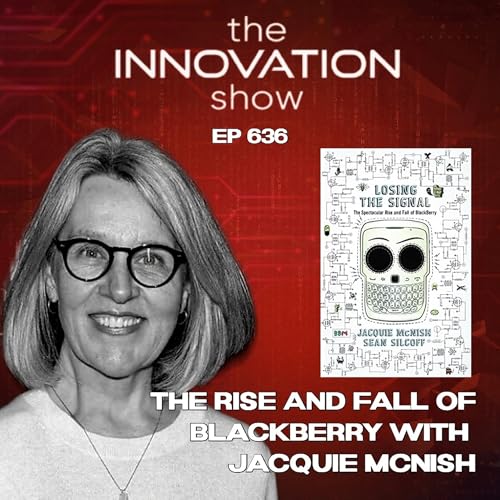
  • The Spectacular Rise and Fall of BlackBerry with Jacquie McNish
    Feb 23 2026

    BlackBerry once ruled the business world.

    Presidents, CEOs, and Wall Street relied on its encrypted devices. Then the iPhone arrived — and everything changed.

    In this episode, Jacquie McNish, co-author of Losing the Signal, unpacks the untold story behind:

    • The improbable rise of Research In Motion
    • The 2011 global outage crisis
    • The NTP patent war
    • 9/11 and encrypted messaging dominance
    • The internal fracture between Mike Lazaridis and Jim Balsillie
    • The Storm failure
    • The QNX pivot and BlackBerry's second act

    A fascinating case study in leadership psychology, technological disruption, and strategic inflection points.

    This is a masterclass in: Innovation Leadership Disruption Scaling culture Strategic blindness Corporate inflection points

    📘 Book: Losing the Signal by Jacquie McNish & Sean Silcoff https://amzn.to/4tVBHWk

    🎙 Hosted by Aidan McCullen Aidan McCullen is a Thinkers50 Innovation Award winner, recognised for his contribution to global innovation practice through The Innovation Show.

    Aidan is a Global and Irish Keynote speaker recognized for his engaging storytelling style and his bestselling book Undisruptable: A Mindset of Permanent Reinvention. The Innovation Show remains the only podcast ever to receive a Thinkers50 award, and Aidan is only the second Irish person—after Charles Handy—to be honoured.

    #BlackBerry #Innovation #BusinessStrategy #TechHistory #Leadership #StartupLessons #iPhone #Apple #Entrepreneurship #Disruption

    Más Menos
    1 h y 20 m
  • Corporate Innovation Strategy: Return Maps, Managing Up & Forecasting with Chuck House
    Feb 18 2026

    Why does corporate innovation fail so often — even with talented teams and strong ideas? In this episode of The Innovation Show with Aidan McCullen, intrapreneur and innovation veteran Chuck House returns to explain why innovation dies when projects, programs, and strategy aren't clearly connected — and why executives often misjudge innovation timelines because they're optimizing established businesses.

    Chuck breaks down the 4 intrapreneur traits (curiosity, perspective, resilience, and comfort with data) and the overlooked career skill that makes or breaks intrapreneurs: managing down AND managing up. Learn how to build team trust, navigate organizational politics, make "invisible work" visible, and persuade decision-makers to keep the right bets alive.

    He also challenges traditional project review approaches (IRR, cost/schedule targets, early sales projections) and introduces his practical alignment tool: the Return Map — a living, cross-functional view that integrates investment, revenue, and profit over time, assigns accountability across functions, and forces iterative re-forecasting as reality changes (slips, market windows, manufacturing costs, and sales forecasts).

    In this episode

    • Why innovation feels like "snakes and ladders" inside large organisations

    • Steve Jobs as a blueprint: iPod → iTunes → iPhone as a strategic cycle

    • Managing up: credibility, trust, and navigating corporate politics

    • Why HQ metrics can kill risky projects too early

    • Brunnergrams vs strategy: what engineering tracking misses

    • How Return Maps improve alignment, accountability, and forecasting

    • Teaser: a future conversation with Kodak digital camera inventor Steve Sasson

    Sponsor: Kyndryl

    Más Menos
    53 m
  • Digital Transformation Playbook (10 Years On) AI, Disruption & Platform Strategy with David Rogers
    Feb 11 2026

    This week's guest is David Rogers, Columbia Business School professor and author of Digital Transformation Playbook.

    We discuss digital transformation strategy, AI in business, disruptive innovation, platform business models, network effects, and leadership in the age of AI.

    If you're navigating digital transformation or AI strategy, this episode is essential listening.

    00:00 Introduction and Sponsor Message

    00:35 Meet the Digital Transformation Expert

    01:38 Impact of the Digital Transformation Playbook

    05:40 Evolution of Digital Transformation

    07:24 The Role of AI in Digital Transformation

    09:21 Frameworks and Theories of Disruption

    09:38 The Story of Encyclopedia Britannica

    16:59 Understanding Business Disruption

    24:44 Disruptive Business Model Map

    33:12 Understanding Network Effects

    34:41 Same Side vs. Cross Side Network Effects

    38:01 The Challenge of Competition in Platform Businesses

    42:21 The Importance of Platform Business Models

    46:13 Four Types of Platform Businesses

    49:19 Platform Business Model Map

    54:28 Value Train Analysis

    01:02:22 The Evolution of Digital Transformation

    Find David:

    https://davidrogers.digital/about/

    Más Menos
    1 h y 8 m