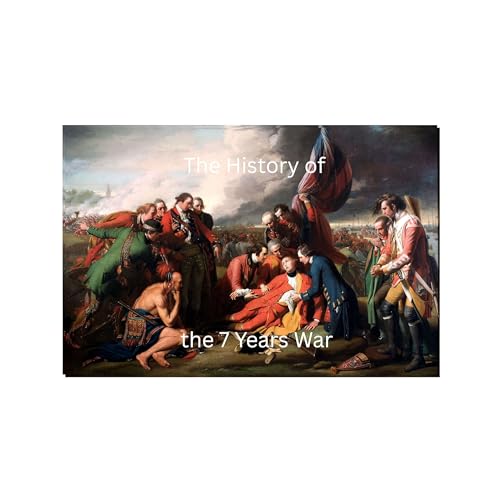
The History of the 7 Years War Podcast Por Rob Hill arte de portada

The History of the 7 Years War

The History of the 7 Years War

De: Rob Hill
Escúchala gratis

OFERTA POR TIEMPO LIMITADO | Obtén 3 meses por US$0.99 al mes

$14.95/mes despues- se aplican términos.

The real first world war, this often overlooked conflict saw action in Europe, North America, the Caribbean, Africa, India, and the Philippines. Its outcome also set the stage for many of the major events that would reshape the world in the coming decades.

© 2026 The History of the 7 Years War
Mundial
Episodios
  • Episode 7 - To Encourage the Others...
    Jan 8 2026

    Send us a text

    Britain thought it could glide through 1756 on sea power and habit. Minorca proved otherwise. We follow the doomed relief of Fort St. Philip from the Admiralty’s hedged orders to John Byng’s compromised squadron, then into a battle where geometry, hesitation, and a ten‑minute delay cost Britain the initiative. The French didn’t need a glorious victory; they needed a functioning plan. They had one. The result was a tactical draw that became a strategic collapse—and a fortress left to face arithmetic alone.

    Inside those walls, William Blakeney managed a shrinking perimeter as French engineers advanced with quiet precision. Beyond the guns, the louder story unfolded in London. The Articles of War demanded death for failure to do one’s utmost, and Byng’s court—officers who knew the truth of his situation—convicted and begged for mercy in the same breath. None came. Voltaire’s bitter line about killing an admiral to encourage the others lands here not as satire but diagnosis: punishment stood in for reform, spectacle for accountability.

    We dig into the system that made this outcome feel inevitable under the Duke of Newcastle: delayed decisions, ambiguous orders, and a Navy drilled to preserve formation at the expense of initiative. Then we track how William Pitt the Elder seized the narrative, arguing for coordinated, global action and the courage to spend for victory rather than manage decline. Minorca’s fall becomes more than a lost base; it’s the moment Britain learns that procedure is not strategy and that naval supremacy must be earned, not assumed. As the war’s tempo shifts to North America and Montcalm gathers momentum, the cost of hesitation becomes brutally clear.

    If this story challenged your view of “naval supremacy,” tap follow, share it with a friend who loves history, and leave a quick review—your words help others find the show and keep this series sailing.

    Más Menos
    56 m
  • Episode 6- Old Enemies, New Friends
    Dec 7 2025

    Send us a text

    In this episode, we watch Europe's diplomatic world turn upside down. For more than two centuries, the bourbon kings of France and the Hapsburg emperors of Austria had defined themselves inn opposition to one another, fighting over Italy, Germany, the Low Countries, and anything else that came within arm's reach. But by the 1750's the od rivalry was non longer useful. the loss of Silesia had shake Austria to it's core, France found itself stumbling into colonial confrontations with Britain, and Prussia's sudden rise had destabilized the entire continental balance. As the old order cracked, a new one began to take shape.

    At the center of the transformation stood Wenzel Anton von Kaunitz, the quiet Austrian statesman whose long-game thinking changed the course of European history. While Maria Theresa rebuilt her monarchy and plotted her revenge against Fredrick the Great, Kaunitz patiently cultivated an alliance that would have been unthinkable a generation ago. Inn Paris, the French court drifted between factions and indecision until Madame de Pompadour- diplomat, taskmaster, and royal confidant- emerged as the unexpected hinge betweennn the two empires. What followed was a slow, deliberate courtship conducted through carefully crafted letters, subtle flattery, and the recognition that Britain, not Austria, had become France's true rival.

    As Britain edged closer to Prussia, to protect Hanover, as Russia grew increasingly hostile toward Fredrick, the diplomatic plates shifted in dramatic fashion. Inn may of 1756, Austria and France signed the First Treaty of Versailles, stunning every court inn Europe. The traditional enemies were now allies, the old alliances were dead, and a new more dangerous alignment emerged. Austria, France, and Russia now formed a continent bloc aimed squarely at Prussia, while Britain, panicked and opportunistic found itself tied to Fredrick's fate in a way no one in London fully appreciated.

    For fredrick the Great, this wa the nightmare scenario that he had been predicting for years. Encircled, threatened, and running out of options, he made the fateful decision to strike first. In August of 1756, Prussian troops marched into Saxony, lighting the fuse that would ignite the Seven Year's War. The Diplomats Revolution was complete. The old word was gone. And before the continent went up in flames, the first sparks would fly far to the south on a rocky Mediterranean island callled Minorca.

    If this kind of history hits your sweet spot, follow the show, share it with a friend, and leave a quick review on Apple Podcasts or Spotify. What moment shocked you most: the Versailles signatures or Frederick’s dash into Saxony?

    Más Menos
    1 h y 23 m
  • Oops!
    Nov 22 2025

    Send us a text

    There was a brief dead spot around the 8:30 mark of Episode 5. I found it, fixed it and reuploaded the episode. Please feel free to send me any feedback like that when you find those things, but hopefully, I figure out how to do this at some point, ha ha ha ha! Enjoy!

    Más Menos
    1 m
Todavía no hay opiniones