Episodios

  • 117: 2026 SHGAPE Prize Winners
    Mar 25 2026


    Today we are delighted to welcome a guest host, Dr. Chelsea Gibson of SUNY Binghampton, and the co-editor of the SHGAPE Blog. who is interviewing three of the 2026 SHGAPE prize winners:


    Carlotta Wright de la Cal, winner of the SHGAPE research grant for her project “Rule of Rail: Railroad Labor and Cross-Border Mobility in the U.S.-Mexico Borderlands, 1880-1930.”


    Nicole Martin winner of the Fischer -Calhoun article prize for “The Indian, Chinese, and Mormon Questions: The American Home and Reconstruction Politics in the West”, Pacific Historical Review 93, no. 3 (Summer 2024): 445–474.


    Manisha Sinha winner of the 2026 Presidents’ Book Prize for The Rise and Fall of the Second American Republic: Reconstruction, 1860-1920 (Liveright, 2024)


    As many of you may know, our podcast’s sponsoring organization, Society for Historians of the GAPE or (SHGAPE) is an affiliated society of the Organization of American Historians (or OAH. This means that we are quite engaged in the OAH’s annual conference, which is being held this year in Philadelphia on April 16-19, 2026.


    SHGAPE sponsors panels at the conference, and also offers workshops, lectures, a luncheon, a reception, and mentoring opportunities for emerging scholars at the annual meeting. The Society also offers a variety of awards, including book and article prizes, a graduate student essay prize, a distinguished historian award, and travel grants to the OAH for graduate students and contingent faculty.


    You can find out more information about these prizes and our other opportunities on the SHGAPE.org and more about the Organization of American Historians at oah.org


    A big congratulations to the winners and thanks to Dr. Chelsea Gibson for joining us as a guest host!

    Hosted on Acast. See acast.com/privacy for more information.

    Más Menos
    1 h y 17 m
  • 116: The Feather Wars: And the Great Crusade to Save America’s Birds
    Mar 11 2026

    In this episode, Boyd Cothran and Cathleen Cahill sit down with James H. McCommons to discuss his sweeping new book, The Feather Wars: And the Great Crusade to Save America’s Birdspublishing March 17, 2026.


    📘 Pre-order now:

    https://us.macmillan.com/books/9781250286895/thefeatherwars/


    At a moment when conservation feels both urgent and politically contested, McCommons takes us back to the late nineteenth and early twentieth centuries, when Americans nearly drove some of their most iconic bird species to extinction — not primarily for food, but for fashion. Millions of birds were killed to supply the booming plume trade. Entire rookeries were destroyed so feathers could adorn women’s hats.


    But The Feather Wars is about far more than birds. It is a story about how societies change.


    McCommons shows that reform required not only outrage, but organization; not only persuasion, but law. The eventual passage of federal wildlife protections reshaped American culture and preserved species that might otherwise have vanished.


    As we confront our own era of environmental crisis, this story raises enduring questions: How does a society move from normalization to moral reckoning? When does law follow culture — and when must it lead? What does it take to create durable change?

    Hosted on Acast. See acast.com/privacy for more information.

    Más Menos
    54 m
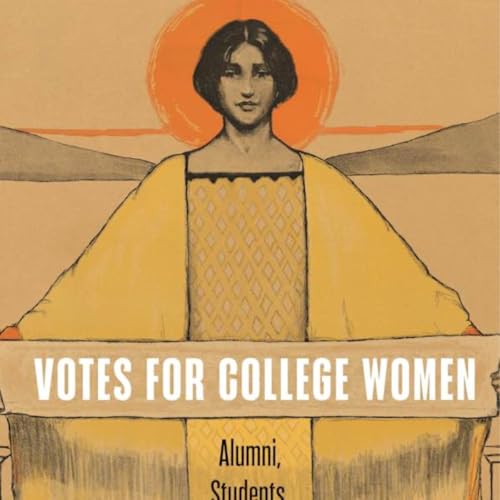
  • 115: Votes for College Women: Alumni, Students, and the Woman Suffrage Campaign
    Feb 25 2026

    There’s a lot in the news these days about politics on college campuses with discussions of student protests, curriculum debates, and faculty engagement serving as hot button issues. This sudden and intense focus makes it seem as if this may be a new phenomenon, though anyone who lived through the 1960s and 70s would beg to differ.

    Our guest today, Dr. Kelly L. Marino’s recent book, Votes for College Women: Alumni, Students, and the Woman Suffrage Campaign, (NYU Press, 2024) https://nyupress.org/9781479825196/votes-for-college-women/ pushes that chronology back even further by exploring the role that female college students and alumni played in the suffrage movement as well as in shaping college activism moving into the future.

    Hosted on Acast. See acast.com/privacy for more information.

    Más Menos
    46 m
  • 114: The Political Reconstruction of American Tobacco
    Feb 11 2026

    In this episode of the Gilded Age and Progressive Era Podcast, Boyd Cothran talks with historian Patrick O’Connor about his new book, The Political Reconstruction of American Tobacco, 1862–1933.


    Rather than treating tobacco primarily as a moral problem or a corporate success story, O’Connor approaches it as a window onto the making of the modern American state. Beginning with Civil War–era taxation and moving through the Gilded Age and Progressive Era, the conversation traces how tobacco became deeply embedded in federal governance—through revenue collection, market regulation, inspection and classification regimes, agricultural science, and expert bureaucracy.


    Along the way, we discuss how taxation helped create national markets, how “quality” and knowledge functioned as forms of power, how growers were disciplined through debt and market institutions, and how Progressive Era expertise reshaped both agriculture and state capacity. The episode also reflects on why tobacco proved so difficult to regulate or dismantle in the early twentieth century—and what this history can tell us about the long-standing challenges of governing harmful but profitable commodities.

    Hosted on Acast. See acast.com/privacy for more information.

    Más Menos
    53 m
  • 113 Unforgettable Sacrifice
    Jan 28 2026

    Cathleen talks with Dr. Hilary N. Green, whose most recent book, Unforgettable Sacrifice: How Black Communities Remembered the Civil War, was published by Fordham University Press in 2025. https://fordhampress.com/unforgettable-sacrifice-hb-9781531508531.html

    An exciting addition to scholarship on Civil War memory with its focus on African American traditions of memorialization, the book also offers historians important methodological tools.


    For Dr. Green's public history projects, see

    With Their Hands: https://www.davidson.edu/news/2025/10/21/memorial-brings-unacknowledged-into-story

    Hallowed Grounds https://www.hngreenphd.com/the-hallowed-grounds-project.html


    We also mentioned Dr. Martha Jones' Hard History project at Johns Hopkins University:

    https://hardhistory.jhu.edu/


    We mentioned a number of books in our conversation including:

    David Blight, Race and Reunion: The Civil War in American Memory (Harvard UP 2001)

    Barbara A. Gannon, The Won Cause: Black and White Comradeship in the Grand Army of the Republic (The University of North Carolina Press, 2011)

    Caroline Janney, Remembering the Civil War: Reunion and the Limits of Reconciliation (University of North Carolina Press, 2013)

    David Silkenat, Raising the White Flag: How Surrender Defined the American Civil War (University of North Carolina Press, 2019)


    Contact the host:

    Cathleen Cahill

    cdcahill@psu.edu

    Hosted on Acast. See acast.com/privacy for more information.

    Más Menos
    1 h y 20 m
  • 112: The Menance of Prosperity
    Jan 14 2026

    In this episode of The Gilded Age and Progressive Era Podcast, Boyd Cothran speaks with historian Daniel Wortel-London about his new book, The Menace of Prosperity, a sweeping history of New York City and the political economy of urban growth from the aftermath of the Civil War through the late twentieth century.


    The conversation centres on the Gilded Age and Progressive Era, when New York’s leaders increasingly tied the city’s finances to real estate development, municipal debt, and rising property values. Wortel-London introduces two key concepts—social costs and fiscal imaginaries—to explain how elite-driven prosperity repeatedly generated fiscal crises, inequality, and instability, even as critics advanced alternative visions rooted in cooperation, public ownership, and democratic control of urban resources.


    Along the way, Boyd and Daniel discuss the 1870s fiscal crisis and fears of “monstrous growth,” Gilded Age fiscal radicals and the cooperative commonwealth, Henry George and the single tax, Progressive Era debates over municipal ownership and planning, and interwar struggles over housing and economic stabilization. The episode concludes by tracing how these late nineteenth- and early twentieth-century choices shaped the New Deal, the 1970s fiscal crisis, and contemporary debates over housing, development, and inequality in New York.


    The Menace of Prosperity is available from the University of Chicago Press


    Contact the host:

    Boyd Cothran can be reached at cothran@yorku.ca

    Hosted on Acast. See acast.com/privacy for more information.

    Más Menos
    1 h
  • 111: The Best of: Chasing Beauty: The Life of Isabella Stewart Gardner
    Dec 30 2025

    There are a few people that embody a period. Isabella Stewart Gardner knew many of the the movers and shakers of the Gilded Age and lived from 1840-1924. Her story, and her compulsion to buy the art of the age, makes her a great lens through which to understand the Gilded Age. Dr. Natalie Dykstra joins the show to discuss her latest biography of Bella.


    Natalie Dykstra, Chasing Beauty: The Life of Isabella Stewart Gardner (2024).


    The webpage for Clara Endicott Sear's Fruitland Museum can be found at https://thetrustees.org/place/fruitlands-museum/


    Hosted on Acast. See acast.com/privacy for more information.

    Más Menos
    51 m
  • 110: The Gilded Age Christmas Cookbook
    Dec 17 2025

    In this festive episode of the Gilded Age & Progressive Era podcast, we welcome back food historian Becky L. Diamond to discuss her latest book, The Gilded Age Christmas Cookbook. Using recipes as historical evidence, Becky takes us into nineteenth-century kitchens to explore how Christmas took shape during the Gilded Age—an era defined by inequality, immigration, and the rise of modern consumer culture.


    We talk about forgotten holiday treats like sugar plums, German and Central European influences on the American Christmas table, the labor behind seasonal abundance, and the challenges of translating nineteenth-century recipes for modern kitchens. Along the way, Becky shows how food opens a powerful window onto aspiration, memory, and domestic life in the Gilded Age.


    This episode builds on Becky’s earlier appearance on the podcast for The Gilded Age Cookbook and reminds us why food history belongs at the centre of Gilded Age and Progressive Era scholarship.


    ----

    Becky L. Diamond, The Gilded Age Christmas Cookbook (Lyons Press)


    Becky L. Diamond, The Gilded Age Cookbook


    Hosted on Acast. See acast.com/privacy for more information.

    Más Menos
    42 m