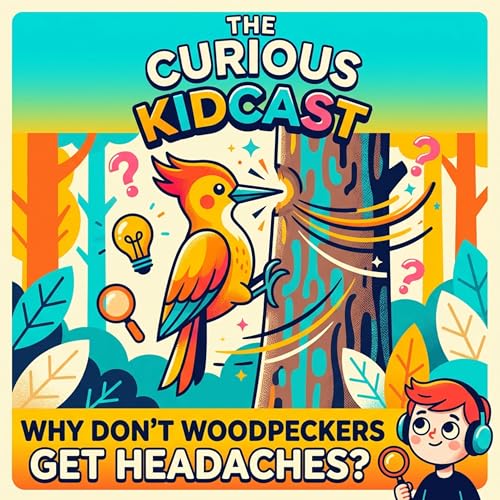
The Curious Kidcast Podcast Por Andy Irving arte de portada

The Curious Kidcast

The Curious Kidcast

De: Andy Irving
Escúchala gratis

The Curious Kidcast is a fun and educational podcast for kids aged 7 to 11 who love exploring science, nature, and curious questions about the world. Each episode answers fascinating questions kids ask—like “Why is the sky blue?”, “Do fish sleep?”, and more! Perfect for parents and families looking for an entertaining kids’ science podcast full of fun facts, discovery, and learning adventures. Tune in for engaging stories, easy explanations, and exciting explorations of the weird and wonderful things kids wonder about.Andy Irving
Episodios
  • Why Don't Woodpeckers Get Headaches? | Amazing Animal facts for Kids
    Apr 8 2026

    A woodpecker can hammer its beak into a tree trunk up to 10,000 times every single day. That is faster than most people can clap, and it never stops. Yet despite all that pounding, woodpeckers go about their business without any sign of pain, dizziness, or injury.

    In this episode, Charlie digs into the extraordinary biology behind one of nature's most puzzling birds, exploring why their entire body, from beak to tail, is built to absorb the kind of forces that would knock any human flat.

    Along the way, listeners discover one of the strangest facts in all of zoology: where exactly a woodpecker's extremely long tongue actually goes when it is not in use. The answer is genuinely astonishing.

    Did you know?

    The word for copying ideas from nature to solve human problems is biomimicry. Scientists studying woodpeckers have used their findings to help design better helmets and safer sports gear for humans.

    The 8 Superpowers Explored in This Episode

    Superpower 01

    The Specialised Skull

    Strong, uniquely shaped, and lined with natural padding that cushions the brain on every impact, like built-in bubble wrap.

    Superpower 02

    The Chisel Beak

    Shaped like a woodworking chisel and designed to redirect force away from the brain rather than directly into it.

    Superpower 03

    A Snugly Fitted Brain

    A smaller, tightly packed brain has less room to slosh around during impact. Less wobble means far less damage.

    Superpower 04

    Natural Shock Absorbers

    Bone structures and soft tissues in the head work together like the springy soles of running trainers, absorbing each peck.

    Superpower 05

    Powerful Neck Muscles

    Incredibly strong muscles that both power the peck and act as a braking system, bringing the head to a safe, controlled stop.

    Superpower 06

    The Wrap-Around Tongue

    The tongue-support bones are so long they loop around the outside of the skull, potentially acting as a built-in crash helmet.

    Superpower 07

    Built-In Safety Goggles

    A special extra eyelid called the nictitating membrane snaps shut during pecking, protecting the eyes from flying wood chips.

    Superpower 08

    Grippy Feet and a Stiff Tail

    Two strong feet and a rigid tail create a stable three-point base on the tree, keeping every peck perfectly controlled.


    New science adventures land every week. Subscribe on your favourite podcast app and share the show with a curious kid you know.

    Got a Curious Question?

    Your question could be the next episode. The weirder the better. Send it in at curiouskidcast.com.

    The Curious Kidcast — Science, nature, and the world's best questions, explored for curious kids aged 7–12.


    Más Menos
    12 m
  • Do Cats, Lions and Tigers Understand each other? | Animal facts for kids
    Apr 1 2026

    In this episode of The Curious Kidcast, host Charlie dives deep into the science of animal communication to find out whether cats, lions, and tigers can actually understand each other.

    This episode is packed with fun facts about animal communication, the feline family, body language in big cats, and even whether cats from different countries around the world speak the same language. It is a brilliant episode for curious kids aged 7 to 11, perfect for science learning at home, homeschool nature study, family car journeys, or just satisfying that brilliant, never-ending curiosity your child carries everywhere.

    What Your Child Will Learn

    This episode introduces kids to real science concepts in a fun, accessible, and laugh-out-loud way. By the end of the episode, young listeners will be able to:

    • Explain what the feline family is and which animals belong to it
    • Understand how cats, lions, and tigers use body language, sound, and scent to communicate
    • Describe what a slow blink means in cat communication
    • Explain why cats from different countries can still understand each other
    • Understand the difference between species-specific signals and universal animal communication
    • Answer fun quiz questions about animal science with growing confidence

    Key Science Topics Covered

    The Feline Family

    Cats, lions, and tigers all belong to the biological family Felidae, commonly called the feline family. This shared ancestry means they have a lot of physical and behavioural traits in common, including sharp claws, strong hunting instincts, excellent night vision, and overlapping communication systems. Understanding this helps children build foundational knowledge in biology, taxonomy, and the natural world.

    Do Cats From Different Countries Understand Each Other?

    A standout section of this episode explores whether a cat from England would understand a cat from Japan or Canada. The answer is a resounding yes. Domestic cats are all the same species and use the same core set of signals regardless of geography. This connects to big ideas in biology around species identity, universal behaviour, and the difference between learned habits and instinctive communication.

    Why This Episode Is Great for Homeschoolers and Families

    The Curious Kidcast is designed to make science and nature irresistibly engaging for children aged 7 to 11. This episode on feline communication ticks a wide range of curriculum boxes, including animal biology, ecosystems, classification of living things, and communication in the natural world. It also encourages children to ask questions about everyday life, like wondering why your cat behaves the way it does, and to turn those observations into genuine scientific curiosity.

    About The Curious Kidcast

    The Curious Kidcast is a fun, facts-filled science and nature podcast for children aged 7 to 11. Every episode starts with a real question sent in by a real kid, and host Charlie investigates the answer with plenty of humour, surprising science, and an end-of-episode quiz. Episodes are screen-free, family-friendly, and designed to make learning feel like an adventure. The Curious Kidcast is perfect for curious kids, busy parents, homeschool families, and anyone who believes that asking big questions is always a great idea.

    Subscribe and never miss an episode.

    If your child has a question they would love Charlie to investigate, head to curiouskidcast.com and send it in. You can also find The Curious Kidcast on Spotify, Apple Podcasts, and wherever you listen to podcasts.

    Más Menos
    9 m
  • Why are bubbles always round? | Science for kids explained
    Mar 25 2026

    Ever watched a bubble float past your nose and thought, "Hang on, why is that round?" In this episode of The Curious Kidcast, your host Charlie dives deep into one of the most brilliant questions a curious kid can ask. Packed with fun facts, gentle laughs, real science and everyday examples from nature, this is family learning at its best. Whether you are a kid, a parent, a homeschooling family or just someone who never quite got a proper answer to this question, you are in exactly the right place.

    In this episode you will learn:

    • What a bubble actually is and how it forms
    • What surface tension means in simple, fun language
    • Why a sphere is the most efficient shape in nature
    • How air pressure and the soap film work together
    • Why shaped wands still make round bubbles
    • How bubble science connects to raindrops and everyday nature
    • What minimal surfaces are and why scientists actually care about soap films

    Episode Summary

    This kids science podcast episode starts with a brilliant question from Priya, a listener from Birmingham, England, who was blowing bubbles through a straw in her living room when it suddenly hit her: why are they always round. Charlie takes that question and turns it into a fun, fact filled journey through physics, nature and the hidden maths that shapes the world around us.

    Kids discover that bubbles are round because of a force called surface tension, which pulls the thin soap film inward while the trapped air inside pushes outward. When these forces balance perfectly in every direction, the shape that uses the least surface area and the least energy is always a sphere. The episode uses real life comparisons, silly observations and easy examples to make sure the science sticks.

    Along the way, there are fun digressions about water strider insects walking on ponds, why the middle seat on a packed bus is a terrible experience for bubbles and people alike, and why being scientifically lazy is sometimes the most correct thing you can do. It is the kind of episode that sparks dinner table conversations and garden experiments in equal measure.

    Science Concepts Covered

    • Surface tension and why water molecules are extremely clingy
    • Spheres and minimal surface area as a geometric and physical principle
    • Energy efficiency in natural systems
    • Air pressure and how it balances with surface tension inside a bubble
    • Soap chemistry and why plain water does not make good bubbles
    • Minimal surfaces and how mathematicians and engineers use soap films
    • Nature connections including raindrops, water droplets and foam

    Why Kids and Families Love The Curious Kidcast

    The Curious Kidcast is a science and nature podcast built around the questions real kids actually ask. Every episode takes a single brilliant question and answers it properly, with real facts, fun storytelling and plenty of comedy. It is designed to make kids feel like their curiosity matters, and to give parents and homeschooling families a reliable, entertaining and genuinely educational listen they can enjoy together.

    Episodes cover science, nature, the human body, animals, space, everyday physics and much more. If your child has a question they would love to hear answered on the show, you can submit it directly on the website.

    Have a Question for Charlie

    No question is too silly, too weird or too random on this show. If your child has been wondering about something and cannot get a satisfying answer, send it in. It might just become the next episode. Visit curiouskidcast.com to submit your question and subscribe so you never miss an episode.

    If you are listening on a podcast app, leaving a review really does help other curious kids and families find the show. Share this episode with a friend, a classmate, a parent or anyone who has ever looked at a bubble and wondered why it is round.

    Keywords: science for kids, educational podcast, homeschooling, family learning, kids podcast, fun facts, nature science, parenting, curious kids, surface tension, bubble science

    Más Menos
    12 m
Todavía no hay opiniones