Episodios

  • #389 – How Tal Peretz questioned the AI playbook and created results competitors can't match
    Jan 14 2026

    A story about choosing what others avoid—and creating competitive advantage no one can copy.

    This episode is for sales-led SaaS founders wondering why their AI product investments are not creating the competitive edge they expected.

    Most SaaS companies race to add AI features and wonder why nothing changes.

    Tal Peretz, CEO of Onfire, took the opposite path. Before writing a single line of code, he interviewed 275 revenue leaders. Then he spent months building a proprietary data layer from the public web—Reddit, Stack Overflow, Discord—tracking 50 million engineers. Only after that foundation was solid did he add AI on top.

    The result: customers generating 4x more pipeline with the same headcount, $50 million in closed deals since beta launch, and a $20 million funding round.

    And this inspired me to invite Tal to my podcast. We explore how mastering curiosity—reading signals competitors ignore—creates competitive moats that compound over time. Tal shares how 275 customer interviews revealed one critical pattern everyone else missed, and why choosing the hardest buyers simplified everything else. You'll discover why he spent months building invisible infrastructure before writing features, and how that decision alone separated Onfire from hundreds of AI tools fighting for attention.

    We also zoom in on three of the 10 traits that define remarkable software companies:

    • Master the art of curiosity
    • Aim to be different, not just better
    • Sell the idea, not the product

    Tal's journey proves that remarkable companies don't chase the obvious path—they build the hard thing first, creating advantages no competitor can copy.

    Here's one of Tal's quotes that captures his contrarian thesis:

    "AI basically makes sales much harder, not easier, because the noise-to-ratio right now goes up. When we started the company, we said the main advantage is to find the needle in the haystack in your context. Building what we call our Knowledge Graph—this is probably the main IP of the company."

    By listening to this episode, you'll learn:

    • Why building infrastructure before features creates advantages competitors cannot replicate
    • What customer discovery reveals when you interview hundreds before building anything
    • Why focusing on the hardest segment often creates easier sales than targeting everyone
    • Why adding intelligence to strong foundations beats bolting features onto weak data

    For more information about the guest from this week:

    Guest: Tal Peretz, Co-founder and CEO at Onfire

    Website: onfire.ai

    Más Menos
    43 m
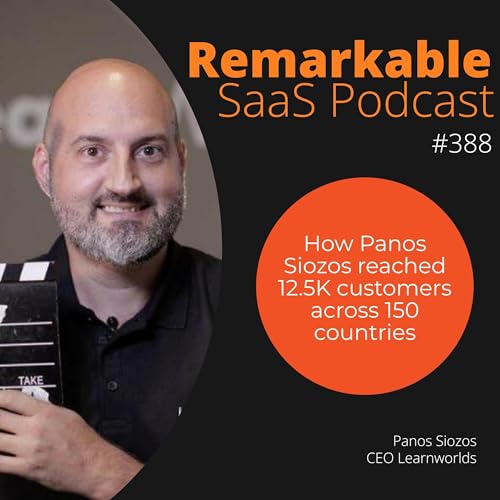
  • #388 – How Panos Siozos reached 12.5K customers across 150 countries
    Jan 7 2026

    A story about solving two problems everyone else picks between.

    This episode is for SaaS founders with deep domain expertise—and wondering why the market isn't responding the way they expected.

    Most SaaS companies struggle because they know what the solution should be.

    Panos Siozos, CEO of Learnworlds, came from a research background in educational technology—three generations of teachers, deep pedagogical expertise. He could have built the pedagogically perfect platform.

    Instead, he put the scientists in the backseat and listened to what customers actually needed. That decision took him from building in isolation to 12,500 customers across 150 countries.

    This inspired me to invite Panos to my podcast. We explore why expertise becomes dangerous when it drowns out customer truth. Panos shares what happens when your expertise blinds you to what customers already know. You'll discover why Learnworlds wins where every competitor chooses: learning depth or selling power.

    We also zoom in on three of the 10 traits that define remarkable software companies:

    • They offer something valuable AND desirable
    • They master the art of curiosity
    • They create NEW value possibilities

    Panos's story is proof that customer problems beat perfect solutions.

    Here's one of Panos's quotes that captures his customer-first philosophy:

    "We put the scientists in the backseat. We said, Okay, now we may be theoretical experts in pedagogy and educational technology, but these guys, they have a problem. We need to solve their real problem, not the things that we have in our mind."

    By listening to this episode, you'll learn:

    • Why theoretical expertise becomes dangerous when it silences customer problems
    • What happens when you marry deep capability with practical customer needs
    • When customers show you markets you never planned to serve
    • Why solving today's customer problem beats building tomorrow's perfect product

    Guest Info

    Guest: Panos Siozos, CEO & Co-founder Learnworlds Website: www.learnworlds.com

    Más Menos
    54 m
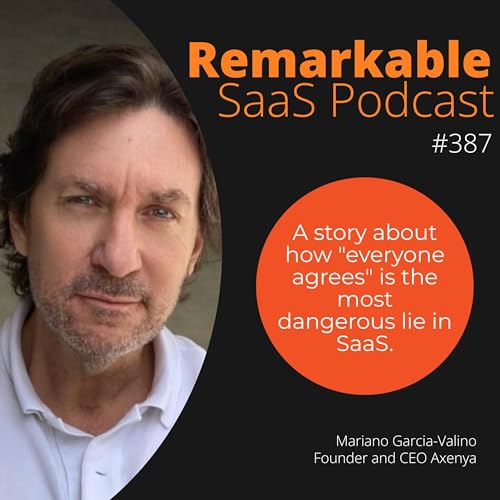
  • #387 – How Mariano Garcia-Valiño proved he could save lives—but couldn't find anyone willing to pay
    Nov 19 2025

    A story about how "everyone agrees" is the most dangerous lie in SaaS.

    This episode is for SaaS founders frustrated watching their solution solve real problems—but wondering why no one actually buys it.

    Most healthcare startups don't fail because their tech doesn't work. They fail because they can't find anyone willing to pay for it.

    Mariano Garcia-Valiño, Founder and CEO of Axenya, spent 18 months proving his preventive care model worked clinically—reducing diabetes costs by 20% and mortality risk by 18%. Then he spent another year without selling a single dollar because insurers, hospitals, and patients all had reasons not to care enough to pay.

    He found the answer by buying a healthcare broker and changing who he sold to: employers in Brazil who actually bear the cost and have the timeframe to benefit from prevention.

    This inspired me to invite Mariano to my podcast. We explore why solving the right problem for the wrong buyer kills traction—and how changing your business model changes who cares. Mariano shares how he rejected the obvious paths (selling to insurers, doctors, or patients) and instead built a broker model that aligns incentives with outcomes. You'll discover why clinical proof means nothing without economic urgency.

    We also zoom in on three of the 10 traits that define remarkable software companies:

    • Acknowledge you cannot please everyone
    • Master the art of curiosity
    • Aim to be different, not just better

    Mariano's story is proof that the best solution dies without the right buyer—and why changing your business model, not your product could be the easy way out.

    Here's one of Mariano's quotes that captures the challenge he faced:

    "It's one thing to actually see the problem and find a technical solution for the problem. It's a different thing to deploy it in the right place within a very complex value chain that has a lot of incentives that are not well aligned."

    By listening to this episode, you'll learn:

    • Why solving a highly valuable and critical problem alone won't create a market without economic incentive alignment
    • What happens when you build for huge global humanity problems instead of expensive local ones
    • Why focusing on who pays reveals better opportunities than focusing on who uses
    • How buying your distribution channel creates stickiness competitors can't copy

    For more information about the guest from this week:

    Guest: Mariano Garcia-Valiño, Founder and CEO at Axenya

    Website: axenya.com

    Más Menos
    45 m
  • #386 – How Rex Kurzius built a business that funds itself
    Nov 12 2025

    A story about choosing autonomy over speed—and building something that lasts.

    This episode is for SaaS founders tired of chasing growth rounds—and wondering if slow, profitable building could win.

    Most software companies raise capital to scale fast. Rex Kurzius, Founder of Asset Panda, rejected that path entirely. His father ran a bakery. His brother built MailChimp. Rex grew up watching immigrant work ethic turn into entrepreneurial success—and applied the same principle to software.

    He spent 13 years building Asset Panda from startup to a world-class asset tracking platform. No investors. No board pressure. No artificial timelines. Just solving one problem—asset tracking—and letting customer revenue fund each next step.

    And this inspired me to invite Rex to my podcast. We explore why staying curious matters more than being right. Rex shares his thinking on positioning pivots (consumer to business, product to platform), building without investor timelines, and the inverse relationship between AI and headcount growth. You'll discover why he calls himself the turtle in the race—and what slow, steady building creates.

    We also zoom in on three of the 10 traits that define remarkable software companies:

    • Master the art of curiosity
    • Focus on the essence
    • Turn customers into fans

    Rex's story is proof that building slow beats chasing speed—when you solve real problems.

    Here's one of Rex's quotes that captures his growth philosophy:

    "It's not about being perfect, and it's not about being right. It's about being curious and having the ability to deal with failure, learn from that failure, and adapt to succeed."

    By listening to this episode, you'll learn:

    • Why staying curious beats being right when building software
    • What happens when you fund growth with customer revenue, not investor capital
    • Why solving client problems matters more than hitting investor timelines
    • How building slow creates more enduring value than chasing speed

    For more information about the guest from this week:

    Guest: Rex Kurzius, Founder and CEO of Asset Panda

    Website: assetpanda.com

    Más Menos
    50 m
  • #385 – Speed is the strategy: Redefining Enterprise software for a changing world
    Nov 5 2025

    A story about speed as strategy—and why saying no to billion-dollar deals built a stronger company.

    This episode is for SaaS founders who feel stuck between landing big logos and building what actually scales.

    Most SaaS companies don't fail because they lack ambition. They fail because they chase the wrong customers.

    Mark Walker, CEO of Nue, took a different path. With decades in enterprise software—ERP, CRM, NetSuite—he joined Nue in March 2022 when it was pre-revenue and a "science experiment." He made one decision that changed everything: focus on speed over complexity. When Nvidia came calling, he said no. When asked to build for everyone, he picked his peers instead.

    And this inspired me to invite Mark to my podcast. We explore why treating speed as your core product creates defensible value. Mark shares his philosophy on saying no to wrong-fit customers, building modular systems that compress implementation from years to weeks, and why honesty beats hype when competing against legacy vendors. You'll discover why OpenAI went live in 8 weeks and Anthropic in 12—and what that speed signals to the market.

    We also zoom in on two of the 10 traits that define remarkable software companies:

    • They acknowledge they cannot please everyone
    • They aim to be different, not just better

    Mark's story is proof that when you optimize every decision for customer speed, saying no to complexity becomes your competitive advantage.

    Here's one of Mark's quotes that captures his approach to market focus:

    "If you want to be great at something, you have to be bad at something else. There are no NFL linemen who are also World Champion marathoners. They're both elite athletes, but they're not the same athlete."

    By listening to this episode, you'll learn:

    • Why the fastest implementations come from saying no to features, not adding them
    • What happens when you tell a billion-dollar prospect they're not the right fit
    • When modularity beats monolithic systems in multi-model revenue businesses
    • Why traditional enterprises are preemptively switching systems before they know what's coming

    For more information about the guest from this week:

    Guest: Mark Walker, CEO at Nue

    Website: nue.io

    Más Menos
    54 m
  • #384 – How Wokelo built trust (and premium prices) by choosing depth over speed
    Oct 29 2025

    When everyone else optimized for instant answers, Sid Masson built for depth and accuracy—and enterprise customers paid more for the difference.

    This episode is for SaaS founders who feel trapped competing on speed—and suspect their customers actually want something else.

    Most SaaS companies don't fail because they're too slow. They fail because they optimize for speed over trust.

    Sid Masson, CEO and Co-founder of Wokelo, took a different path. He started his career as a management consultant doing private equity due diligence with dozens of tabs open, knowing how costly missed insights could be. When he began experimenting with early GPT models while pursuing his second master's in AI, he saw the potential to automate deep analysis—but refused to compromise on rigor.

    While others chased instant gratification, Wokelo focused on producing more in-depth, decision-grade insights. That choice became its edge. Enterprise clients quickly recognized that thoughtful, well-supported answers were worth more than instant ones.

    This inspired me to invite Sid to my podcast. We explore why building for accuracy rather than instant gratification creates differentiation in competitive markets. Sid shares hard-won lessons about segment selection, the hidden cost of trying to serve everyone, and why their first 10 customers taught them more about usage patterns than any growth hack could. You’ll hear how customers measured ROI not in hours logged, but in the depth of impact—renewing and expanding after a single insight shifted key client conversations.

    We also zoom in on two of the 10 traits that define remarkable software companies:

    • They acknowledge they cannot please everyone
    • They aim to be different, not just better

    Sid's story is proof that constraints drive innovation—and capital efficiency forces strategic clarity.

    Here's one of Sid's quotes that captures his approach to capital efficiency:

    "Capital efficiency for us, being slightly constrained at times, actually helps us in being more innovative. The most innovations, the most disruptive ideas, actually come out of constraints. We don't want to give our team that luxury that, hey, there's enough money on the table that I can go and do a land grab. We need to still solve a few fundamentals."

    By listening to this episode, you'll learn:

    • Why accuracy at scale requires patience—not just better prompts
    • What happens when you design for outcomes instead of feature parity
    • When capital constraints become competitive advantages rather than limitations
    • Why your first 10 customers teach you more about segmentation than any persona document

    Guest Information

    For more information about the guest from this week:

    • Guest: Sid Masson, CEO and Co-founder of Wokelo AI
    • Website: wokelo.ai
    • Email: sid@wokelo.ai
    Más Menos
    44 m
  • #383 - How Joshua Summers turned a banking crisis into an AI workforce for credit
    Oct 22 2025

    This episode is for founders stuck building features nobody asked for—who want to discover what customers actually need.

    Joshua Summers, CEO of EnFi, took a different path. After helping dozens of startups move their cash during the Silicon Valley Bank collapse, he discovered the real problem wasn't deposits or covenants—it was human capacity to assess risk. While others rushed to capitalize on the crisis, he spent months investigating what actually broke.

    And this inspired me to invite Joshua to my podcast. We explore how building from crisis reveals opportunities others miss. Joshua shares hard-earned wisdom about why founder-led sales beats hiring early, what happens when you achieve greater-than-human accuracy, and why building a culture where employees jump at the chance to work with you again matters more than your product. You'll discover why taking more capital early can save your company—even if it means more dilution.

    We also zoom in on two of the 10 traits that define remarkable software companies:

    • Remarkable software companies focus on the essence
    • Remarkable software companies create something valuable and desirable

    Joshua's story is proof that the best insights come when you're not trying to sell anything.

    Here's one of Joshua's quotes that captures his approach to building companies:

    “Culture itself is an organism. It lives, it breathes, and it is impacted positively or negatively by every single thing around it. You can't design a culture. You can't say here's what our company will feel like, not look like, but feel like as an employee, it's impossible, but you can feed a culture with all the good things that hopefully help it to evolve like an organism."

    By listening to this episode, you'll learn:

    • Why building in the open beats perfectionism
    • How 14 people can operate like a company of 150
    • When discovering the essence changes everything
    • What makes employees want to work with you (again)

    For more information about the guest from this week:

    Guest: Joshua Summers, CEO of EnFi

    Website: www.enfi.ai

    Más Menos
    50 m
  • #382 - How Martin Balaam chose depth over scale and built to $7M ARR
    Oct 15 2025

    This episode is for SaaS founders tired of the "grow at all costs" playbook—who suspect there's power in saying no to the wrong customers.

    Most SaaS companies don't fail because of bad product. They fail because they try to please everyone. Martin Balaam, CEO of Pimberly, chose restraint over reach. Former physicist turned serial entrepreneur, he'd already scaled and exited Jigsaw24 at 3x returns. At Pimberly, he refuses customers his team can't delight—even when they're ready to sign.

    And this inspired me to invite Martin to my podcast. We explore how qualifying customers as rigorously as they qualify you creates compound advantages. Martin shares hard-won insights about why he walked away from license-only models, when to choose service depth over customer volume, and what happens when you give your product roadmap to customers instead of VCs. You'll discover why maintaining sub-5% churn matters more than doubling growth rates.

    We also zoom in on two of the 10 traits that define remarkable software companies:

    • Aim to be different, not just better
    • Focus on the essence

    Martin's story is proof that sustainable SaaS growth comes from doing what others call unscalable.

    Here's one of Martin's quotes that captures his contrarian philosophy:

    "I really don't want to lose customers. I know from my life experience how much time and effort, blood, sweat, and tears you have in trying to acquire a customer. We'll openly put our hand up and say I can't see that this is actually gonna add the value—even though they might be happy to sign."

    By listening to this episode, you'll learn:

    • Why saying no to willing customers protects your business
    • What "VIP leads" actually means (hint: not big orders)
    • When founder-led sales should naturally transition
    • Why physical presence beats remote-first for market entry

    For more information about the guest from this week:

    Guest: Martin Balaam, CEO & Founder Pimberly

    Website: pimberly.com

    Más Menos
    52 m
adbl_web_global_use_to_activate_DT_webcro_1694_expandible_banner_T1