Switchyard Podcast Por The University of Tulsa arte de portada

Switchyard

Switchyard

De: The University of Tulsa
Escúchala gratis

Switchyard is a podcast for people hungry for eye-opening essays, moving fiction, soul-stirring poetry, and honest, thought-provoking conversation. Join us monthly for new content.2023 Arte Ciencias Sociales Historia y Crítica Literaria
Episodios
  • This Land: Oklahoma's Past, America's Future
    Oct 13 2025

    In January 2025, just after the Inauguration of President Donald Trump, Switchyard organized a gathering of journalists from across the country to discuss how we would go about covering the new administration. We gathered together the biographers of Michelle Obama and Mitch McConnell, authors of books about the Koch Brothers and The Family, about Amazon and Google and Facebook, about the rise of white supremacy and the cash value of racism. We featured writers and editors for the New York Times, the LA Times, The New Yorker, The Atlantic, and Mother Jones, for StoryCorps, This American Life, and Reveal. We also had musicians, filmmakers, novelists, essayists, and poets.

    As we had hoped, the gathering was a source of solace, a call to action and a chance to recommit ourselves to our values and best practices and a rekindling of our belief in the power of storytelling, in all its forms. In these unprecedented and difficult times, we are once again reporting on a president who characterizes journalists as enemies of the state and jokes about killing us. And he empowers and emboldens state and local level officials to indulge their most authoritarian impulses. Here, in the heart of Tulsa, on the grounds of the Tulsa Race Massacre and the end of the Trail of Tears, we have state officials who have sought to block the teaching of that history while requiring schools to buy Bibles branded with the new president's name.

    The solemn question each of our panels addressed: What are we going to do now?

    In this live episode, Rebecca Nagle and Caleb Gayle discuss how Oklahoma's peculiar history both stands apart from and seems to encapsulate the history of America.

    Rebecca Nagle is an award-winning journalist and citizen of the Cherokee Nation. She is the author of By The Fire We Carry: The Generation-Long Fight for Justice on Native Land and the writer and host of the podcast This Land. Her writing on Native representation, federal Indian law, and tribal sovereignty has been featured in The Atlantic, the Washington Post, The Guardian, USA Today, and Indian Country Today. She is the recipient of the American Mosaic Journalism Prize, Women's Media Center's Exceptional Journalism Award, a Peabody nomination, and numerous awards from the Indigenous Journalist Association.

    Caleb Gayle is the author of We Refuse to Forget: A True Story of Black Creek, American Identity, and Power and Black Moses: A Saga of Ambition and the Fight for a Black State. He is an award-winning journalist who writes about race and identity and is a contributing writer for the New York Times Magazine. His writing has been featured in The New York Times, The Guardian, Three Penny Review, Guernica, New York Times Magazine, The Atlantic, Harvard Review, Pacific Standard, and The New Republic. He serves as a Senior Fellow and Professor of Practice at Northeastern University as well as a Visiting Scholar at the Arthur Carter Journalism Institute at NYU.

    Más Menos
    50 m
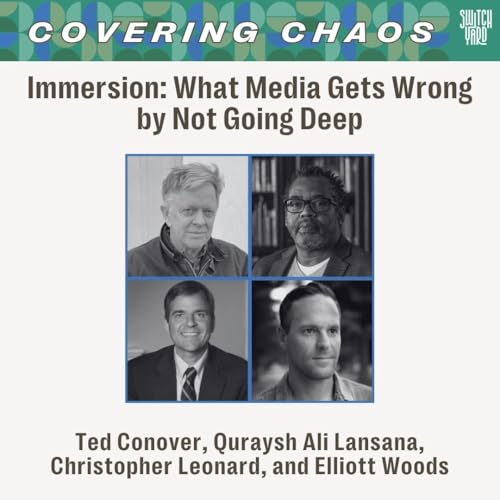
  • Immersion: What Media Gets Wrong by Not Going Deep
    Oct 13 2025

    In January 2025, just after the Inauguration of President Donald Trump, Switchyard organized a gathering of journalists from across the country to discuss how we would go about covering the new administration. We gathered together the biographers of Michelle Obama and Mitch McConnell, authors of books about the Koch Brothers and The Family, about Amazon and Google and Facebook, about the rise of white supremacy and the cash value of racism. We featured writers and editors for the New York Times, the LA Times, The New Yorker, The Atlantic, and Mother Jones, for StoryCorps, This American Life, and Reveal. We also had musicians, filmmakers, novelists, essayists, and poets.

    As we had hoped, the gathering was a source of solace, a call to action and a chance to recommit ourselves to our values and best practices and a rekindling of our belief in the power of storytelling, in all its forms. In these unprecedented and difficult times, we are once again reporting on a president who characterizes journalists as enemies of the state and jokes about killing us. And he empowers and emboldens state and local level officials to indulge their most authoritarian impulses. Here, in the heart of Tulsa, on the grounds of the Tulsa Race Massacre and the end of the Trail of Tears, we have state officials who have sought to block the teaching of that history while requiring schools to buy Bibles branded with the new president's name.

    The solemn question each of our panels addressed: What are we going to do now?

    In this live episode, we hear from Ted Conover, Quraysh Ali Lansana, Christopher Leonard, and Elliott Woods with responses from Theodore Ross and Esther Honig.

    Ted Conover the award-winning author of Cheap Land Colorado: Off-Gridders at America's Edge, Newjack: Guarding Sing Sing, Rolling Nowhere: Riding the Rails with America's Hoboes, Coyotes: A Journey Across Borders with America's Mexican Migrants, and several other works. He has also written for The New Yorker, New York Times Magazine, and Harper's. He is a professor at NYU's Arthur L. Carter Journalism Institute.

    Quraysh Ali Lansana is author of over twenty books in poetry, nonfiction, and children's literature. He is a Visiting Associate Professor of English/Creative Writing at the University of Tulsa and an alumnus of the Tulsa Artist Fellowship. Lansana is Executive Producer of KOSU's Focus: Black Oklahoma, a monthly radio program, which has received a duPont-Columbia Award, a NAACP Image Award, and a Peabody Award nomination.

    Christopher Leonard is a business reporter and author whose work has appeared in The New York Times, Fortune, and Time magazine. He is the New York Times-bestselling author of The Lords of Easy Money, The Meat Racket, and Kochland, which won the J. Anthony Lukas Work-in-Progress Award. He is the founder and director of the Watchdog Writers Group at the University of Missouri, a nonprofit investigative reporting center.

    Elliott Woods is the host of Third Squad, an Edward R. Murrow Award-winning podcast about the Afghanistan War. He has covered America's post-9/11 wars, veterans' issues, politics, humanitarian crises, right-wing extremism, and the environment for numerous publications, including Texas Monthly, The New Republic, Outside Magazine, and Wired. His work has received an Overseas Press Club Award, a National Magazine Award, and a Chairman's Grant from the National Endowment for the Humanities.

    Theodore Ross is the editor-in-chief of the Food & Environment Reporting Network. He is an editor, writer, and television and audio producer with more than twenty years of experience at national publications, websites, and productions. He was an executive editor of The New Republic, and an editor at Harper's and Men's Journal. His writing has appeared in the New York Times Magazine, Harper's, The New Republic, The Atlantic, VICE, and Businessweek.

    Esther Honig's work focuses on the intersection of agriculture and immigration. Her work has been published by The Nation, Snap Judgment, Latino USA, NPR, and Mother Jones. She is a recipient of the UC Berkeley 11th Hour Food and Farming Fellowship and her work has been recognized by the Edward R. Murrow Awards and the Society for Professional Journalists. She is a producer for StoryCorps where she helps everyday people tell their own profound and illuminating stories.

    Más Menos
    1 h y 1 m
  • Merchants of Fear: Stirring Hatred for Political Gain
    Oct 13 2025

    In January 2025, just after the Inauguration of President Donald Trump, Switchyard organized a gathering of journalists from across the country to discuss how we would go about covering the new administration. We gathered together the biographers of Michelle Obama and Mitch McConnell, authors of books about the Koch Brothers and The Family, about Amazon and Google and Facebook, about the rise of white supremacy and the cash value of racism. We featured writers and editors for the New York Times, the LA Times, The New Yorker, The Atlantic, and Mother Jones, for StoryCorps, This American Life, and Reveal. We also had musicians, filmmakers, novelists, essayists, and poets.

    As we had hoped, the gathering was a source of solace, a call to action and a chance to recommit ourselves to our values and best practices and a rekindling of our belief in the power of storytelling, in all its forms. In these unprecedented and difficult times, we are once again reporting on a president who characterizes journalists as enemies of the state and jokes about killing us. And he empowers and emboldens state and local level officials to indulge their most authoritarian impulses. Here, in the heart of Tulsa, on the grounds of the Tulsa Race Massacre and the end of the Trail of Tears, we have state officials who have sought to block the teaching of that history while requiring schools to buy Bibles branded with the new president's name.

    The solemn question each of our panels addressed: What are we going to do now?

    In this live episode, we hear from Siddhartha Deb, Ralph Eubanks, C.J. Janovy, and Patrick Phillips with responses from Eliza Barclay and Jenny Casas.

    Siddhartha Deb, author of Twilight Prisoners: The Rise of the Hindu Right and the Fall of India. His fiction and nonfiction have been longlisted for the International Dublin Literary Award, shortlisted for the Orwell Prize, and been awarded the Pen Open prize and the 2024 Anthony Veasna So Fiction prize. His journalism and essays have appeared in the New York Times, The Guardian, The New Republic, Dissent, The Baffler, N+1, and Caravan.

    Ralph Eubanks is the author of A Place Like Mississippi: A Journey Through A Real and Imagined Literary Landscape, Ever Is a Long Time, The House at the End of the Road, andd When It's Darkness on the Delta: An American Reckoning. His work focuses on race, identity, and the American South, and has appeared in Vanity Fair, The American Scholar, The Georgia Review, and The New Yorker. He is a 2007 Guggenheim fellow, a 2021-2022 Harvard Radcliffe Institute fellow, and the recipient of a 2023 Mississippi Governor's Arts Award.

    C.J. Janovy is the author of No Place Like Home: Lessons in Activism from LGBT Kansas, which won the 2019 Stubbendieck Great Plains Distinguished Book Prize and was nominated for a Lambda Literary Award in LGBTQ nonfiction. She is director of content at Kansas City's NPR affiliate, and spent a decade as editor of the city's alt-weekly. Her work has also been published by Switchyard, Catapult, NPR, New Letters, Ms., and the New York Times.

    Patrick Phillips is the author of Blood at the Root: A Racial Cleansing in America, which was named a best book of the year by the New York Times, the Boston Globe, and Smithsonian. He is also the author of four books of poems, including Elegy for a Broken Machine, which was a finalist for the National Book Award. He is a recent fellow at the Cullman Center for Writers and Scholars at the New York Public Library. He teaches writing and literature at Stanford.

    Eliza Barclay is the climate editor for New York Times Opinion where she commissions and edits guest essays on climate, environment and food issues. In 2024, she curated and edited the series "What to Eat on a Burning Planet" about how lawmakers, scientists, farmers and consumers can confront and solve the growing strain on our global food supply and the natural systems it depends on. She was the science, health and climate editor at Vox, where she co-wrote and co-edited the award-winning "supertrees" project.

    Jenny Casas is a senior radio editor for Reveal. She was previously a narrative audio producer at the New York Times. Before that, she reported on the ways that cities systematically fail their people, for WNYC Studios, USA Today, City Bureau, and St. Louis Public Radio.

    Más Menos
    58 m
Todavía no hay opiniones