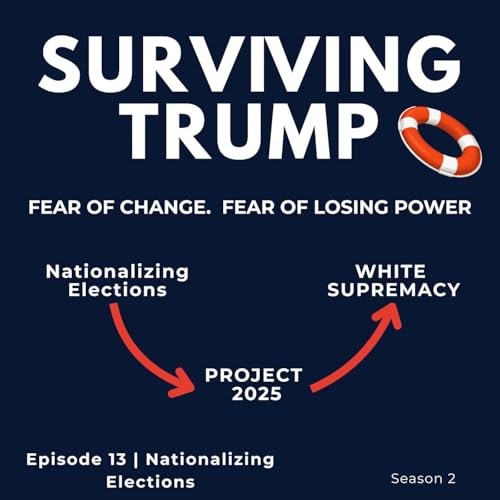
Surviving Trump: Your Essential Guide to His Second Term Podcast Por Bella Goode arte de portada

Surviving Trump: Your Essential Guide to His Second Term

Surviving Trump: Your Essential Guide to His Second Term

De: Bella Goode
Escúchala gratis

Navigating the chaos of today’s politics can be overwhelming —this show helps make sense of it all. In about 30 minutes each week, host Bella Goode breaks down the players, policies, and threats facing democracy — in plain language and straight talk. Your crash course in today’s politics


© 2026 Surviving Trump: Your Essential Guide to His Second Term
Ciencia Política Política y Gobierno
Episodios
  • How ICE Was Supercharged: Ideology, Executive Authority, and the Growth of Immigration Raids
    Apr 2 2026

    Send us Fan Mail

    In Episode 15 of Surviving Trump, we examine how ICE was strengthened, accelerated, and reoriented during Trump’s second term.

    This episode is not about one raid. It’s about how enforcement expanded — through political rhetoric, executive authority, internal policy directives, institutional loyalty, and rapid hiring.

    When those forces align, operations intensify. Arrests increase. Detention grows. Procedural safeguards narrow.

    Episode 15 breaks down how that alignment takes shape.


    In This Episode

    • How immigration is framed as invasion and demographic threat


    • Stephen Miller’s role in translating ideology into enforcement strategy


    • Internal DHS and ICE directives that reinterpret warrant authority and expand removal practices


    • Senior officials defending aggressive enforcement posture


    • Rapid hiring and tactical deployment reshaping field operations


    Why This Matters

    ICE did not simply “become more active.” It was deliberately scaled up.

    When ideology, executive power, policy reinterpretation, and enforcement capacity align, the result is not only more arrests — it is a shift in who feels secure remaining in the country and participating in civic life.

    Understanding how the system was intensified is essential to understanding what follows.


    Next Episode

    ICE, Part 2: The Consequences of Expanded ICE Operations

    We move from construction to impact — examining how concentrated ICE operations affect cities like Minneapolis, expand detention infrastructure, and provoke organized resistance.


    Support the show

    Bella Goode is a pseudonym — but the voice, research, and mission are all real. A Republican turned Democrat advocate in 2016, I was raised by middle class parents in Pennsylvania. I’m a former marketing executive, entrepreneur, and lifelong learner with an MBA from Wharton and a Master’s in Psychology from Penn. I spent decades telling stories in the business world; now I use those skills to connect the dots in American politics.

    I’m here because the truth matters — and because the stakes have never been higher. Surviving Trump isn’t lighthearted. It’s clarity, evidence, and a fight for the future of our democracy.

    Follow my blog on Substack https://survivingtrumppodcast.substack.com


    Más Menos
    16 m
  • Voting Under Threat: How Trump Uses ICE, Armed Presence, and Fear to Intimidate Voters
    Mar 26 2026

    Send us Fan Mail

    In Episode 14, Bella Goode examines how fear and federal power are being used to shape who feels safe enough to vote. This episode moves beyond rule changes and paperwork to focus on something more direct: raids, armed presence, mass voter challenges, and threats aimed at voters and election workers.

    Rather than claiming elections will be cancelled or turnout will collapse nationwide, this episode explains how intimidation actually works — quietly, unevenly, and long before Election Day. It shows how immigration enforcement, ballot seizures, and aggressive “election security” rhetoric change behavior in targeted communities, even when polls still open and ballots are still counted.

    What This Episode Covers

    • What voter intimidation legally means — and how courts evaluate it
    • Why armed federal agents near polling places are not routine or neutral
    • How Trump and his allies have talked about using ICE and federal force around elections
    • Real examples from Minnesota and Georgia
    • How mass voter challenges and threats against election workers function as pressure
    • Why intimidation often doesn’t show up in turnout statistics
    • What voters, communities, and local officials can do in response

    Why It Matters

    Elections don’t usually fail all at once. They fail when enough people decide voting isn’t worth the risk. This episode explains how fear — not just laws — can determine who participates in democracy, and why that danger is hard to measure but impossible to ignore.


    Support the show

    Bella Goode is a pseudonym — but the voice, research, and mission are all real. A Republican turned Democrat advocate in 2016, I was raised by middle class parents in Pennsylvania. I’m a former marketing executive, entrepreneur, and lifelong learner with an MBA from Wharton and a Master’s in Psychology from Penn. I spent decades telling stories in the business world; now I use those skills to connect the dots in American politics.

    I’m here because the truth matters — and because the stakes have never been higher. Surviving Trump isn’t lighthearted. It’s clarity, evidence, and a fight for the future of our democracy.

    Follow my blog on Substack https://survivingtrumppodcast.substack.com


    Más Menos
    19 m
  • The Endgame: One Man in Charge of Our Elections
    Mar 19 2026

    Send us Fan Mail

    In Episode 13, Bella Goode examines a dangerous shift in how elections are being talked about—and increasingly, how they are being structured.

    Donald Trump is no longer just disputing election outcomes after the fact. He is openly calling for Republicans to “take over the voting” and “nationalize” elections in places he claims can’t be trusted. Those claims are tied directly to familiar narratives about immigrant voters, big cities, and Democratic-run states being inherently corrupt.

    This episode explains what that language really means, how power over elections is already being pulled upward, and why the push to centralize control does not require a formal federal takeover to do real damage.

    What This Episode Covers

    • What Trump means when he talks about “nationalizing” elections
    • Why presidents have no constitutional role in running or counting elections
    • How fraud narratives are used to declare certain voters and communities illegitimate
    • State laws passed since 2020 that weaken local election control
    • How takeover powers and mass voter challenges work in practice
    • The growing use of federal “election integrity” tools and data pressure
    • Real-world examples of state takeovers in majority-Black communities
    • What courts, officials, and civil society have done to push back
    • Why decentralization—not central control—is one of democracy’s strongest safeguards

    Why It Matters

    American elections are designed to be decentralized for a reason. Thousands of local officials, across fifty states, administer elections under laws the president does not control. That structure makes it harder for any one person or party to seize control.

    This episode shows how that design is being tested—not through a single dramatic coup, but through step-by-step changes that shift power away from local communities and toward partisan state actors and, potentially, the presidency.

    Understanding how this works is essential. Once voters are labeled illegitimate, it becomes easier to justify overriding their choices. And once election control is centralized, it becomes much harder to undo.

    Where This Leaves Us

    The outcome is not settled. Courts have drawn lines. State and local officials have resisted. Election-protection groups are preparing for what comes next.

    But the system still depends on public understanding and local support. Knowing who runs elections where you live—and why that matters—is one of the strongest defenses against efforts to concentrate control at the top.


    Support the show

    Bella Goode is a pseudonym — but the voice, research, and mission are all real. A Republican turned Democrat advocate in 2016, I was raised by middle class parents in Pennsylvania. I’m a former marketing executive, entrepreneur, and lifelong learner with an MBA from Wharton and a Master’s in Psychology from Penn. I spent decades telling stories in the business world; now I use those skills to connect the dots in American politics.

    I’m here because the truth matters — and because the stakes have never been higher. Surviving Trump isn’t lighthearted. It’s clarity, evidence, and a fight for the future of our democracy.

    Follow my blog on Substack https://survivingtrumppodcast.substack.com


    Más Menos
    22 m
Todas las estrellas
Más relevante
I feel like I should have known a lot of the things she talked about. But the news only scratches the surface of a lot of the issues. She lays it all out in a comprehensive easily digested way. Very eye-opening. I have insisted my mother and my husband both listen to her podcast series. I would love more as we watch our country crumble into unrecognizable ruin.

Very well done! Lots of important information!

Se ha producido un error. Vuelve a intentarlo dentro de unos minutos.