Stress-Free Longevity Podcast Por Dr Eoghan Colgan arte de portada

Stress-Free Longevity

Stress-Free Longevity

De: Dr Eoghan Colgan
Escúchala gratis

Feeling overwhelmed by conflicting health advice? Join Dr. Eoghan Colgan and leading scientists as they cut through the noise to uncover what really works. We explore the science behind life’s essential pillars, finding simpler paths to wellness. No rigid rules – just clear, evidence-based insights you can trust. For curious minds seeking better ways to live well. Desarrollo Personal Higiene y Vida Saludable Éxito Personal
Episodios
  • Episode 23: Understanding Microplastics with Professor Richard Thompson
    Mar 31 2026
    Episode Overview Professor Richard Thompson — the marine biologist who coined the term "microplastics" — reveals what three decades of research have uncovered about these microscopic particles now found in our food, water, and air. Prof. Thompson explains how microplastics move from the environment into our bodies, why the chemicals associated with them pose a growing threat to human health, and what practical steps we can all take to reduce our exposure. Key 'Microplastics' Insights: The Scientist Who Named the Problem: Prof. Thompson published the first paper using the term "microplastics" in Science in 2004. There are now over 7,000 scientific publications on the topic. Microplastics Are Literally Everywhere: Microscopic plastic particles have been found on every continent, 4,000 metres deep in the ocean, and in Arctic ice cores — often in greater quantities in remote locations than near major cities. Your Kitchen Air Is a Bigger Source Than Your Fish Supper: The quantity of microplastics in your kitchen air during meal preparation exceeds the amount present in the fish itself. Household dust is a major source of human exposure. 16,000 Chemicals, 4,000 Potentially Harmful: Over 16,000 chemicals are associated with plastic production, more than 4,000 of which are known to be potentially harmful — yet very few are regulated. The Health Costs May Equal the Entire Plastic Market: Research suggests that global health costs from plasticizer chemicals alone could match the entire annual value of the plastics industry. Today's Plastic Items Are Tomorrow's Microplastics: Even if all pollution stopped today, microplastic levels would continue rising for decades as existing large items fragment into smaller pieces. Want the complete framework? Get The Vital 3 Method guide free — the evidence-based system for sustainable health after 40. Download the Free Guide Expert 'Microplastics' Takeaways Reduce single-use plastic where possible — carry a refillable bag, water bottle, and coffee cupDrink tap water instead of bottled water where it's safe to do soRefuse unnecessary plastic packaging in shops, restaurants, and bars — consumer resistance sends a powerful market signalCheck which plastics your local authority actually accepts for recycling, as this varies significantly between areasWash synthetic clothes less frequently — half of all fibre emissions come from everyday wear rather than launderingMaintain car tyres properly, as each set releases roughly 4–5kg of microplastic dust into the environment before replacementRecognise that individual changes alone cannot solve this — the biggest impact comes from better product design, stronger policy, and industry accountability About Our Guest Professor Richard Thompson OBE is a marine biologist at the University of Plymouth who coined the term "microplastics" in his landmark 2004 paper in Science. He is co-coordinator of the Scientists' Coalition for an Effective Plastics Treaty, a network of 400 scientists bringing independent evidence to global policy negotiations. Visit Professor Thompson's Academic Profile Watch the 'Gut-Brain Connection' Interview 'Microplastics' Resources Key Research Discussed: Thompson et al. 2004, "Lost at Sea: Where Is All the Plastic?" (Science) — The landmark paper coining the term "microplastics": https://www.science.org/doi/10.1126/science.1094559Thompson et al. 2024, "Twenty Years of Microplastic Pollution Research — What Have We Learned?" (Science) — The 20-year review paper: https://www.science.org/doi/10.1126/science.adl2746 Relevant Organisations: Scientists' Coalition for an Effective Plastics Treaty: https://ikhapp.org/scientistscoalition/Marine Conservation Society: https://www.mcsuk.org/ It's not about willpower A doctor's guide to healthy living and making it stick What's inside Why healthy living matters for you and your loved onesThe actions that make a difference - not 100 biohacks that don't!My exact program that helped me lose 14kg in weight, reverse my metabolic age, and feel in the best shape of my lifeTips on using AI to supercharge your lifestyle changes First Name Please enter your name. Email Address Please enter a valid email address. Send me the Free PDF! Please check your email for further instructions. Check your junk mail if you cannot find the email in the next few minutes. Something went wrong. Please check your entries and try again. I will not share your details with any third party Additional Interviews Are you interested in other expert interviews on health, wellness and longevity topics? Click on the links below to discover more. Sleep The most under-rated life pillar of all! Sleep Content Exercise The foundation of lasting health Exercise Content Nutrition The...
    Más Menos
    56 m
  • Episode 22: Understanding the Gut-Brain Connection with Professor John Cryan
    Mar 17 2026

    Episode Overview Professor John Cryan — Vice President for Research at University College Cork and a pioneer of microbiome-gut-brain science — reveals how trillions of gut microbes directly influence your mood, stress resilience, and long-term brain health. From coining the term "psychobiotic" to leading research linking gut bacteria to social behaviour and neurodegenerative disease, Prof. […]

    The post Episode 22: Understanding the Gut-Brain Connection with Professor John Cryan first appeared on Stress-Free Longevity.

    Más Menos
    42 m
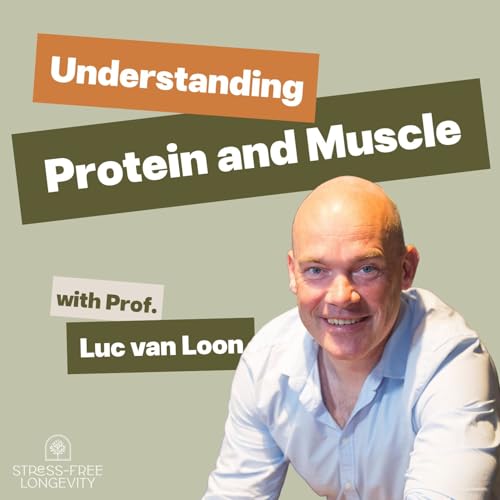
  • Episode 21: Understanding Protein and Muscle with Professor Luc Van Loon
    Feb 2 2026
    Episode Overview In this evidence-rich conversation, Professor Luc Van Loon, one of the world's leading researchers on protein and muscle metabolism at Maastricht University, cuts through the noise to reveal what the science actually shows. With over three decades of research spanning elite athletes to intensive care patients—and approximately 40 million euros of research investment—Prof. Van Loon explains the relationship between protein and muscle, why the protein aisle in supermarkets is mostly marketing, and the surprisingly simple factors that affect how well we absorb what we eat. This interview separates genuine nutritional science from social media hype and provides practical guidance on protein and muscle health at any age. Key 'Protein and Muscle' Insights: Your Muscles Completely Renew Every Few Months: Muscle proteins turn over at 1-2% per day, meaning your entire muscle mass is broken down and rebuilt roughly every 50-100 days. This constant refurbishment is why protein and muscle health are so closely linked—and why muscle loss becomes apparent so quickly during illness or immobility. The WHO Minimum Isn't the Optimum: The WHO guideline of 0.83g protein per kilogram body weight per day represents the minimum to maintain nitrogen balance, not optimal intake. Most healthy, active people naturally consume 1-1.2g/kg, while athletes easily reach 1.5g/kg simply by eating more food. 20-25 Grams Per Meal Is the Sweet Spot: This amount of protein stimulates muscle protein synthesis for four to six hours. That's equivalent to half a litre of milk, two to three eggs, 70-100g of meat or fish, or a coffee cup full of nuts. Plant Proteins Work—You Just Need More: While plant-based proteins have lower digestibility and may lack certain amino acids, eating a diverse range of plant foods compensates for these limitations. As Prof. Van Loon puts it: "Similar to cheap beer, you can compensate for lesser quality by greater quantity." Sitting Upright and Chewing Well Aren't Just Manners: Research shows body position and chewing have measurable effects on protein digestion—comparable in magnitude to the differences between whey and casein proteins. Studies hanging participants upside down revealed dramatically impaired gastric emptying. Hospital Patients Are Severely Underproteinised: People recovering from elective surgery consume only 0.5g protein per kilogram body weight daily—roughly one third of the 1.2-1.5g/kg recommended for recovery. Most food provided simply isn't eaten. Age-Related Muscle Loss Is Largely Preventable: The demographic decline in muscle mass as we age isn't inevitable biology—it's the accumulated impact of successive periods of illness and immobility where people lose more muscle than they regain during recovery. Want the complete framework? Get The Vital 3 Method guide free — the evidence-based system for sustainable health after 40. Download the Free Guide Expert 'Protein and Muscle' Takeaways Include 20-25 grams of protein at each main meal, paying particular attention to breakfast where most people fall shortSit upright while eating and chew your food thoroughly—these simple habits meaningfully improve protein digestion and absorptionConsume some protein after evening exercise sessions, whether as a snack or a later meal, to support overnight muscle recoveryCombine different plant-based protein sources if eating predominantly plant-based, rather than relying on any single source, to ensure complete amino acid coverageFocus on your overall diet before considering supplements—most people using protein powders don't actually know how much protein they're already consuming from foodIf using GLP-1 agonist medications for weight loss, prioritise protein-dense foods since reduced eating makes nutrient quality even more criticalRecognise that most "high protein" products in supermarkets were already high in protein before the label was added—it's often education rather than fortificationMaintain physical activity during periods of illness or recovery, as the combination of exercise and protein creates a synergistic effect on muscle building that neither achieves alone About Our Guest Professor Luc Van Loon leads the protein and muscle metabolism research group at Maastricht University in the Netherlands. With over 30 years of research spanning elite athletes to intensive care patients, his work has fundamentally shaped our understanding of protein and muscle, including protein timing, digestion, and absorption. Visit Prof. Luv van Loon's Academic Profile Watch the 'Protein and Muscle' Interview 'Protein and Muscle' Resources Key Research Discussed: WHO/EFSA Protein Guidelines — The recommendation of 0.83g protein per kilogram body weight per day for nitrogen balance: https://www.efsa.europa.eu/en/press/news/120209Body Position and Protein Digestion ...
    Más Menos
    42 m
Todavía no hay opiniones