Episodios

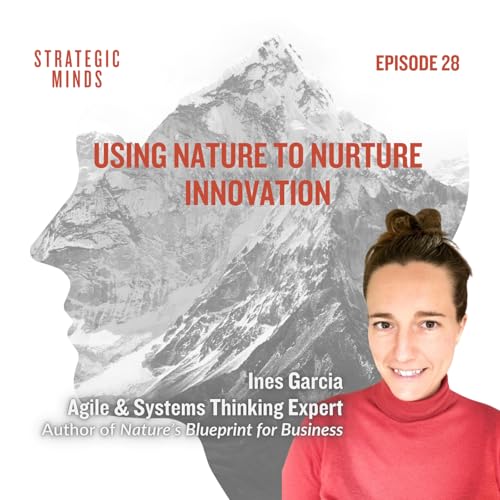
  • Using Nature to Nurture Innovation
    Dec 16 2025

    Nature has spent billions of years perfecting strategy, and those lessons can help leaders think more clearly about innovation. Rich Horwath sits down with Ines Garcia, author of Nature’s Blueprint for Business, in this episode of Strategic Minds Podcast to explore how ecosystem principles can strengthen the way organizations work and grow.

    She shows why leaders must stay attuned and responsive to their environment, just as ecosystems do when they face tension and change. Ideas like ecotones and “bending without breaking” highlight how the space between teams can spark the most innovation.

    Listeners gain a new lens for strategy and instead of adding complexity, tap into natural patterns that have been refined over billions of years. The result is smarter innovation, stronger collaboration, and environments where people and ideas can truly flourish.

    🔑 Key Quotes:

    “Biomimicry is, Jenin-Bernion says, innovation inspired by nature.”

    “The opportunity for where things meet is an opportunity, a space to create, to collect materials and exchange nutrients.”

    “We often use value stream mapping to look at within the organizational boundaries, ideally across your value chain, how can you reduce waste of time, right?”

    “If after an injury or stress, then have the ability to learn from that into what you’re becoming rather than going back. Even staying still is going backwards.”

    “I think that we should quiet our cleverness and observe the natural patterns that govern us.”

    “I would encourage leaders to breathe in and look outside.”

    “We are in this time of moving from competitive advantage to collaborative advantage.”

    “Ninety percent of the materials that we use in our products are wasted. Imagine if you keep them within your value chain or don’t even put them there to start. What a savings of energy, transport, effort, materials cost.”

    🏆 Winsight:

    Ralph Waldo Emerson wrote, “Nature has made up her mind that what cannot defend itself shall not be defended.” It’s a powerful reminder for leaders: advantage isn’t something we claim, it's something we build. Organizations thrive when they invest in capabilities that genuinely strengthen their position.

    As you assess your business, ask whether you’re developing the skills, knowledge, and systems that create a defensible moat. Are you sharpening differentiation or simply maintaining activity? Strategic advantage requires intention, not inertia.

    If we’re not actively creating the capabilities that separate us from the competition, we limit our ability to shape the position we want in the market. The question for leaders becomes simple: Are we building what we need to defend, and deserve, our future advantage?

    🔗 Links:

    Connect with Ines Garcia:

    Ines Garcia's website

    Nature’s Blueprint for Business (Book)

    Ines Garcia on LinkedIn

    🚀 Resources from Rich Horwath, Host of Strategic Minds:

    🌐 Strategic Thinking Institute Website 👤 Rich Horwath on LinkedIn 🎥 Rich Horwath on YouTube 🐦 Rich Horwath on X 📸 Rich Horwath on Instagram 📘 STRATEGIC Book 🧠 Strategic Fitness System 📬 Free Strategic Thinker Newsletter 🧪 Strategic Quotient (SQ) Assessment 🎧 Listen on Apple Podcasts 🎧 Listen on Spotify

    Más Menos
    46 m
  • Managing the Mental Game
    Dec 2 2025

    In this episode of Strategic Minds Podcast, Rich sits down with Derin McMains to explore how elite athletes develop clarity, resilience, and composure—and how business leaders can do the same. Drawing from his career in professional baseball and mental performance coaching across major sports, Derin breaks down the “mental game”: the crucial seconds between moments where decisions are shaped.

    He shares practical tools leaders can use to shift from emotion-driven reactions to process-driven responses, manage confidence, and prepare with greater intention. The discussion shows how the principles that help athletes perform under pressure can empower executives to show up as the version their team needs most.

    🔑 Key Quotes:

    “I define the mental game as the game you play between moments.”

    “Emotions are great informants and terrible dictators.”

    “The scoreboard doesn’t care how you feel. Fans don’t care how you feel. When I focus on confidence and feelings, I’m not focused on the task at hand.”

    “Let’s start with identity. How I see myself determines how I see the world.”

    “With every goal, it always starts with what problem you’re really trying to solve.”

    🏆 Winsights:

    Jack Welch once warned that when the rate of change inside a company lags the rate of change outside it, the end is already in motion. Reed Hastings echoes the same truth: organizations rarely die from moving too fast—they die from moving too slow. Together, their message is unmistakable.

    Leaders must cultivate a constant urgency around getting better. Value creation isn’t static, and neither is the environment we compete in. The moment we stop evolving, we start falling behind.

    Set aside time regularly with your team to look beyond the present and define the future state of the business. Where are you going, and what must change to get there? Strategic progress begins with intentional forward focus.

    🔗 Links:

    Connect with Derin McMains:

    LinkedIn: Derin McMains on LinkedIn

    Podcasts: No Show Dogs & The Way 2 Play Free

    Instagram: @dmac_mindset

    X: @McMainsDmac

    🚀 Resources from Rich Horwath, Host of Strategic Minds:

    🌐 Strategic Thinking Institute Website 👤 Rich Horwath on LinkedIn 🎥 Rich Horwath on YouTube 🐦 Rich Horwath on X 📸 Rich Horwath on Instagram 📘 STRATEGIC Book 🧠 Strategic Fitness System 📬 Free Strategic Thinker Newsletter 🧪 Strategic Quotient (SQ) Assessment 🎧 Listen on Apple Podcasts 🎧 Listen on Spotify

    Más Menos
    50 m
  • The Power of Frameworks as Disruptive Catalysts
    Nov 18 2025
    In this episode of Strategic Minds, host Rich Horwath speaks with legendary strategist and bestselling author Geoffrey A. Moore, whose landmark books - Crossing the Chasm, Zone to Win, and Dealing with Darwin - have transformed how leaders approach innovation, disruption, and go-to-market strategy. Moore shares how storytelling, pattern recognition, and intellectual curiosity shaped his unique approach to strategic frameworks - tools that help executives make smarter decisions in high-risk, low-data environments. Together, they unpack how frameworks act as disruptive catalysts, enabling leaders to synthesize complexity, uncover trapped value, and allocate resources more strategically. Through examples from Salesforce, Microsoft, and Amazon, Moore explains the power of “zoning the enterprise” - aligning performance, productivity, incubation and transformation zones to optimize investment, leadership focus, and execution. His insights reveal why frameworks are not formulas but languages of strategic alignment, empowering leaders to think clearly and act decisively amid rapid business transformation. 🔑 Key Quotes “The first part of strategy is context. The second part of the strategy is, okay, where do I apply force to have… it’s like, where’s the fulcrum?” “I think what Microsoft did under Bill Gates, and Balmer doesn’t get any credit, which is not fair — Gates and Balmer and now Satya — they’ve never been the disruptor. They’ve always been the fast follower, but they’ve been amazing at fast following.” “I think of it as a pyramid a bit — with business models at the top, and then the business model gives rise to the operating model, and the operating model gives rise to the infrastructure model.” “I do think you ought to have a library of frameworks. I think you ought to bring them out and kind of say, ‘Is this helping or not?’” “And resource allocation really is the essence. This is the deliverable from strategy.” 🏆 Winsights Our Winsight today comes from Charles Darwin, the English naturalist, who said: “It’s not the strongest of the species that survive, nor the most intelligent, but the ones most responsive to change.” As you think about your business, your leadership, and your performance, ask yourself: How open to change and evolution am I? We don’t want to repeat the same patterns year after year or rely on tactics that no longer serve us. Strategic leaders evolve — they adapt, improve, and think differently to drive growth for themselves and their organizations. 🔗 Links: Connect with Geoffrey A Moore: Website: https://geoffreyamoore.com/ LinkedIn: Geoffrey A Moore on LinkedIn Books: Crossing the Chasm: Marketing and Selling Technology Products to Mainstream Customers Zone to Win: Organizing to Compete in an Age of Disruption Dealing with Darwin: How great Companies Innovate at Every Stage of Evolution The Infinite Staircase: What the Universe Tells Us about Life, Ethics, and Morality 🚀 Resources from Rich Horwath, Host of Strategic Minds: 🌐 Strategic Thinking Institute Website 👤 Rich Horwath on LinkedIn 🎥 Rich Horwath on YouTube 🐦 Rich Horwath on X 📸 Rich Horwath on Instagram 📘 STRATEGIC Book 🧠 Strategic Fitness System 📬 Free Strategic Thinker Newsletter 🧪 Strategic Quotient (SQ) Assessment 🎧 Listen on Apple Podcasts 🎧 Listen on Spotify
    Más Menos
    53 m
  • Win or Learn: Finding Your Optimal Challenge Point
    Nov 4 2025

    Neuroscientist and performance coach Dr. Mark Guadagnoli joins Rich Horwath to share how neuroscience and strategy intersect to elevate performance under pressure. Drawing from his groundbreaking Challenge Point Framework, Dr. Guadagnoli explains how practicing at your personal edge boosts learning speed, resilience, and confidence.

    From the operating room to the boardroom, he shows why the best leaders and teams embrace challenge, reframe failure, and build cultures where it’s not win or lose—it’s win or learn.

    🔑 Key Quotes:

    “Great performers are also stubborn, tenacious, but they're also open enough to seek out ways to be better.”

    “Think about what life is like if you're not worried about whether or not you're going to be successful.”

    “Number one, I was successful. Number two, I learned something. Those are the two options, right? If one of those things isn't true, then there's a problem in the system.”

    “The first thing that I would say is you don't prepare for high pressure moments with low pressure preparation.”

    “And again, you either win or you learn.”

    🏆 Winsights:

    Tom Gentile, CEO of Spirit Aerosystems, reminds us that time is part of your strategy. Too often, leaders let their calendars control them instead of the other way around. High-performing executives manage time from the top down—batching activities, reducing context switching, and focusing deeply on what drives the most strategic value.

    As you plan your week, ask yourself: Are you managing your time, or is your time managing you?

    🔗 Links:

    Connect with Mark Guadagnoli:

    LinkedIn: Mark Guadagnoli on LinkedIn

    Books: Practice to Learn, Play to Win: The Answer to Your Best Golf

    Human Learning: Biology, Brain, and Neuroscience

    Research: https://pubmed.ncbi.nlm.nih.gov/15130871/

    🚀 Resources from Rich Horwath, Host of Strategic Minds:

    🌐 Strategic Thinking Institute Website 👤 Rich Horwath on LinkedIn 🎥 Rich Horwath on YouTube 🐦 Rich Horwath on X 📸 Rich Horwath on Instagram 📘 STRATEGIC Book 🧠 Strategic Fitness System 📬 Free Strategic Thinker Newsletter 🧪 Strategic Quotient (SQ) Assessment 🎧 Listen on Apple Podcasts 🎧 Listen on Spotify

    Más Menos
    1 h y 3 m
  • Discovering Insights at the Edges
    Oct 21 2025
    Discovering Insights at the Edges In this episode, Rich Horwath sits down with Dr. Rita McGrath, Columbia Business School professor and one of the world’s foremost experts on strategy and innovation. Known for her books including, Discovery-Driven Growth, The End of Competitive Advantage and Seeing Around Corners, Dr. McGrath reveals how leaders can identify the early signals of change and shape organizations that thrive through disruption. From checkpoint-based planning to the power of systematic disengagement, Rita explains how today’s most successful leaders move beyond rigid planning and instead experiment, learn, and adapt. She explores the value of leading indicators, resource reconfiguration, and discovering opportunity in emerging “arenas” rather than static industries. Together, Rich and Rita discuss why true strategic clarity demands courage—the willingness to stop doing what no longer serves and the foresight to invest in what could be. 🔑 Key Quotes: “My friend Sharon Price-John, who happens to be the CEO of Build-A-Bear Workshop, has a great way of framing this. She said, stop doing stupid stuff.” “And what an inflection point does is it changes that envelope of possibilities. So now you can do things you never could before.” “And if you think about things like a mission, Patagonia would come to mind as a firm that’s centered on that. So I think the first choice you need to make is—what are we sort of centering ourselves on?” “And if you don’t invest in creating the conditions for those future choices, you just won’t have those choices to make.” “A leading indicator is giving you some clues about what could be—not necessarily will be—but what could be in the future.” “And I think strategy is really critical, because how else are you going to have the clarity to say, yes, I’m doing this and not that?” 🏆 Winsights: This week’s Winsight comes from Reed Hastings, CEO of Netflix, who reminds us: “If you are not genuinely pained by the risk involved in your strategic choices, then it’s not much of a strategy.” Real strategy requires trade-offs. It’s not about doing everything—it’s about deciding what matters most, and having the discipline to say no to what doesn’t. Great leaders make those choices consciously, knowing that clarity comes with discomfort. As Hastings suggests, the anxiety we feel when we commit to one path and close off others is the signal that strategy is working. If every decision feels easy, we’re not being strategic—we’re just being busy. This week, reflect on the trade-offs you and your team are making. If you feel that tension, you’re likely heading in the right direction. 🔗 Links: Connect with Rita Mcgrath: Website: ritamcgrath.com LinkedIn: Rita McGrath on LinkedIn Books: Seeing Around Corners: How to Spot Inflection Points in Business Before They Happen – Amazon Link The End of Competitive Advantage: How to Keep Your Strategy Moving as Fast as Your Business — Amazon link Discovery-Driven Growth--Amazon Link The Entrepreneurial Mindset: Strategies for Continuously Creating Opportunity in an Age of Uncertainty — Amazon Link 🚀 Resources from Rich Horwath, Host of Strategic Minds: 🌐 Strategic Thinking Institute Website 👤 Rich Horwath on LinkedIn 🎥 Rich Horwath on YouTube 🐦 Rich Horwath on X 📸 Rich Horwath on Instagram 📘 STRATEGIC Book 🧠 Strategic Fitness System 📬 Free Strategic Thinker Newsletter 🧪 Strategic Quotient (SQ) Assessment 🎧 Listen on Apple Podcasts 🎧 Listen on Spotify
    Más Menos
    53 m
  • The Octopus Approach to AI
    Oct 7 2025
    The Octopus Approach to AI In this episode, Rich sits down with Stephen Wunker, innovation strategist, author, and Managing Director at New Markets Advisors. As the co-author of AI and the Octopus Organization, Steve brings decades of experience helping companies harness innovation to drive real strategic change. Together, Rich and Steve explore how artificial intelligence is transforming the way organizations think, decide, and lead. They discuss the octopus as a metaphor for distributed intelligence—where agility at the edges connects seamlessly to alignment at the core—and share a practical framework for building the “superintelligent firm.” From shifting the role of managers to freeing time for creativity and connection, this episode uncovers how leaders can use AI to reshape their organizations for the future. If you’re looking to understand how strategy and AI truly intersect—and how to prepare your business for what’s next—this conversation is for you. 🔑 Key Quotes: “AI has the ability to free up so much time that’s spent gathering and processing information. The real promise is giving people more time to coach, collaborate, and connect.” “AI creates a fluidity of information—like a neural necklace in an octopus—enabling coordination but also potential dysfunction if left unmanaged.” “AI brings intelligence and rapid action to the edge of the organization, empowering frontline teams while keeping decisions within smart guardrails.” “In AI-infused workplaces, middle managers move from spending 25% of their time with people to 65%. That’s a massive unlock of capability.” “Great ideas are easy if you start with great questions.” ⏱️ Timestamps: (00:00) Deep Dive Interview with Stephen Wunker (42:38) Practice Makes Profit (45:18) League of Strategic Minds (46:49) Winsights: Ideas for Advantage 💰 Practice Makes Profit: Rich challenges leaders to take a strategic pause and think about their career evolution — not just where they are, but where they want to go. He outlines a simple framework used with executives to guide this reflection. Rich reminds listeners that effective leaders design their future, building each career move as a deliberate step toward their end game. 🧠 League of Strategic Minds: This listener's question: “What should a one-page business plan include?” Rich recommends creating a StrategyPrint — a clear, one-page snapshot of how your business creates value. He also suggests including your purpose, mission, vision, and values at the top to keep your plan anchored in intent. Listeners can submit their own questions at StrategySkills.com for a chance to be featured — and win some Strategic Minds swag. 🏆 Winsights: Rich closes with a Winsight — an idea for advantage — from Cal Henderson, co-founder of Slack, who asks: “What are the things that are most strategically important — and am I allocating my time to them correctly?” It’s easy for leaders to get lost in the weeds. Rich reminds teams to step back and structure their discussions around what truly drives the business forward. If your meetings are filled with tactics, your organization will stay tactical. Strategy begins with how you spend your time. 🔗 Links: 📘 AI and the Octopus Organization: Building the Superintelligent Firm: Amazon Link 📘Costovation: Innovation that Gives Your Customers Exactly What They Want–and Nothing More: Amazon Link 📘 The Innovative Leader: Step-by-Step Lessons from Top Innovators For You and Your Organization: Amazon Link 📘 Jobs To Be Done: A Roadmap for Customer-Centered Innovation: Amazon Link 💼 Stephen Wunker on LinkedIn: linkedin.com/in/stephenwunker 🚀 Subscribe to Strategic Minds: 🌐 Strategic Thinking Institute Website 👤 Rich Horwath on LinkedIn 🎥 Rich Horwath on YouTube 🐦 Rich Horwath on X 📸 Rich Horwath on Instagram 📘 STRATEGIC Book 🧠 Strategic Fitness System 📬 Free Strategic Thinker Newsletter 🧪 Strategic Quotient (SQ) Assessment 🎧 Listen on Apple Podcasts 🎧 Listen on Spotify
    Más Menos
    49 m
  • Shaping the Future with Strategic Thinking
    Sep 23 2025
    Strategy: The Art of Shaping the Future In this episode, Rich sits down with renowned strategist, psychologist, and innovation expert Dr. Max McKeown. As the author of The Strategy Book, SuperAdaptability, and several other bestsellers, Max brings a uniquely creative lens to the world of strategic thinking — blending research, live visual art, and a deep appreciation for paradox. Together, Rich and Max explore what strategy really is, how imagination fuels innovation, and why developing a rhythm to your strategic work is essential in today’s ever-changing world. With insight, humor, and sharp metaphors, this episode offers a powerful reframing of how leaders can shape the future. If you're looking to reconnect with the why behind your strategy — and equip yourself with creative tools to thrive — this episode is for you. 🔑 Key Quotes: “Strategy is about shaping the future.” “Strategy is everything you need to get to where you want to go. Strategy is everything — but everything is not strategy.” “One organization I'm thinking about has a strategic rhythm to their work… slow, slow, quick, quick, slow.” “I define innovation as being practical creativity — making new ideas useful.” ⏱️ Timestamps: (00:00) Deep Dive Interview with Dr. Max McKeown (1:00:45) Practice Makes Profit (1:04:24) League of Strategic Minds (1:06:10) Winsights: Ideas for Advantage 💰 Practice Makes Profit: In this segment, Rich highlights the value chain as a powerful tool for sharpening strategic thinking. Originally developed by Michael Porter, the value chain breaks a business into primary activities (like production, operations, marketing, or sales) and the supporting secondary activities that enable them. By mapping these activities—whether at the industry level, such as bean production through roasting in the coffee industry, or at the company level, like Uber’s operations spanning rides, delivery, and freight—leaders can see where differentiation and costs shape customer value. Comparing your value chain against competitors’ makes it easier to identify areas of competitive advantage and disadvantage, offering a practical way to practice strategic thinking. 🧠 League of Strategic Minds: This listener Q&A tackled the question, “How can I tell if my strategy is working?” Rich explained that one common pitfall is changing strategies too quickly without truly testing them. The key lies in setting measurable objectives with clear timeframes, then building in milestones to track progress along the way. For example, instead of aiming vaguely to increase sales by 15% over the year, a leader might target 3% growth in Q1, 6% by Q2, and 10% by Q3. These checkpoints create a clear rhythm for evaluation, allowing leaders to adjust thoughtfully rather than guessing whether their strategy is paying off. 🏆 Winsights: To close the episode, Rich shared a quote from Olympic gold medal gymnast Shannon Miller, who observed that at the highest levels of competition, everyone is talented and works hard, but what separates the gold medalists from the silver medalists is the mental game. The insight applies equally to business: mental fitness is a strategic advantage. Rich encouraged listeners to build their own mental game by starting the day with short “mental workouts” to increase focus and resilience, positioning themselves to perform at their best when it matters most. 🔗 Links: 📘 SuperAdaptability 📘 The Strategy Book 📘 The Innovation Book 📘 The Innovator’s Book 🌐 TheSpeedStrategy.com 🎥 Max McKeown Live Drawings 🚀 Subscribe to Strategic Minds: 🌐 Strategic Thinking Institute Website 👤 Rich Horwath on LinkedIn 🎥 Rich Horwath on YouTube 🐦 Rich Horwath on X 📸 Rich Horwath on Instagram 📘 STRATEGIC Book 🧠 Strategic Fitness System 📬 Free Strategic Thinker Newsletter 🧪 Strategic Quotient (SQ) Assessment 🎧 Listen on Apple Podcasts 🎧 Listen on Spotify
    Más Menos
    1 h y 8 m
  • Mindfulness: Setting the Stage to Think
    Sep 9 2025
    In this episode, Rich sits down with Mo Edjlali, mindfulness innovator, entrepreneur, and founder of Mindful Leader. With more than 25 years of cross-industry experience, Mo has helped shape how mindfulness is applied in the workplace. His book, Open MBSR, reimagines the future of mindfulness in organizational life. Together, Rich and Mo explore the intersections of mindfulness, leadership, and strategy—examining how leaders can build self-awareness, navigate paradoxes, and bring greater presence to their decision-making. If you're curious about how contemplative practices can influence performance and leadership, this conversation offers practical insights and powerful reframes. 🔑 Key Quotes: “The practice of mindfulness is paying attention to the present moment with openness and curiosity.” “Just turn off the noise and be alone with your thoughts. And there's no excuse not to do that.” “I think it's very difficult to have situational awareness if you don't have self-awareness. And if you do have situational awareness, but you don't have self-awareness, then it might be difficult to share what you've discovered in ways that are effective and that rally folks around.” “I'm a staunch advocate for this idea of dialectic thinking to get us to just remember that idea of balance, almost like the yin and the yang… We have to find balance, to think in paradox, like we could accept who we are fully and we could want to become a better person.” 💰 Practice Makes Profit: Leadership inconsistency is one of the top reasons employees leave organizations. Just as athletes want referees to call the game consistently, teams want their leaders to act with clarity and stability. One powerful tool? Leadership principles. These short, actionable statements help guide how leaders show up and make decisions — every day. By practicing them consistently, leaders build trust, foster alignment, and create the conditions for lasting performance. 🧠 League of Strategic Minds: Listener Question: How do you define leadership? Leadership is the ability to set a clear direction and support others in achieving shared goals. Great leaders don't just chart a path — they equip their teams with the tools, training, and guidance to succeed. If you'd like to submit a question for this segment, visit strategyskills.com. Selected entries receive exclusive Strategic Minds swag. 🏆 Winsights: Ideas for Advantage Today’s Winsight comes from David Novak, former CEO of Yum! Brands: “Take time to reflect. It’s the stillness that leads to the action.” Strategic thinkers don’t just do — they pause. Set aside 30 minutes each week to step off the activity treadmill and ask yourself: What am I doing? Why am I doing it? How could I do it better? The stillness might just be your biggest advantage. ⏱️ Timestamps: (00:00) Deep Dive Interview with Mo Edjlali (38:52) Practice Makes Profit (41:33) League of Strategic Minds (44:20) Winsights: Ideas for Advantage 🔗 Links: Open MBSR: Reimagining the Future of Mindfulness: https://www.amazon.com/Open-MSBR-Vision-Framework-Mindfulness/dp/1119988632 Mindful Leader: https://www.mindfulleader.org/ Mo Edjlali on LinkedIn: https://www.linkedin.com/in/medjlali/ 🚀 Subscribe to Strategic Minds Strategic Thinking Institute Website Rich Horwath on LinkedIn Rich Horwath on YouTube Rich Horwath on X Rich Horwath on Instagram STRATEGIC Book Strategic Fitness System Free Strategic Thinker Newsletter Strategic Quotient (SQ) Assessment 🎧 Listen on Apple Podcasts 🎧 Listen on Spotify
    Más Menos
    1 h y 4 m