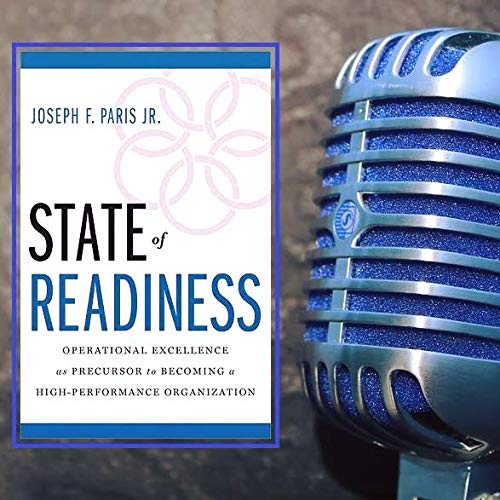
State Of Readiness Podcast Por Joseph F Paris Jr arte de portada

State Of Readiness

State Of Readiness

De: Joseph F Paris Jr
Escúchala gratis

A podcast devoted to sharing knowledge of how companies can become high-performance organizations. Hosted by Joseph Paris. Economía Gestión y Liderazgo Liderazgo
Episodios
  • State of Readiness | Tim Fox
    Mar 19 2026
    Video Version About Tim Fox What Does It Take to Change Everything — One Small Step at a Time? A Conversation with Tim Fox, Author of Swarm of Change | State of Readiness Podcast In this episode of State of Readiness, host Joseph Paris sits down with Tim Fox for a wide-ranging conversation that touches on the arc of a remarkable career, the philosophy behind a one-of-a-kind book, and why the most powerful ideas in operational excellence are often the ones hiding in plain sight. Tim is the founder of Gemba Vision and author of "Swarm of Change". There are books that inform, and then there are books that serve to transform. He set out to write the latter — a deceptively simple yet richly layered guide to continuous improvement that uses one of nature's most efficient and collaborative organisms as its central metaphor: the honeybee. From the Milk Round to the Boardroom Tim's journey into the world of manufacturing and continuous improvement didn't begin in a university lecture hall. It began at age twelve, on a milk round. From those early mornings, he went on to complete a mechanical and production engineering apprenticeship, earn a master's degree, and build his career through some of the most demanding environments in British industry — including British Steel Distribution, the Manufacturing Advisory Service, and eventually his own consultancy, GEMBA Vision. What sets Tim apart isn't just the breadth of his experience — it's the depth of conviction he brought to each chapter of it. Guided by influential mentors, including figures who shaped his thinking on Total Productive Maintenance and lean manufacturing, Tim developed an abiding belief that practical, hands-on learning is the only kind that truly sticks. When the 2008 financial crisis tested that conviction, he didn't abandon it — he refined it. A Book Born from a Facebook Scroll The origin story of Swarm of Change is, appropriately, both humble and instructive. The idea came to Tim not in a moment of grand strategic planning, but while scrolling through Facebook — a reminder that inspiration rarely announces itself. What followed was a process of dictation, refinement, and honest feedback (including from his daughter) that produced something genuinely unusual in the business and operational excellence space. The book uses bees — their behavior, their social structures, and their remarkable problem-solving instincts — as a sustained metaphor for organizational change and continuous improvement. Joseph notes that the book's decision to bring in an external perspective partway through adds what he calls "contextual fidelity" — the kind of clarity that, like an outsider observing a culture, can illuminate what those living inside it have long stopped seeing. In a telling detail, Tim chose not to put his name on the cover. The book, he explains, is not about him. It is about the reader, and the changes they are capable of making. More Than a Book — A Toolkit Swarm of Change doesn't ask to be read passively. Tim has built interactive elements directly into the experience — including read-it cards to help readers track their progress and apply concepts in real time, and buzz blocks designed to challenge leaders and test whether the ideas have truly landed. These aren't gimmicks. They reflect Tim's core philosophy: that simplicity and practical application are not the easy path, but the right one. A companion website, swarmofchange.com, extends the conversation further, offering a space for readers to share the small changes they've made and the results they've achieved. On Simplicity, and Why It's So Hard Running through this conversation — and through Tim's career — is a quiet frustration with the tendency to overcomplicate what should be straightforward. Whether discussing the fundamentals of problem-solving, the pitfalls of process bloat, or the challenge of sustaining improvement long after the consultant has left the building, Tim returns again and again to a simple question: does this actually work for the people doing the work? It is the right question. And Swarm of Change is his most considered answer to it. Listen to the full conversation with Tim Fox on the State of Readiness podcast. You can learn more about Tim's work and pick up a copy of Swarm of Change at swarmofchange.com, and explore GEMBA Vision at gembavision.com.
    Más Menos
    1 h y 15 m
  • State of Readiness | Alan Michaels; Director of Industry Research at Industry Knowledge Graph
    Sep 25 2025
    Video Version About the Podcast In this episode of State of Readiness, host Joseph Paris speaks with Alan Michaels, founder of the Industry Knowledge Graph, a strategic planning tool built on Michael Porter's competitive strategy framework. The discussion traces Alan's multi-decade journey to develop a globally comprehensive, highly granular industry taxonomy and its transformation into a usable, dynamic digital platform. Alan recalls the pivotal moment in 1986 when, while working in IT at Manufacturers Hanover Bank, he was introduced to Porter's Competitive Advantage. The structured, recipe-like nature of Porter's methodology resonated deeply with him, prompting a career pivot toward corporate strategy. Over time, Alan held various strategic roles, including at IBM and in insurance, but ultimately dedicated himself full-time to his ambitious goal: to map the entire global economy by industry, using Porter's definitions of competitive structure and market forces. The result, launched in April 2024, is the Industry Knowledge Graph, a platform that classifies the global economy into over 24,000 distinct industries, based on competitive commonalities such as products, buyers, substitutes, and vendors. This granularity far exceeds traditional classifications like NAICS codes. For instance, while NAICS might group all jet aircraft in one industry, Alan's system separates fighter jets, commercial jets, and blimps into unique segments. Even within food, categories like potato chips, pretzels, and popcorn are treated as different industries based on buyer behavior and competitive factors. The platform supports top-down and bottom-up analysis. A user can examine which industries a company like PepsiCo operates in (156 in total), or conversely, explore a given industry like potato chips and see the top competitors, value chains, channels, and influencing trends. Users can also compare companies by overlapping and unique industry participation—offering a precise view ideal for M&A analysis, competitive benchmarking, strategic expansion, or private equity targeting. Alan emphasizes that his system empowers corporate planners, marketers, and strategists to cut research time dramatically. What previously took months—such as comparing competitors by line of business—can now be done in seconds. A standardized set of industry data fields, inspired by Porter's methodology, makes this possible. Each industry entry includes value chains, buyer segments, substitute threats, supplier dependencies, market trends, and more. To bring this vision to life digitally, Alan partnered with Semantic Arts, a leader in semantic technology and the data-centric revolution. Together, they formed Industry Knowledge Graph LLC, combining Alan's industry content with a modern knowledge graph platform. The system launched with an initial demo and subscription access, and plans are underway to expand its data, integrate public classification codes (e.g., NAICS, UN), and invite partnerships to enrich its content. Alan concludes by emphasizing that the Industry Knowledge Graph offers a strategic lens to view the economy—one grounded in Porter's logic, built with real-world granularity, and powerful enough to revolutionize strategic planning across industries. About Alan Michaels As the Director of Industry Research at Industry Knowledge Graph LLC, I am solely focused on enhancing our industry model of the global economy, which leverages the IBB model of the global economy (covering 25,000 industries) developed by Industry Building Blocks LLC. For the past 24 years, I have been building and maintaining the best available industry segmentation of the global economy by line of business, using Michael E. Porter's five forces industry analysis methodology. My business expertise is in corporate planning, business unit planning, industry analysis, new business development, and aligning and coordinating business and IT and other activities to make the whole greater than the sum of the parts. In 1994, I self-published (a Porter-inspired step-by-step corporate planning workbook) "Structured Strategic Planning" while teaching at Pace University Graduate School. In short, since reading Porter's book "Competitive Advantage" in 1986 I have been passionate about leveraging his five-forces industry framework to provide high-quality, granular, and comprehensive industry data to raise the level of strategic thinking. Executive Contact: Alan Michaels Title: Managing Director of Industry Research LinkedIn Profile: https://www.linkedin.com/in/alansmichaels/ Company: Industry Knowledge Graph Website: https://www.industrykg.com/ Company Type: Private Year Founded: 2021 Practice Areas: Industry Model of the Global Economy, Knowledge Graph Platform, Market Segmentation, Five Forces Industry Analysis, M&A Analysis, Industry Taxonomy, Industry Classification Systems, Industry Ecosystems, Michael Porter Frameworks, Semantics, ...
    Más Menos
    1 h y 3 m
  • State of Readiness | Benjamin Taylor; MD of RedQuadrant
    Jul 7 2025
    Video Version About the Podcast Benjamin Taylor, the Managing Director of RedQuadrant, engages in a thought-provoking dialogue with Joseph Paris, delving into the nuanced intricacies of organizational evolution and improvement within the public sector landscape. Drawing from their wealth of experiences and insights, Taylor and Paris underscored the paramount importance of democratizing knowledge accessibility and fostering collaborative group dynamics as catalysts for organizational advancement. Taylor elucidated the genesis of Red Quadrant, inspired by a London cab company's GPS system, symbolizing their vision of a network consultancy akin to a dynamic film crew, partnering with domain experts as the need arises. The discourse swiftly shifted towards the unique challenges inherent in driving operational excellence within public sector contexts, navigating the complexities of competitive tendering processes, and discerning the elusive nuances of client requisites. Taylor lamented the dearth of ethical considerations prevalent in government engagements, highlighting the exigency of infusing ethical imperatives into the fabric of public sector initiatives. Amidst discussions on the utilization of AI and systems thinking paradigms in public sector consultancy, Taylor evinced a fervent passion for converging systems cybernetics and complexity frameworks to distill practical insights for organizational enhancement. He underscored the indispensable value of understanding the interplay between humans and their environment, leveraging cybernetic principles to craft pragmatic tools for organizational optimization. Taylor and Paris also deliberated on the multifaceted challenges of maintaining organizational continuity and integrity amidst stewardship transitions, emphasizing the imperative of preserving institutional knowledge to avert potential programmatic disruptions. Concluding on a note of forward-looking optimism, Taylor expounded on the evolving landscape of complexity and systems thinking, envisioning a future where operational excellence knowledge permeates frontline staff, fostering islands of coherence through well-informed systemic perspectives. As the dialogue drew to a close, Taylor's impassioned advocacy for a holistic approach to organizational development resonated as a clarion call for embracing the transformative potential of complexity science in driving sustained business evolution. About Benjamin Taylor Benjamin Taylor brings an authentic, human, and inclusive approach to leadership and change. With a career that spans over 20 years helping public organizations tackle complex, systemic issues, he leads RedQuadrant, a UK-based consultancy, and a social enterprise academy dedicated to supporting public service leaders through learning cohorts, tools, and events. He also serves on the advisory board of The Operational Excellence Society and as a non‑executive director for Systems and Practice in Organization; the professional body for systems practitioners. People often know him as "Antlerboy", a anagram of "Ben Taylor" which he uses as a unique moniker which he adopted early on to maintain a consistent digital identity. A prolific communicator and thought leader, Benjamin publishes a regular "Transduction – leading transformation" newsletter and has contributed over 190 articles and 3 000+ posts on LinkedIn. His writing focuses on systems, cybernetics, organizational complexity, and the human-centered design of public services. He frequently reflects on the power of insight in transformation; underscoring that "It is easier to act yourself into a new way of thinking than to think yourself into a new way of acting". Outside of consulting, he hosts workshops and podcasts (such as on Evolving Enterprises), exploring leadership, complexity, and the art of meaningful public service transformation. Executive Contact: Benjamin Taylor Title: Managing Partner LinkedIn Profile: https://www.linkedin.com/in/antlerboy/ Company: RedQuadrant Website: https://www.redquadrant.com/ Company Type: Private Limited Company Year Founded: 2018 Practice Areas: Public Service Transformation
    Más Menos
    50 m
Todas las estrellas
Más relevante
I’m sorry. Nearly all the interviews are pretty interesting and informative. This one went off the rails early and never recovered. Larry Long is a rambling mess with an annoying personality. Has the phony charisma of a professional wrestler.

All that is to say, if this works for him, great. Not me.

Tough Listen

Se ha producido un error. Vuelve a intentarlo dentro de unos minutos.