• Palestine & Generational Trauma: CHERIEN DABIS on Directing All That's Left of You - Highlights
    Mar 19 2026

    Two weeks away from filming her most ambitious film to date, Cherien Dabis and her crew were forced to evacuate Palestine as the devastating events of October 2023 began. Instead of abandoning the project, they adapted, filming across Cyprus, Jordan, and Greece, creating a cinematic love letter to the resilience, joy, and humanity of the Palestinian people.

    My guest today is Cherien Dabis. She’s a filmmaker and actress who has spent much of her career trying to fill the silences in the American narrative. In 2022, she became the first Palestinian to receive an Emmy nomination. She has worked on everything from The L Word to Ozark, Only Murders in the Building to the hit Netflix series Mo, always with an eye toward breaking the one-dimensional mold that has historically defined Arab representation in the West. But her latest project is perhaps her most ambitious yet. It’s a film called All That’s Left of You. It follows one Palestinian family across three generations, beginning in 1948 and ending in 2022. It is a story of exile and memory, and it’s Jordan’s official submission for this year’s Academy Awards.

    (0:00) The Inheritance of Trauma
    Cherien Dabis discusses how collective trauma is passed down and the importance of showing Palestinian resilience and humanity

    (1:50) Inherited Trauma: Identity And History The passage of trauma requires a multi-generational lens to truly understand how history and political events shape people

    (2:37) The Bakri Acting Dynasty: Collaborative Lineage Collaborating with four generations of the Bakri Family brought immense authenticity to the screen

    (4:02) Filming The Nakba: Art Imitating Crisis Evacuating Palestine weeks before shooting forced the crew to adapt amidst devastating, ongoing events

    (7:09) The Moment Of Activation: Racism In Ohio Experiencing severe racism during the first Gulf War ignited a lifelong drive to challenge dangerous media stereotypes

    (9:34) Psychological Violence: Impact Of Humiliation The film explores how non-physical harassment and humiliation leave devastating, long-term relational scars

    (10:48) Broken Distribution: Industry Gatekeepers Navigating systemic fear and gatekeeping in Hollywood distribution remains a profound challenge for Palestinian cinema

    (11:37) Previous Films, Television And Craft Directing television hones the craft and expands the creative capacity needed for ambitious feature films

    (12:28) Truth Seekers: The Next Generation Hope lies with young people who refuse to accept the broken systems and hidden truths of previous generations

    Episode Website

    www.creativeprocess.info/pod

    Instagram:@creativeprocesspodcast

    Más Menos
    14 m
  • The Psychological & Emotional Impact of Occupation w/ Actress, Director CHERIEN DABIS
    Mar 19 2026

    “These oppressive structures are built to strip us of our humanity. One of the ways they do that is by filling us with anger and hatred. If we allow ourselves to stay there, we're doing the job of the oppressor for them by slowly killing ourselves. I wanted to make a movie that would remind people that we can't allow them to win by giving up our humanity. We have to hold onto our humanity and try in these impossible circumstances.”

    My guest today is Cherien Dabis. She’s a filmmaker and actress who has spent much of her career trying to fill the silences in the American narrative. In 2022, she became the first Palestinian to receive an Emmy nomination. She has worked on everything from The L Word to Ozark, Only Murders in the Building to the hit Netflix series Mo, always with an eye toward breaking the one-dimensional mold that has historically defined Arab representation in the West. But her latest project is perhaps her most ambitious yet. It’s a film called All That’s Left of You. It follows one Palestinian family across three generations, beginning in 1948 and ending in 2022. It is a story of exile and memory, and it’s Jordan’s official submission for this year’s Academy Awards.

    (0:00) The Inheritance of Trauma

    Cherien Dabis discusses showing the multifaceted humanity of Palestinians beyond just pain and suffering

    (3:41) Inherited Trauma: Identity And History The film explores how collective trauma is passed down across generations and shapes individual identities

    (5:52) The Bakri Dynasty: Collaborative Lineage Working with the legendary Bakri Family brought deep, authentic relational dynamics to the screen

    (9:25) Filming The Nakba: Art Imitating Crisis The crew faced severe challenges and had to evacuate Palestine during the October 2023 escalation

    (16:10) Representation Gap: Dehumanization In Media Growing up in Ohio, Cherien Dabis witnessed the dangerous misrepresentation of Arabs in Western media

    (21:24) The Moment Of Activation: Racism In Ohio The stark racism experienced during the first Gulf War ignited her passion to become a filmmaker

    (33:40) Psychological Violence: Impact Of Humiliation The film depicts how psychological harassment under occupation leaves devastating, long-term impacts on families

    (38:23) Broken Distribution: Industry Gatekeepers Despite international success, systemic fear and gatekeeping in the US distribution market remain significant obstacles

    (45:28) Previous Films, Television And Craft Directing television shows like Only Murders in the Building expanded her creative capacity and adaptability

    (51:45) Truth Seekers: The Next Generation
    Cherien Dabis shares her profound hope for young people who refuse to accept the broken systems of the past

    Episode Website

    www.creativeprocess.info/pod

    Instagram:@creativeprocesspodcast

    Más Menos
    54 m
  • Trust, Education & Writing as Resistance w/ AL KENNEDY - Highlights
    Mar 3 2026

    "The thing that puzzled him was why people don't agree to be fully expressed while they're alive. Why does it only happen in their last moment? Why wouldn't you live being fully expressed?"

    My guest today is AL Kennedy. She is one of Britain’s most acclaimed and versatile literary voices, a writer who can inhabit the internal life of a soldier in a POW camp, as she did in her Costa Book Award-winning novel Day, as easily as she can navigate the "professional lying" of a modern civil servant.

    Her latest novel, Alive in the Merciful Country, takes place during the 2020 lockdown. It tells the story of a primary school teacher who receives a confession from an undercover police officer who infiltrated her life decades earlier. It’s a provocative investigation into state power, the "Spy Cops" scandal and the search for mercy in an age of surveillance. It’s a book about the breakdown of trust. We talk about her life, her activism, and why she believes fiction is the only way to tell the truth when the facts are forbidden and how she balances the truth of her novels with the relief of stand-up comedy.

    (0:00) Finding Your Voice

    On the Alfred Wolfsohn voice method and the power of being fully expressed

    (2:30) Reading from Alive in the Merciful Country

    Kennedy shares a passage from her latest novel, exploring hope and resilience in dark times.

    (4:43) The Myth of Shrinking Attention Spans

    Challenging the narrative that modern audiences cannot focus, and the importance of engaging storytelling.

    (6:22) Education and the Foundation of Democracy

    The dangers of dismantling education and how critical thinking protects us from fascism.

    (10:26) The Spy Cop Scandal and State Surveillance

    Unpacking the reality of undercover police infiltrating peaceful protests and intimate lives.

    (13:59) Lockdown: A Global Pause and the Inrush of Empathy

    The fleeting moment of unified humanity during the pandemic and how it was ultimately betrayed.

    (17:34) Writing Without Theft: The Ethics of Character Creation

    Kennedy explains her imaginative process and why she refuses to steal details from real people's lives.

    (28:16) AI, Digital Slop, and the Loss of Trust

    Reflections on artificial intelligence as an unstable plagiarism machine and its impact on truth.

    (30:03) Nature, Spirituality, and the Merciful Country

    Finding healing in the natural world and navigating the future with love and awareness.

    Episode Website

    www.creativeprocess.info/pod

    Instagram:@creativeprocesspodcast

    Más Menos
    34 m
  • The Art of Fiction, Democracy & Truth with AL KENNEDY
    Mar 3 2026

    What happens when the state infiltrates your most intimate relationships? How do we protect the innocence and imagination of children in an increasingly authoritarian world? “"If you have love, eventually you're going to win. It's not that people aren't going to die. It's not terrible things aren't going to happen. But if you stay with that and you stay centered in that, you'll get through and you will not have turned into a monster in order to overcome monsters.”

    My guest today is AL Kennedy. She is one of Britain’s most acclaimed and versatile literary voices, a writer who can inhabit the internal life of a soldier in a POW camp, as she did in her Costa Book Award-winning novel Day, as easily as she can navigate the "professional lying" of a modern civil servant.

    Her latest novel, Alive in the Merciful Country, takes place during the 2020 lockdown. It tells the story of a primary school teacher who receives a confession from an undercover police officer who infiltrated her life decades earlier. It’s a provocative investigation into state power, the "Spy Cops" scandal and the search for mercy in an age of surveillance. It’s a book about the breakdown of trust. We talk about her life, her activism, and why she believes fiction is the only way to tell the truth when the facts are forbidden and how she balances the truth of her novels with the relief of stand-up comedy.

    (0:00) Finding Your Voice
    On the Alfred Wolfsohn voice method and the power of being fully expressed

    (2:17) Education and the Foundation of Democracy
    The dangers of dismantling education and how critical thinking protects us from fascism.

    (5:14) The Myth of Shrinking Attention Spans
    Challenging the narrative that modern audiences cannot focus, and the importance of engaging storytelling.

    (8:23) Reading from Alive in the Merciful Country
    Kennedy shares a passage from her latest novel, exploring hope and resilience in dark times.

    (17:45) The Spy Cop Scandal and State Surveillance
    Unpacking the reality of undercover police infiltrating peaceful protests and intimate lives.

    (22:07) AI, Digital Slop, and the Loss of Trust
    Reflections on artificial intelligence as an unstable plagiarism machine and its impact on truth.

    (28:29) The Power of the Powerless: Radical Whimsy
    How absurdity, humor, and inflatable costumes can disrupt authoritarian mindsets and potential violence.

    (33:13) Lockdown: A Global Pause and the Inrush of Empathy
    The fleeting moment of unified humanity during the pandemic and how it was ultimately betrayed.

    (42:53) Writing Without Theft: The Ethics of Character Creation
    Kennedy explains her imaginative process and why she refuses to steal details from real people's lives.

    (1:29:40) Nature, Spirituality, and the Merciful Country
    Finding healing in the natural world and navigating the future with love and awareness.

    Episode Website

    www.creativeprocess.info/pod

    Instagram:@creativeprocesspodcast

    Más Menos
    1 h y 36 m
  • SIRI HUSTVEDT on Love, Grief & the Future of Democracy
    Feb 23 2026

    “Grief happens because you don't stop loving the person who died. The person doesn't exist in your reality anymore. The everyday is not colored and shaped by this other human being, but you don't stop loving the person. So grief is a particular kind of unrequited love. And probably without that dynamic relationship with this person, I would be someone else. And he would've been someone else. I mean, Paul died before me. But we were, I think, hugely important to the drama of becoming in our own lives.”

    Today, we are honored to welcome a writer whose work has long explored the intimate landscapes of the mind, memory and the heart. Siri Hustvedt’s writing moves between the personal and the philosophical, the literary and the deeply human. Her work bridges collections of essays, non-fiction, poetry, and seven novels, including the international bestsellers What I Loved and The Summer Without Men. Recipient of the Princess of Asturias Award for Literature and the Gabarron Prize for Thought, her work has been translated into over thirty languages. Her new memoir, Ghost Stories, is a reflection on forty-three years shared with her late husband, the writer and filmmaker Paul Auster. In its pages, we encounter not only love and loss, but the quiet persistence of presence, memory, and language itself.

    (0:00) Grief as Unrequited Love

    Siri explores the emotional reality of living without Paul Auster, noting that grief occurs because love does not stop when a person dies.

    (4:00) Facing Death with Courage

    The importance of not hiding from mortality and how discussing end-of-life wishes offered a necessary perspective.

    (12:37) Reading from Ghost Stories

    Siri reads the opening passage of her memoir, detailing how the loss of her husband deranged her sense of time and bodily rhythms.

    (18:41) The Phantom Limb: ” The beloved is taken away and it feels as if you're amputated or gutted.”

    (21:50)  Grandfather, Father and Son: Generational Traumas Behind Paul Auster's Writing

    (24:11)  How Powerful Emotions and a Person's Life Can Play a Role in Illness

    (30:09) Feeding the Earth

    "Paul very pointedly told me that he wanted to be buried in the Jewish mode. And the phrase he used was, “I want my body to feed the earth.”

    (44:23) Physical Love in Marriage

    On the importance of physical intimacy in long-term marriages, a reality often left out of grief memoirs.

    (54:00) The Philosophy of the Between

    How relational existence is foundational to life.

    (1:00:16) The Hubris of Controlling Nature

    (1:12:00) The Dark History of Statistics

    (1:32:12) The Art of Learning vs. AI and Automated Outcomes

    “I think we have to ask ourselves, what is education? What do we want from it? How do we want people to learn?

    Episode Website

    www.creativeprocess.info/pod

    Instagram:@creativeprocesspodcast

    Más Menos
    1 h y 38 m
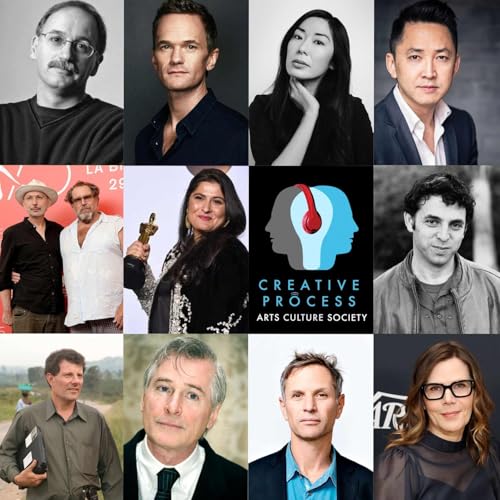
  • Who Are We? What Makes Us Care? Jim Shepard, Neil Patrick Harris, John Patrick Shanley & Artists Share Their Stories
    Feb 11 2026

    Can curiosity and empathy be taught? How can we expand our sense of solidarity through stories? In this episode, we explore the internal dialogues of artists, actors and writers to ask what it means to step into someone else's shoes.

    (0:00) Novelist Jim Shepard discusses Literature as a Tool for Emotional Education and Exploring History

    (2:05) Tony Award-winning Actor Neil Patrick Harris on Being Moved by Theater and its Ability to Bridge Worlds

    (3:55) Novelist Katie Kitamura on How a Book is Made in Collaboration with the Reader

    (5:00) Screenwriter, Playwright Laura Eason on Inhabiting the Hearts of Characters Different from Ourselves

    (6:03) Academy Award-winning Director Sharmeen Obaid-Chinoy on the Art of Visual Storytelling

    (6:37) Cinematographer, Director Benoit Delhomme on the Freedom of Handheld Cinematography

    (7:19) Author Etgar Keret on Looking for Humanity through Shared Intention

    (8:18) Viet Thanh Nguyen – Opposing Power through Expansive Solidarity

    (9:27) Adam Moss – Author, Fmr. Editor New York magazine on “The Work of Art”

    (10:29) John Patrick Shanley – Tony & Academy Award-winning Writer, Director on Finding Value in Ordinary Experiences and the Creative Power of Daydreaming

    (11:56) Pulitzer Prize-winning Journalist Nicholas Kristof on Why Individual Stories are Necessary to Generate Connection

    To hear more from each guest, listen to their full interviews.

    Episode Website

    www.creativeprocess.info/pod

    Instagram:@creativeprocesspodcast

    Más Menos
    14 m
  • The Wisdom of Nature: Artists & Scientists on The Beauty & Fragility of Our Planet
    Jan 9 2026

    In this special edition, we hear from our guests from across the arts and sciences. From composers and poets to forest ecologists and climate envoys, they tell the story of our planet. Moving beyond the data of destruction, we explore the intelligence of nature, the ethics of what we eat, and the empathy required to save our future.

    MAX RICHTER, Composer, Sleep, The Blue Notebooks

    CARL SAFINA, Author, Becoming Wild

    ADA LIMÓN, 24th US Poet Laureate

    CYNTHIA DANIELS, Grammy Award-winning Sound Eng.

    SUZANNE SIMARD, Finding the Mother Tree

    JOELLE GERGIS, Lead Author, IPCC 6th Assessment Rpt

    NOAH WILSON-RICH, CEO, Best Bees Company

    INGRID NEWKIRK, PETA Founder

    BERTRAND PICCARD, Solar Impulse Foundation

    DAVID FARRIER, Author, Footprints

    KATHLEEN ROGERS, Pres, Earth Day Network

    ODED GALOR, Unified Growth Theory

    PETER SINGER, Philosopher

    GEOFF MULGAN, Another World Is Possible

    CLAIRE POTTER, Welcome to the Circular Economy

    CHRIS FUNK, Dir. Climate Hazards Car.

    JENNIFER MORGAN, Special Envoy, International Climate Action

    To hear more from each guest, listen to their full interviews.

    Episode Website

    Más Menos
    18 m
  • The Musician Who Sings to Animals - PLUMES on Trust & Cross-Species Communication - Highlights
    Dec 31 2025

    On Music, Trust and Connection with the Animal World

    “Mostly I’ll play in a minor key, something sad, which I think can work for an animal because they can sense the sadness, and they try to reassure me and comfort me. I chose love songs because I'm convinced they are very intuitive and they can sense what I am trying to say to them, and profess my love in a way. I think there's always a way to connect, and if you're being cautious and don't threaten the animals, something beautiful can happen.”

    Musician Plumes takes his guitar to the world's most unlikely concert halls—farms, sanctuaries, and wild habitats. A passionate advocate for veganism and animal welfare, we discuss what animals hear, how trust forms, and what music can reveal when it enters a world not made for humans alone.

    Episode Website

    www.creativeprocess.info/pod

    Instagram:@creativeprocesspodcast

    Más Menos
    Menos de 1 minuto