SoCCC Pre-Rounds: Bite-Sized Critical Care Cardiology Topics Delivered By Experts Podcast Por Dr. Balim Senman Dr. Elliott Miller Dr. Simon Parlow Dr. Anthony Carnicelli arte de portada

SoCCC Pre-Rounds: Bite-Sized Critical Care Cardiology Topics Delivered By Experts

SoCCC Pre-Rounds: Bite-Sized Critical Care Cardiology Topics Delivered By Experts

De: Dr. Balim Senman Dr. Elliott Miller Dr. Simon Parlow Dr. Anthony Carnicelli
Escúchala gratis

OFERTA POR TIEMPO LIMITADO | Obtén 3 meses por US$0.99 al mes

$14.95/mes despues- se aplican términos.
SoCCC Pre-Rounds is your go-to for quick, high-yield insights in critical care cardiology, hosted by members of the Society of Critical Care Cardiology (SoCCC). With only 160 specialists in the U.S., mentorship is rare. This podcast bridges the gap with bite-sized episodes featuring clinical pearls, expert tips, and real-world answers on topics like cardiogenic shock, ECMO, and resuscitation. Perfect for pre-rounds, night shifts, or leveling up anytime. Listen in. Level up. Join the SoCCC community.Dr. Balim Senman, Dr. Elliott Miller, Dr. Simon Parlow, Dr. Anthony Carnicelli Enfermedades Físicas Higiene y Vida Saludable
Episodios
  • Navigating the Initial Hours of Cardiogenic Shock with Dr. Rebecca Mathew
    Jan 2 2026
    How do you diagnose cardiogenic shock quickly and accurately at the bedside? What should your first therapeutic move be? And how do you know if your resuscitation is working?In this episode of SoCCC Pre-Rounds, Dr. Simon Parlow sits down with Dr. Rebecca Mathew, Director of the Cardiac ICU at the University of Ottawa Heart Institute and co-principal investigator of the CAPITAL Research Group. Together, they break down a clear, real-world approach to diagnosing, stabilizing, and treating cardiogenic shock from the moment the patient arrives.Drawing from frontline CICU experience and landmark trials such as CAPITAL DOREMI, Dr. Mathew discusses why history and physical exam still drive the diagnosis, how to approach congestion and perfusion, when inotropes actually help, and how to integrate invasive hemodynamics when available. The episode offers practical, bedside-ready guidance for clinicians managing shock in any setting.Key TakeawaysCardiogenic shock is best diagnosed through history, exam, and perfusion assessment, not lactate or invasive data alone.SCAI is the most practical framework, but Stage D should be assigned only after a failed therapeutic trial.Use inotropes only if hypoperfusion persists after decongestion; dobutamine quickly shows responsiveness.Swan-Ganz catheters help when available, but most shock worldwide is managed without invasive hemodynamics.Avoid early prognostication in the first 24–48 hours to prevent harmful self-fulfilling assumptions.In This Episode[00:00] Introduction [01:06] Importance of initial medical management in cardiogenic shock[02:53] Defining cardiogenic shock and SCAI classification[05:27] Phenotypes and subtypes of cardiogenic shock[07:23] Caveats in SCAI classification[07:49] Bedside diagnosis and risk stratification[09:53] Physical exam: hyperperfusion and congestion[11:54] Initial management approach: decongestion and inotropes[14:17] Therapeutic targets and monitoring response[15:24] Inotrope selection and individualized therapy[16:55] Ongoing research and future directions[17:55] Therapeutic targets: clinical and biochemical markers[19:47] Mean arterial pressure (MAP) targets[21:01] Prognostic factors and risk scoresNotable Quotes[03:21] “I think in its most basic sense, I think of cardiogenic shock as a clinical syndrome of clinical and biochemical hyper perfusion that’s due to a primary cardiac disorder.” — Dr. Rebecca [15:48] “People often ask me what inotrope I reach for, and despite having done the DoReMi trial and proving there’s no difference, I am anecdotally a big believer in dobutamine.” - Dr. Rebecca [22:10] “Once you’re in the throes of shock, I think we just need to focus on the tsunami in front of us and manage that.”[23:26] “The most exciting thing about cardiac critical care and managing cardiogenic shock is you are basically seeing physiology in real time." — Dr. RebeccaDr. Rebecca MathewDr. Rebecca Mathew is a critical care cardiologist and Director of the Cardiac ICU at the University of Ottawa Heart Institute. She leads major cardiogenic shock research programs, including the CAPITAL DOREMI trial published in the New England Journal of Medicine and the ongoing CAPI2 trial focused on early inotrope strategies. Her work spans clinical care, trial leadership, and translational shock physiology.Resources and LinksBecome a member of the Community: https://www.soccc.org/subscribeDr. Rebecca Mathewhttps://www.ottawaheart.ca/profile/mathew-rebeccaDr. Simon Parlowhttps://www.ottawaheart.ca/profile/parlow-simonhttps://www.soccc.org/Supported By:This episode is made possible by unrestricted support from Zoll LifeVest — thanks for keeping high-impact education free for our community.DisclaimerThis podcast is not medical advice, just candid, practical discussions about what your hosts do every day in the CICU. Always consult your supervising team and current guidelines before applying any interventions.
    Más Menos
    26 m
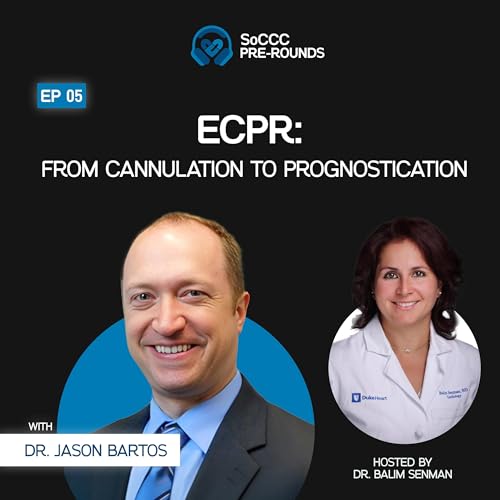
  • ECPR: From Cannulation to Prognostication with Dr. Jason Bartos
    Dec 5 2025
    Should we be using ECMO during cardiac arrest? In this episode of SoCCC Pre-Rounds, Dr. Balim Senman sits down with Dr. Jason Bartos, interventional and critical care cardiologist at the University of Minnesota and one of the nation’s leading voices on extracorporeal cardiopulmonary resuscitation (ECPR). Together, they break down when and why to consider ECMO in cardiac arrest, the patient selection puzzle, and what truly impacts outcomes in the field.Dr. Bartos shares pearls from the ARREST trial and offers hard-won insights into what it takes to build an ECPR program that saves lives from timing and volume to sedation, TTM, and neuroprognostication. Whether you’re a trainee encountering ECPR for the first time or a team leader building a resuscitation program, this episode delivers essential guidance grounded in real-world experience.Key TakeawaysECPR = ECMO during or shortly after cardiac arrest; best for patients with witnessed arrest and refractory shockable rhythmsAvoid ECPR in patients with poor baseline function, irreversible comorbidities, or prohibitive vascular anatomyOutcomes depend on systems: high-volume centers, early activation, and streamlined protocols improve survivalDon’t oversedate; sedation is not required for ECMO; prioritize comfort and cannula safetyUse 37°C TTM with aggressive fever prevention; ECMO allows precise temperature controlNeuroprognostication takes time; wait beyond 72 hours, and don’t withdraw care too early some patients recover even after 30 daysIn This Episode[00:00] Introduction[00:45] Episode introduction & guest welcome[01:25] What is ECPR?[02:14] Rationale and data behind ECPR[03:13] Key ECPR trials and outcomes[08:56] ECPR patient selection & center volume[10:15] Selection criteria details[13:06] Absolute and relative contraindications[15:11] In-hospital ECPR activation & information gathering[16:21] Standardizing in-hospital ECPR response[18:22] Timing and team mobilization for ECR[19:56] Post-ECMO management: sedation & temperature[21:40] Sedation practices on ECMO[23:28] Temperature management evolution[25:29] Neuroprognostication after ECPR[29:13] Early predictors of poor neurological outcomeNotable Quotes[01:34] "ECPR is extracorporeal cardiopulmonary resuscitation. It's the use of ECMO for patients with cardiac arrest." — Dr. Jason Bartos[25:40] "The danger to the patients in the ICU post-arrest is us. We really have the task of trying to determine and predict and inform family members of how their loved one is going to do in this worst circumstance of their life." — Dr. Jason Bartos[25:29] "Neuroprognostication is near and dear to my heart, partly because I think it's honestly the most important thing we do in the ICU for any post-arrest patient, but particularly for this population." — Dr. Jason BartosDr. Jason BartosDr. Jason Bartos is an interventional and critical care cardiologist at the University of Minnesota. He leads one of the nation’s highest-volume ECPR programs and is a founding member of the Center for Resuscitation Medicine. He is nationally recognized for his leadership in post-arrest care, real-world ECMO implementation, and advancing cardiac arrest science.Resources and LinksBecome a member of the Community: https://www.soccc.org/subscribeDr. Jason Bartoshttps://med.umn.edu/bio/jason-bartoshttps://www.linkedin.com/in/jason-bartos-b6898441Dr. Balim Senmanhttps://www.linkedin.com/in/balim-senman-7561436b/https://x.com/BalimSenmanMDhttps://www.soccc.org/Supported By:This episode is made possible by unrestricted support from Zoll LifeVest — thanks for keeping high-impact education free for our community.DisclaimerThis podcast is not medical advice, just candid, practical discussions about what your hosts do every day in the CICU. Always consult your supervising team and current guidelines before applying any interventions.
    Más Menos
    32 m
  • The Hidden Heart Crisis: Managing Right Ventricular Failure with Dr. Ryan Tedford
    Nov 7 2025
    In this episode, Dr. Anthony Carnicelli sits down with Dr. Ryan Tedford, a top expert on right ventricular (RV) failure, to break down everything you need to know about this tricky condition. RV failure happens when the right side of the heart struggles to pump properly, messing with blood flow through the lungs and raising pressure in the veins. It shows up in a bunch of serious illnesses like pulmonary hypertension, left heart failure, and sepsis.Dr. Tedford walks us through how to spot RV failure using key measurements from right heart catheterization, like right atrial pressure and the pulmonary artery pulsatility index (PAPi).He also shares a simple, practical approach to managing RV failure: avoid overloading the heart with fluids, lower the pressure, the right heart has to pump against with pulmonary vasodilators, and boost its strength with inotropes like dobutamine. And when things get really serious, mechanical support might be needed. The good news? The right ventricle is pretty resilient, and with the right care, patients can bounce back.Key TakeawaysRV failure is a clinical syndrome due to dysfunction in any part of the right heart circulatory system, not just the RV itself.Don't skip hemodynamics: Right heart cath data is essential to distinguish RV from LV failure and guide therapy.Afterload reduction strategies include managing left-sided filling pressures and careful ventilator settings (avoid high PEEP and hyperinflation).The RV is more resilient than we think with the right therapy, recovery is often possible, even in severe cases.In This Episode[00:00] Introduction[01:39] Defining right ventricular failure[02:14] Importance of the right heart in critical care[03:57] Role of hemodynamic evaluation[04:12] Key hemodynamic metrics for RV failure[05:19] Echo vs. hemodynamics in RV failure[08:01] Treatment strategies: preload, afterload, and contractility[10:04] Avoiding hypotension and ischemia[11:16] Stepwise vs. immediate mechanical support[12:07] Prognosis and recovery of RV failure[13:50] Closing remarks and takeawaysNotable Quotes[02:02] "Although the RV is one of the biggest and perhaps most important components of the right heart circulatory system, actually any part of the right heart circulatory system can contribute to overall right heart failure." — Dr. Ryan Tedford[02:43] "If you go back, you know, 30 years or 80 years, in fact, the right heart has been largely ignored." — Dr. Ryan Tedford[04:04] "A comprehensive hemodynamic evaluation is really key. And I would say you really can't get it right without the right heart catheterization." — Dr. Ryan TedfordDr. Ryan TedfordDr. Tedford is a Professor of Medicine/Cardiology and holds the Dr. Peter C. Gazes Endowed Chair in Heart Failure at the Medical University of South Carolina (MUSC). He directs the Advanced Heart Failure and Transplant Fellowship and serves as the section head of heart failure and medical director of cardiac transplantation. An internationally recognized researcher with over 200 publications, his work focuses on right ventricular function, pulmonary hypertension, and hemodynamics.Resources and LinksBecome a member of the Community: https://www.soccc.org/subscribeDr. Ryan Tedfordhttps://www.linkedin.com/in/ryan-tedford-7163aa6/Dr. Anthony Carnicellihttps://www.soccc.org/https://www.linkedin.com/in/anthony-carnicelli-926a0b88/Mentioned Pragmatic approach to temporary mechanical circulatory support in acute right ventricular failure by Dr. Anthony CarnicelliSupported By:This episode is made possible by unrestricted support from Zoll LifeVest — thanks for keeping high-impact education free for our community.DisclaimerThis podcast is not medical advice, just candid, practical discussions about what your hosts do every day in the CICU. Always consult your supervising team and current guidelines before applying any interventions.
    Más Menos
    15 m
Todavía no hay opiniones