Shaken Not Burned Podcast Por Felicia Jackson and Giulia Bottaro arte de portada

Shaken Not Burned

Shaken Not Burned

De: Felicia Jackson and Giulia Bottaro
Escúchala gratis

Shaken Not Burned is the podcast that helps you make sense of sustainability. We unpack the big debates shaping climate, business, food, and society: debunking myths, clarifying trade-offs, and sharing ideas you can actually use to think, decide, and act in a changing world.

© 2026 Shaken Not Burned
Economía Política y Gobierno
Episodios
  • Do we need deep sea mining? With Seas At Risk
    Apr 9 2026

    Welcome to the second instalment of our mining arc. After covering the geopolitics of critical minerals (check out the episode here), this week we ask a harder question: is deep sea mining a necessary innovation, or a risk we don’t yet understand well enough to take?

    Deep sea mining means extracting minerals from the bottom of the ocean, at depths of 2,000 metres and beyond, no easy feat. It’s often framed as the next frontier for securing the metals needed for the energy transition – batteries, renewables, electrification. But that framing sits alongside a more uncomfortable reality: these ecosystems are among the least understood on Earth, and the consequences of disturbing them may be irreversible.

    This is a question of baseline knowledge: whether we even understand what normal looks like at those depths, and therefore whether impact can be meaningfully assessed at all.

    Governance remains contested. Negotiations at the International Seabed Authority (ISA) – the body regulating the mineral resources of the seabed beyond national jurisdiction – have been slow and fraught, reflecting deep disagreement over whether the industry should proceed at all, or under what conditions.

    In this episode, Giulia speaks with Simon Holmström, senior deep sea mining policy officer at Seas At Risk, an association of over 30 environmental NGOs from across Europe. Together, they unpack the environmental risks, the limits of current knowledge,and the evolving policy landscape.

    Simon highlights the economic viability of deep sea mining, the need for precautionary measures, and the importance of sustainable practices in the face of growing demand for critical minerals.

    Their main takeaways are:

    • The deep ocean is one of the least understood ecosystems
    • The economic viability of deep sea mining remains highly speculative
    • Opposition to deep sea mining is growing across civil society and parts of industry
    • The regulatory pathway, and therefore the industry’s future, is still unresolved

    What emerges is not a simple case for or against, but a more fundamental question: how should we make decisions about technologies where the downside risks are uncertain, potentially systemic and not easily reversible – especially when they are being justified in the name of solving a different global problem?

    In trying to address climate change, if we introduce new environmental risks we don't yet fully understand, how should those trade-offs be evaluated? Who gets to decide what level of risk is acceptable, and for whom?

    If you enjoyed this episode, subscribe to our newsletter and follow us on LinkedIn, TikTok and Instagram – and why not spread the word with your friends and colleagues?

    Más Menos
    37 m
  • The geopolitics of critical minerals with Minefield Consulting
    Apr 2 2026

    Once a somewhat niche industry, critical minerals are now dominating headlines, influencing geopolitical trends and driving international trade.

    These materials are core components of technologies crucial to the energy transition and defence systems, and heightened interest in these areas is fuelling demand. For example, lithium demand jumped by 30% in 2024, while nickel, cobalt, graphite and rare earths all increased by 6-8% – and it is expected to keep climbing.

    With the International Energy Agency forecasting demand for these minerals to triple or even quadruple by 2040, the rush for critical minerals will continue shaping international relations, highlighting the need to address major environmental and social implications.

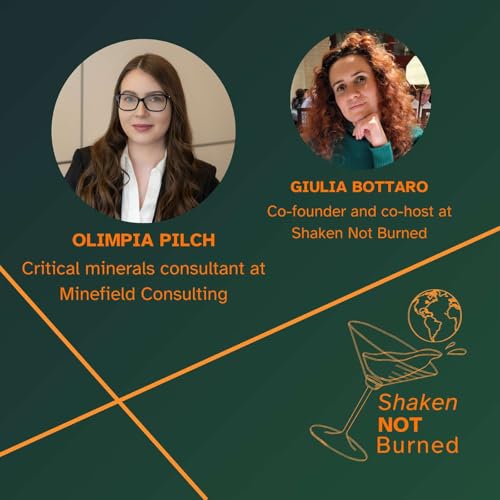
    In this week's episode, Giulia interviews Olimpia Pilch, critical minerals consultant at Minefield Consulting, on the complex world of critical minerals, their importance in energy transition and defence, and the geopolitical and environmental challenges involved.

    Their wide-ranging conversation covers:

    • The definition of critical minerals
    • Supply chain vulnerabilities and geopolitical risks
    • China's role in critical mineral processing and supply
    • What are the potential and limitations of critical mineral recycling
    • The environmental and social implications of mineral extraction

    While the Global North has outsourced polluting industries, including mining, for decades, it’s crucial to understand that clean technologies need these primary sources. Amid geopolitical tensions straining supply chains, achieving the energy transition may require a new world order.

    If you enjoyed this episode, subscribe to our newsletter and follow us on LinkedIn, TikTok and Instagram – and why not spread the word with your friends and colleagues?

    Más Menos
    1 h y 3 m
  • Why the world feels unpredictable – and what's really going on
    Mar 26 2026

    The world is starting to feel unpredictable in ways that are difficult to pin down.

    Not just because of individual events, but because of how many different pressures are building at the same time. Climate impacts are becoming more visible, geopolitics is fragmenting, technology is moving quickly and economic conditions are being shaped by multiple shocks at once rather than a single, identifiable cause.

    It is tempting to treat these as separate issues. Climate as an environmental problem, geopolitics as a political one, technology as something else again. But that separation is becoming harder to sustain. What we’re seeing instead is how these pressures show up together. Changes in one area increasingly show up in others, shaping costs, constraints and the choices available. Assumptions about work, markets or even where it is safe to invest or build are becoming less reliable.

    That’s the starting point for this season.

    In this opening episode, Felicia and Giulia step back to look at what’s changed in how the world is behaving. Why issues that used to be discussed separately are now overlapping and what that means, whether you’re seeing it through your work or simply trying to make sense of what comes next.

    Once these pressures start to show up together, their effects become harder to separate.

    Climate risk, for example, is no longer only a question of long-term environmental change. It is increasingly reflected in insurance markets, in the cost of capital and in public finances. Supply chains are being shaped not only by efficiency, but by geopolitical relationships and physical constraints. What might once have been treated as separate risks are now influencing the same outcomes.

    At the same time, many of the structures that guide decisions, particularly in finance and policy, are still built around shorter time horizons than the risks they are dealing with.

    That is where things become difficult. There is more information available than ever before, but that doesn’t necessarily make choices clearer: different risks point in different directions and the incentives facing companies, investors and governments do not always line up. And so decisions are often delayed until something forces them.

    That’s why this season, we’re going to be looking at that reality directly.

    By going inside specific industries and areas of the economy, the aim is to understand how these pressures play out in practice, where decisions are actually made, and how different parts of the system influence one another. Not to simplify what is happening, but to make it easier to see what matters and how to respond when the path ahead isn’t always clear.

    Each industry or topic we explore will be paired with a conversation like this one, stepping back to break down what’s happening and what it really means. We hope you’ll find it useful.

    If you enjoyed this episode, subscribe to our newsletter and follow us on LinkedIn, TikTok and Instagram – and why not spread the word with your friends and colleagues?

    Más Menos
    38 m
Todavía no hay opiniones