Episodios

  • My Science List is Weirder Than Yours (Season 5: Episode 9)
    Mar 30 2026

    Hello and welcome to Science Research Weekly. Get ready for the dangers of cold weather on cardiovascular health, new amphipods aplenty, a list of habitable rocky exoplanet, pico-satellite concepts, mitochondrial flickers, toxin-antidotesystems in vertebrates, and using science to find the best decaf coffee. Science On.


    References:

    • Cardiovascular disease mortality attributable to monthly non-optimal temperature in the united states: a county-level analysis
    • New deep-sea Amphipoda from the Clarion-Clipperton Zone: 24 new species described under the Sustainable Seabed Knowledge Initiative: One Thousand Reasons campaign
    • Biodiversity boost: 24 new deep-sea species discovered in major Pacific research
    • Probing the limits of habitability: a catalogue of rocky exoplanets in the habitable zone
    • Text embedding models yield detailed conceptual knowledge maps derived from short multiple-choice quizzes
    • Thousands of pico-satellites may transform how phones connect to space
    • Dynamical Systems in Cosmology: Reviewing An Alternative Approach
    • Massive star clusters detected by JWST as natural birth places to form intermediate-mass black holes
    • Beyond Pulsing Dyes: Are Flickers the Language of the Mitochondrial
    • Network?
    • The morphotype approach to classification of aerial animals in radar data
    • A Vertebrate Toxin-Antidote System That Sabotages Mouse Embryogenesis
    • Digital Biology with R: Advanced Bioinformatics, Predictive Modeling, and Time Series Analysis for Modern Life Science
    • Using science to find the best decaf

    R Packages:

    • Ixsurface: Interactive 3D Surface Plots for Multi-Factor Interaction Visualization
    • longitree: Decision Tree Analysis for Longitudinal Measurement Data
    • ggforestplotR: Publication-Ready Forest Plots with 'ggplot2'
    • ksformat: 'SAS'-Style 'PROC FORMAT' for R
    • stopmotion: Build Stop Motion Animations from Image Sequences
    • subtools: Read and Manipulate Video Subtitles
    • taxodist: Taxonomic Distance and Phylogenetic Lineage Computation

    Cardiovascular diseasemortality attributable to monthly non-optimal temperature in the united states:a county-level analysis

    New deep-sea Amphipodafrom the Clarion-Clipperton Zone: 24 new species described under theSustainable Seabed Knowledge Initiative: One Thousand Reasons campaign

    Biodiversity boost: 24new deep-sea species discovered in major Pacific research

    Probing the limits ofhabitability: a catalogue of rocky exoplanets in the habitable zone

    Text embedding modelsyield detailed conceptual knowledge maps derived from short multiple-choicequizzes

    Thousands ofpico-satellites may transform how phones connect to space

    Dynamical Systems inCosmology: Reviewing An Alternative Approach

    Massive star clustersdetected by JWST as natural birth places to form intermediate-mass black holes

    Beyond Pulsing Dyes: AreFlickers the Language of the Mitochondrial

    Network?

    The morphotype approachto classification of aerial animals in radar data

    A VertebrateToxin-Antidote System That Sabotages Mouse Embryogenesis

    Digital Biology with R:Advanced Bioinformatics, Predictive Modeling, and Time Series Analysis forModern Life Science

    Using science to findthe best decaf

    Más Menos
    9 m
  • Cellular Senses and Psyche’s Interior (Season 5: Episode 8)
    Mar 23 2026

    Welcome to Science Research Weekly, Season 5, Episode 8, Cellular Senses and Psyche’s Interior. Get ready for cellular mechanosensing, modeling the interior structure of Psyche, microbial succession in soil restoration, and Bayesian Linear regression in R. Science On.


    References:

    • Emergent depth-mechanosensing of epithelial collectives regulates cell clustering and dispersal on layered matrices
    • Exploring the Interior Structure of (16) Psyche Through Basin-Scale Collisions
    • Organic, Transparent, and Flexible Films Exhibiting White-Light Emission via Polymer-Network Engineering: A Non-Dye-Centric Strategy
    • Genome-wide discovery of cis-regulatory elements in a large genome
    • Taxonomic filtering accompanies functional expansion during long-term soil restoration
    • Microscale spatial fragmentation promotes bacterial survival under
    • antibiotics
    • Bayesian Linear Regression in R: A Step-by-Step Tutorial


    R Packages:

    • SCIproj: Creates a Scientific Project Skeleton as an R Package
    • Causalplot: Create Publication-Ready Causal Diagrams
    • Scimetr: Analysis of Scientific Publication Data with R
    Más Menos
    7 m
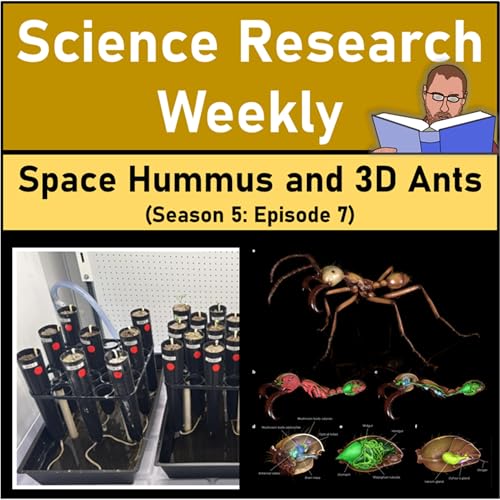
  • Space Hummus and 3D Ants (Season 5: Episode 7)
    Mar 16 2026

    Hello and welcome to Science Research Weekly, Season 5, Episode 7. Get ready for 3D ants via synchrotron, recycled aluminum alloys, chickpeas in lunar regolith, planet collisions, World Mouse, R version "Reassured Reassurer", estimating pi by tossing coins, and a grant on reducing housing hazards. Science On.


    References:

    • High-throughput phenomics of global ant biodiversity
    • New ORNL aluminum alloy to strengthen domestic auto supply chain
    • Bioremediation of lunar regolith simulant through mycorrhizal fungi and plant symbioses enables chickpea to seed
    • Gaia-GIC-1: An Evolving Catastrophic Planetesimal Collision Candidate
    • The 3D architecture of the ctenophore aboral organ and the evolution of complex integrative centers in animals
    • Cryptic species are widespread across vertebrates
    • Searching for Magnetic White Dwarfs in LAMOST DR10
    • World Mouse: Exploring Interactions with a Cross-Reality Cursor
    • Hunting for microsatellite instability in long-read data with Owl
    • R 4.5.3 is released
    • Estimate pi by tossing coins
    • Housing-Related Hazards and Lead-Based Paint Capital Fund Program


    • R Packages:
    • wstats: Weighted Descriptive Statistics
    • ggwidth: Standardise 'ggplot2' Geom Width
    • AV1R: 'AV1' Video Encoding for Biological Microscopy Data
    Más Menos
    7 m
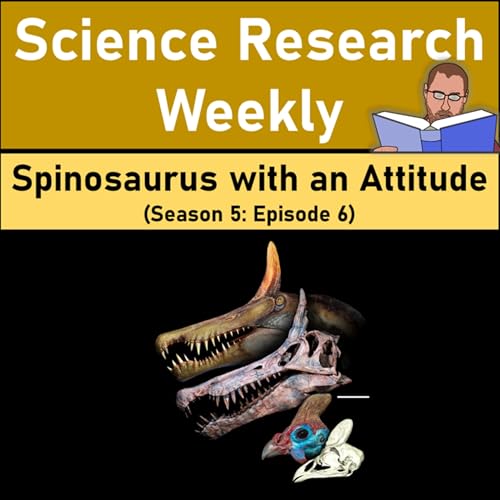
  • Spinosaurus with an Attitude (Season 5: Episode 6)
    Mar 2 2026

    Welcome to Science Research Weekly, Season 5, Episode 6. Get ready for quorum sensing for bacterial engineering, an antibiotic-resistant microbe on ice, a new scimitar-crested spinosaurid, planetesimal snowmen, sheepox viral evolution, the fate of horizontally acquired genes, the R Journal Volume 17/4, and a grant for Feed the Future innovation labs. Science On.


    References:

    Revision of the trematosaurid Erythrobatrachus noonkanbahensis confirms a cryptic marine temnospondyl community from the Lower Triassic of Western Australia

    Construction and Functional Characterization of a Heterologous Quorum Sensing Circuit in Clostridium sporogenes

    First genome sequence and functional profiling of Psychrobacter SC65A.3 preserved in 5,000-year-old cave ice: insights into ancient resistome, antimicrobial potential, and enzymatic activities

    Scimitar-crested Spinosaurus species from the Sahara caps stepwise spinosaurid radiation

    Direct contact binary planetesimal formation from gravitational collapse

    Oxygen metabolism in descendants of the archaeal-eukaryotic ancestor

    Exocometary physics: material release and tails

    Searches for new physics beyond the Standard Model in hyperon sector

    3,500 years of sheeppox virus evolution inferred from archaeological and codicological genomes

    The fate of horizontally acquired genes: rapid initial turnover followed by long-term persistence

    The R Journal: Volume 17/4

    Comparing flavor characteristics of Scotch whiskies: A principal component analysis

    Little useless-useful R functions – Typing speed benchmark

    Pathways to Enable Secure Open-Source Ecosystems

    Feed the Future Innovation Labs


    R Packages:

    bigMICE: Multiple Imputation of Big Data

    bracketeer: Tournament Generator

    phymapnet: Phylogeny-Guided Bayesian Microbial Network Inference

    tReeTraits: Calculate Tree Traits from Terrestrial Lidar

    ort: Create a Data Frame Representation of an Image

    tinyimg: Optimize and Compress Images

    Más Menos
    Aún no se conoce
  • Oops, All Singularities! (Season 5: Episode 5)
    Feb 23 2026

    Hello and welcome to Science Research Weekly, Season 5, Episode 5, Oops, All Singularities! Get ready for tiny nanopores, a supernova-skipping black hole, kidney disease ultrasounds by robot, and keeping files organized for publication. Science On.


    References:

    • https://www.nature.com/articles/s41467-026-68800-x
    • https://www.science.org/doi/10.1126/science.adt4853
    • https://arxiv.org/pdf/2602.16673
    • https://arxiv.org/pdf/2602.16641
    • https://www.biorxiv.org/content/10.64898/2026.02.16.706223v2
    • https://www.biorxiv.org/content/10.1101/2024.12.24.629435v2
    • https://www.biorxiv.org/content/10.64898/2025.12.11.693795v2
    • https://www.r-bloggers.com/2026/02/keeping-files-organised-for-publication/

    R Packages:

    • Framework: Structured Data ScienceProject Scaffolding
    • gsDesignNB: Sample Size andSimulation for Negative Binomial Outcomes
    • SimtablR: Easy Publication-ReadyTables and Regression Analysis
    • Scholid: Tools for Scholarly andAcademic Identifiers


    R Packages:

    Framework: Structured Data Science Project Scaffolding

    gsDesignNB: Sample Size and Simulation for Negative Binomial Outcomes

    SimtablR: Easy Publication-Ready Tables and Regression Analysis

    Scholid: Tools for Scholarly and Academic Identifiers

    References:

    Chemistry-drivenautonomous nanopore membranes

    Disappearanceof a massive star in the Andromeda Galaxy due to formation of a black hole

    NeighborhoodStability as a Measure of Nearest Neighbor Searchability

    TowardsAutonomous Robotic Kidney Ultrasound: Spatial-Efficient Volumetric Imaging viaTemplate Guided Optimal Pivoting

    Differentialanalysis of genomics count data with edge*

    Virus-freecontinuous directed evolution in human cells using somatic hypermutation

    TranscriptionalActivation of Estrogen Receptor-alpha and Estrogen Receptor-beta from ElephantShark (Callorhynchus milii)

    Keeping files organised forpublication

    R Packages:

    Framework: Structured Data ScienceProject Scaffolding

    gsDesignNB: Sample Size andSimulation for Negative Binomial Outcomes

    SimtablR: Easy Publication-ReadyTables and Regression Analysis

    Scholid: Tools for Scholarly and AcademicIdentifiers

    Más Menos
    6 m
  • And the Crowd Goes Wild for Chitons (Season 5: Episode 4)
    Feb 17 2026

    Welcome to Science Research Weekly, Season 5, Episode 4, And the Crowd Goes Wild for Chitons. Get ready for genes before the last common ancestor, a new Cold Earth, herbivorous microsaurs, lava tubes on Venus, a publicly-named chiton species, paleontology R packages, and the Protean grant from DARPA. Science On.


    References:

    • Universal paralogs provide a window into evolution before the last universal common ancestor
    • A Cool Earth-sized Planet Candidate Transiting a Tenth Magnitude K-dwarf From K2
    • Does the Measured Abundance Suggest a Biological Origin for the Ancient Alkanes Preserved in a Martian Mudstone?
    • Carboniferous recumbirostran elucidates the origins of terrestrial herbivory
    • Ocean Species Discoveries 28–30 — new species of chitons (Mollusca, Polyplacophora) and a public naming competition
    • Radar-based observation of a lava tube on Venus
    • Formalization and inevitability of the Pareto principle
    • Light to Heavy, Brief to Eternal: An Axion for Every Occasion (in the Early Universe)
    • Reading TEA leaves for de novo protein design
    • A toolkit for programmable transcriptional engineering across eukaryotic kingdoms
    • Temporal dynamics of microbiome communities within urban compost piles undergoing the heat process
    • Introducing geoboundaries
    • Paleontology R Packages to Benefit from Software Sustainability Institute Grant
    • Advancing Bioinformatics, Translational Bioinformatics and Computational Biology Research (R01 Clinical Trial Optional)
    • Protean


    R Packages:

    • mixpower: Simulation-Based Power Analysis for Mixed-Effects Models
    • aesopR: Tools for Text Analysis of Aesop's Fables
    • ohvbd: One Health VBD Hub
    • statuser: Statistical Tools Designed for End Users


    Más Menos
    10 m
  • Cave Robots in Space (Season 5: Episode 3)
    Feb 9 2026

    Welcome to Science Research Weekly, Season 5, Episode 3, Cave Robots in Space. Get ready for endoplasmic reticulum remodeling, marine bacteria streamlining shortcomings, robotic run-throughs of space-cave explorations, non-exponential growth for AI, viral protein immune escape constraints, the Top 40 new CRAN packages of December 2025, and pilot projects from the NIH on using common fund data sets. Science On.


    References:

    ER remodelling is a feature of ageing and depends on ER-phagy

    Cell cycle dysregulation of globally important SAR11 bacteria resulting from environmental perturbation

    Cooperative robotic exploration of a planetary skylight surface and lava cave

    Protein Autoregressive Modeling via Multiscale Structure Generation

    Primordial black holes as cosmic accelerators of light dark matter: Novel direct detection constraints

    Are AI Capabilities Increasing Exponentially? A Competing Hypothesis

    Habitat fragmentation controls bacterial community composition outcomes

    Constrained Evolutionary Funnels Shape Viral Immune Escape

    A deep-learning-based score to evaluate multiple sequence alignments

    December 2025 Top 40 New CRAN Packages

    caugi (Causal Inference), phylospatia (Genetics), distionary (Statistics), svgedit (Utilities)

    Pilot Projects Enhancing Utility and Usage of Common Fund Data Sets (R03 Clinical Trial Not Allowed)


    R Packages:

    regextable: Pattern-Based Text Extraction and Standardization with Lookup Tables

    fru: A Blazing Fast Implementation of Random Forest

    marinepredator: Marine Predators Algorithm

    Más Menos
    8 m
  • Beat AI By Being Above Average (Season 5: Episode 2)
    Feb 2 2026

    Get ready for supermassive dark stars, human creativity versus AI, unsinkable metal tubes, robot-assisted microscopy, the Collaborative Microbial Metabolite Center knowledgebase, and a grant to strengthen agricultural systems. Science On.


    References:

    • https://www.mdpi.com/2218-1997/12/1/1
    • https://www.nature.com/articles/s41598-025-25157-3
    • https://iopscience.iop.org/article/10.3847/PSJ/ae2b6f/pdf
    • https://advanced-onlinelibrary-wiley-com.ezproxy.library.und.edu/doi/epdf/10.1002/adfm.202526033
    • https://arxiv.org/pdf/2601.20849
    • https://arxiv.org/pdf/2601.20808
    • https://arxiv.org/pdf/2601.20776
    • https://www.biorxiv.org/content/10.64898/2026.01.24.701521v1
    • https://www.biorxiv.org/content/10.64898/2026.01.27.698081v1
    • https://www.biorxiv.org/content/10.64898/2026.01.27.701945v1
    • https://simpler.grants.gov/opportunity/c026db8a-157d-42de-bac7-4baf5602cd0a


    R Packages:

    • glmSTARMA: (Double) Generalized Linear Models for Spatio-Temporal Data
    • repfun: Create Tables, Listings and Figures using Functions Styled after SAS™ Macros
    • GimmeMyStats: Statistics Utilities
    Más Menos
    9 m