

Robots Took My Tasks, Not My Tea Break
No se pudo agregar al carrito
Add to Cart failed.
Error al Agregar a Lista de Deseos.
Error al eliminar de la lista de deseos.
Error al añadir a tu biblioteca
Error al seguir el podcast
Error al dejar de seguir el podcast

Robots Took My Tasks, Not My Tea Break
-
Narrado por:
-
De:
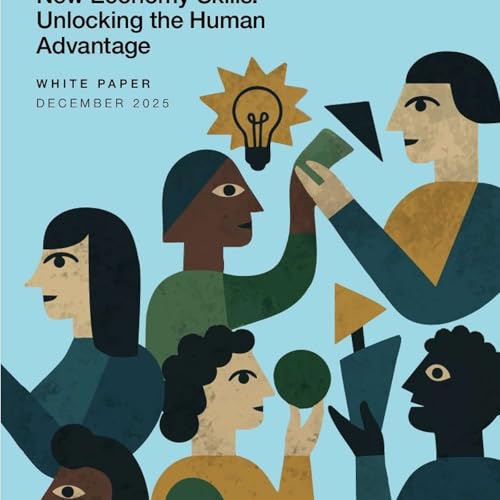
The 2025 World Economic Forum white paper argues that human-centric skills, such as creative thinking, emotional intelligence, and resilience, have become the primary "hard currency" of the modern workforce.
While artificial intelligence and automation continue to transform technical tasks, these unique human attributes drive the essential innovation and adaptability required for economic growth.
Despite their high value, the report notes a significant gap where these capabilities are rarely explicitly mentioned in job descriptions or systematically measured by educational systems.
To address this, the document proposes a global framework to improve how these "durable" yet fragile skills are developed, assessed, and credentialed.
The text concludes with real-world case studies demonstrating how organizations are successfully integrating human-focused training into their professional ecosystems. Together, these findings highlight that the ultimate competitive advantage in a digital age is the cultivation of human potential.
TLDR / At a Glance:
• WEF forecasts on skill disruption and role shifts
• Why human judgment frames problems and value
• The four core groups of human-centric skills
• Market signalling gaps in job ads and hiring
• Education shortfalls in teaching and assessing SEL
• Regional strengths and the global weakness in curiosity
• Post-pandemic fragility and timelines to rebuild skills
• Automation resilience of empathy, creativity, leadership
• The recognition paradox inside organisations
• A playbook for assessment, development, credentialing
• Case studies: AI simulations and digital badges
• Guardrails against cognitive offloading to AI
In a world where AI can draft code, write reports, and analyse oceans of data tempts us to believe the smartest career move is more tech, faster.
We take a different bet: the skills that compound over time and resist automation are the human ones we were taught to call soft. Creativity that reframes problems. Curiosity that hunts for better questions. Emotional intelligence that steadies teams through uncertainty. Communication and leadership that turn analysis into action.
Drawing on fresh evidence from the World Economic Forum and real workplace data, we map the new skill economy: 40% of job skills are set to change within five years, yet the capabilities that convert technology into business outcomes are under-signalled in job ads and under-taught in classrooms.
Google AI agents and the WEF break the human skill set into four clear groups -creativity and problem solving, emotional intelligence, collaboration and communication, and learning and growth and explain why each one acts as a force multiplier for AI. You will hear why empathy and leadership have low potential for AI transformation, why curiosity is the global weak point, and how post-pandemic atrophy proved these skills are fragile without deliberate practice.
We go practical with a three-part playbook to make human skills visible and valuable: assessment that measures thinking in co
Support the show
𝗖𝗼𝗻𝘁𝗮𝗰𝘁 my team and I to get business results, not excuses.
☎️ https://calendly.com/kierangilmurray/results-not-excuses
✉️ kieran@gilmurray.co.uk
🌍 www.KieranGilmurray.com
📘 Kieran Gilmurray | LinkedIn
🦉 X / Twitter: https://twitter.com/KieranGilmurray
📽 YouTube: https://www.youtube.com/@KieranGilmurray
📕 Want to learn more about agentic AI then read my new book on Agentic AI and the Future of Work https://tinyurl.com/MyBooksOnAmazonUK