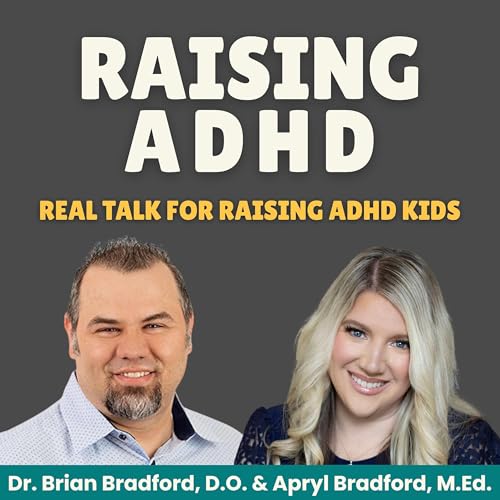
Raising ADHD: Real Talk For Parents & Educators Podcast Por Dr. Brian Bradford & Apryl Bradford arte de portada

Raising ADHD: Real Talk For Parents & Educators

Raising ADHD: Real Talk For Parents & Educators

De: Dr. Brian Bradford & Apryl Bradford
Escúchala gratis

Raising a child with ADHD can feel overwhelming—meltdowns, school struggles, medication decisions, and the constant fear you’re doing it wrong. Raising ADHD is the podcast for parents and teachers who want clarity, strategies, and real-life support.


Hosted by Apryl Bradford, M.Ed. (former teacher and ADHD mom) and Dr. Brian Bradford, D.O. (Child & Adolescent Psychiatrist), this show cuts through the myths and misinformation about Attention-Deficit/Hyperactivity Disorder. Together, Apryl and Dr. Bradford bring both lived experience and clinical expertise to help you:


  • Understand what ADHD really is (and isn’t)
  • Navigate school challenges and partner with teachers
  • Make sense of medication options without the jargon
  • Support your child’s strengths while tackling everyday struggles
  • Feel less alone and more empowered on this journey


Each week, you’ll hear practical tips, the latest insights from the field, and conversations that validate what you’re living through. Whether you’re dealing with emotional outbursts, executive function challenges, or the stigma that still surrounds ADHD, you’ll find real talk and real help here.


If you’ve ever asked yourself, “Am I doing this right?”—this podcast is your answer.

Disclaimer: This podcast is for educational and informational purposes only. It is not medical or psychiatric advice and should not replace professional consultation with a qualified healthcare provider. Always seek the advice of your physician or other licensed professional with any questions you may have regarding your child’s health or behavior.

© 2026 Raising ADHD: Real Talk For Parents & Educators
Crianza y Familias Higiene y Vida Saludable Psicología Psicología y Salud Mental Relaciones
Episodios
  • How to Discipline Kids with ADHD: What the Research Says Actually Works
    Mar 26 2026

    Send us Fan Mail

    Traditional discipline fails ADHD kids. Learn what research from Harvard, Yale, and the AAP says actually works, plus the strategies that changed our home.
    ________________________________________________________________

    If you've ever taken away the iPad, watched your kid escalate, so you took it away for the rest of the week, watched them escalate MORE, and thought... nothing works with this child. This episode is going to change everything.

    Here's what nobody told you: traditional discipline strategies were designed for neurotypical brains. Your ADHD child's brain is wired differently. They experience punishment more intensely but become desensitized to it faster. They can't connect delayed consequences to behavior. And every time you escalate, their thinking brain goes offline.

    Apryl breaks down what the research from Harvard, Yale, the American Academy of Pediatrics, and the CDC actually says works for disciplining kids with ADHD. Spoiler: it starts with YOU, not your child.

    You'll learn:

    • Why traditional discipline plans fail for ADHD kids (the neuroscience)
    • The punishment escalation cycle and how to break it
    • Why behavioral parent training is the #1 recommended first-line treatment
    • The stat from Boston Children's Hospital that will change how you parent: positive attention alone addresses 80% of behavioral challenges
    • How to set up a token economy that actually works (and doesn't backfire)
    • The 5:1 praise-to-correction ratio from the Mayo Clinic
    • Why you should never re-discipline your child at home for something that happened at school
    • What the research says about harmful discipline practices (and what to avoid)

    After this episode, you'll stop trying to punish your way to better behavior and start building a system that actually works.

    RESOURCES MENTIONED

    • Dr. Russell Barkley – ADHD and executive function research
    • American Academy of Pediatrics – Behavioral therapy recommendations
    • National Institute of Mental Health – ADHD treatment guidelines
    • Boston Children's Hospital – Structure as the "magic ingredient" for ADHD behavior management
    • Mayo Clinic – 5:1 praise-to-correction ratio
    • CDC – Positive vs. punitive disciplinary strategies for ADHD
    • Ohio State University – Study on reducing harsh discipline practices
    • Harvard, Yale – Behavioral parent training research
    • Peg Dawson – Executive function skills research

    READY TO BUILD A CALMER HOME? START HERE:

    🎓 Want the full system? Raising ADHD Foundations is the step-by-step course that took our home from chaos to calm. Research-backed strategies, coaching with Apryl, and a system you can actually stick with. 👉 https://raisingadhd.org/foundations

    🧩 Take the Free Executive Function Quiz — Compare your skills with your child's and find out where the gaps are creating friction in your home. 👉 https://raisingadhd.org/quiz

    📲 Come Say Hi on Instagram — Real talk, ADHD strategies, and the stuff nobody else is saying out loud. 💛 @raisingadhd_org

    SUBSCRIBE & REVIEW If this episode helped you see your child differently, we'd love it if you'd subscribe and leave a review on Apple Podcasts. Every review helps another overwhelmed parent find the support they've been searching for. 💛

    Más Menos
    27 m
  • Executive Function Skills and ADHD: Why Your Child Can't "Just Do It" (And How to Help)
    Mar 17 2026

    Send a text

    ADHD kids are 30-40% behind peers in executive function skills. Learn what that means, which skills matter most, and how to build them at home.

    _______________________________________________________________

    You've said "stop bugging your brother" 47 times. It's not even 7 a.m. and you're already yelling. Your child KNOWS how to put on their shoes. So why does it feel like nothing is happening?

    Here's the thing: the skill that's missing isn't shoe-tying. It's the invisible skills underneath. Task initiation, impulse control, working memory. These are called executive function skills, and kids with ADHD are 30 to 40% behind their peers in developing them. That means your 10-year-old is operating with the executive function of a 7-year-old. Your 16-year-old? More like an 11-year-old.

    In this episode, Apryl breaks down the 11 core executive function skills, explains what's happening in your child's brain, and gives you real ways to start building these skills at home (including one that's as simple as a weekly family game night).

    You'll learn:

    • Why Dr. Russell Barkley says ADHD is actually an executive dysfunction disorder
    • The 11 executive function skills and which 3 matter most for ADHD kids
    • Why your child "not listening" is a brain problem, not a behavior problem
    • How to build scaffolding at home so the environment does the heavy lifting
    • What to do when YOUR executive function strengths clash with your child's weaknesses
    • Simple ways to build executive function skills through board games and everyday moments
    • A free quiz to compare your skills with your child's and find the gaps causing tension

    After this episode, you'll stop seeing "won't" and start seeing "can't yet."

    RESOURCES MENTIONED

    • Free Executive Function Quiz – raisingadhd.org/quiz
    • Free Workshop: The 3-Step System for ADHD Mornings – raisingadhd.org/training
    • Harvard Center on the Developing Child – Building the Brain's "Air Traffic Control" System: How Early Experiences Shape the Development of Executive Function
    Más Menos
    25 m
  • Why Is My ADHD Child on So Many Medications? How to Prevent the Drug Cascade with Dr. Kate Trapani
    Mar 2 2026

    Send a text

    Your ADHD child is on multiple meds and you're not sure why. Two psychiatrists explain how to prevent the drug cascade and advocate at every appointment.

    _________________________________________________

    You took your child to the doctor for ADHD. One medication turned into two, then three—and now you're staring at a pill organizer wondering how did we get here?

    You're not a bad parent for feeling uneasy about that. A recent Wall Street Journal article confirmed what many families quietly fear: kids who start ADHD medication young often end up on multiple psychiatric drugs within a few years. But here's the reframe—this isn't a reason to avoid medication. It's a reason to become a better advocate.

    In this episode, Apryl sits down with two psychiatrists—Dr. Brian Bradford and guest Dr. Kate Trapani, a child psychiatry resident—to break down exactly why the drug cascade happens and what you can do to prevent it.

    You'll learn:

    • Why ADHD medication often becomes the "gateway" to additional prescriptions—and when that's actually appropriate vs. a red flag
    • The one question to ask before any new medication is started
    • How to respectfully request a second opinion (and why good doctors actually welcome it)
    • What psychiatrists do when a child arrives on a long medication list
    • The critical difference between treating symptoms and treating the root cause
    • Specific questions to ask at your child's very first medication appointment
    • Why your pediatrician may be one of your most powerful allies

    After this episode, you'll walk into your child's next appointment knowing exactly what to say—and feeling confident enough to say it.


    RESOURCES MENTIONED

    • Wall Street Journal article, "Millions of Kids are on ADHD Pills. For Many, It's the Start of a Drug Cascade."
    Más Menos
    36 m
Todavía no hay opiniones