Episodios

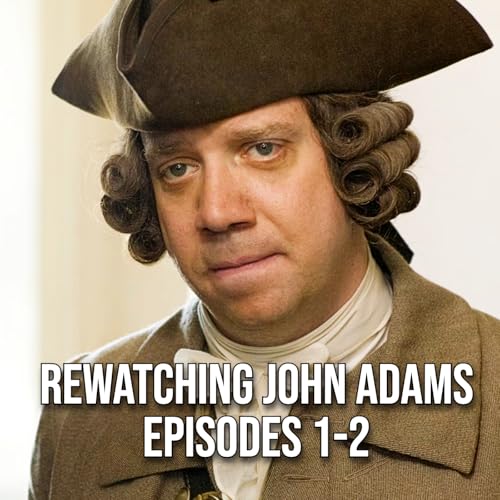
  • Rewatching John Adams: Law, Revolution, and Abigail's America (Episodes 1-2)
    Feb 23 2026

    In this episode of Public History with Justin, Jake, and Molly, we begin our rewatch of HBO's 2008 miniseries John Adams — and it feels different this time.

    Jake, Justin, and Molly dive into the first two episodes of John Adams, beginning with the Boston Massacre and John Adams' controversial defense of British soldiers. It's a legal drama rooted in principle and ambition - a reminder that the rule of law has always been contested in American history, even in 1770.

    From there, the conversation moves into the Continental Congress, the long road to independence, and the fragile coalition that produced the Declaration.

    Along the way, the trio unpacks the radicalization of John Adams, the diplomacy of Benjamin Franklin, the complicated legacy of George Washington, and the indispensable role of Abigail Adams - moral compass, political strategist, and intellectual equal.

    This episode of Public History with Justin, Jake, and Molly explores:

    • The Boston Massacre and why Adams defended the British soldiers
    • "Facts are stubborn things" and the meaning of the rule of law
    • The violence and instability of revolutionary Boston
    • The Continental Congress and the messy politics of independence
    • Jefferson, Franklin, and the drafting of the Declaration
    • The slavery clause that didn't survive
    • Smallpox, inoculation, and medicine in wartime
    • Abigail Adams as the quiet force behind the Revolution
    Más Menos
    1 h y 17 m
  • A Governor's Scandal: Sally McDowell, Francis Thomas, and A Very Public Divorce in the 1840s
    Feb 16 2026

    In this episode, Jake and Justin are joined by public historian Travis Shaw for a story that feels very modern - and yet unfolds in the 1840s.

    It begins with a marriage between Sally Preston McDowell, the daughter of a powerful Virginia political family, and Francis Thomas, a rising Maryland political star. Within weeks, suspicion, jealousy, and accusation turn that marriage into one of the most explosive public scandals of the antebellum era.

    What follows is a cascade of drama: alleged infidelity, a miscarriage, public accusations of infanticide, private letters turned into political weapons, and - at one point - two sitting governors physically fighting on a train platform in Virginia.

    Francis Thomas published a 52-page pamphlet detailing the intimate collapse of his marriage and places it on the desk of every member of Congress. State legislatures in Maryland and Virginia debated the case. Crowds packed the galleries. The press leapt at the chance to spill ink about this unfolding drama.

    But beneath the spectacle is something more human - and more revealing. This episode explores how marriage, divorce, reputation, and gender operated in the 19th century. It traces how a woman navigated public shame in a world that gave her few legal protections. And it follows the strange afterlife of a political career that seemed permanently destroyed - only to be resurrected during the Civil War.

    This episode of Public History with Justin, Jake, and Molly explores:

    • Marriage, jealousy, and power in the 1840s political elite
    • Divorce through state legislatures in antebellum America
    • Public scandal before tabloids and reality TV - broadsides, pamphlets, and packed galleries
    • Two governors fighting on a train platform
    • The Civil War redemption arc of Francis Thomas
    • Sally McDowell's second act - and a life reclaimed

    Want to learn more? Here's this episode's reading list and more information about Travis Shaw:

    The Great Catastrophe of My Life Divorce in the Old Dominion by Thomas E. Buckley

    If You Love That Lady Don't Marry Her: The Courtship Letters of Sally Mcdowell and John Miller, 1854-1856 (Volume 1)

    Statement of Francis Thomas

    Historians on Tap

    Virginia Piedmont Heritage Area

    Más Menos
    55 m
  • Running Through History: Rewatching Last of the Mohicans
    Feb 9 2026

    In this episode, Jake, Justin, and Molly revisit Last of the Mohicans - Michael Mann's sweeping 1992 epic set during the French and Indian War.

    The conversation moves between cinema and history, unpacking the real events behind the film's dramatic core, including the siege and massacre at Fort William Henry in 1757. Jake and Justin trace the historical landscape of the war itself - a global conflict sparked in North America - and walk through how a young, inexperienced George Washington helped ignite a world war.

    Molly brings the film critic's eye, reflecting on performances, score, and why this movie feels fundamentally different from historical epics made today.

    The episode also explores the deeper cultural layers behind the story: James Fenimore Cooper's 19th-century novel, the romantic myth of the disappearing frontier, and how Native nations were portrayed by early American writers. Along the way, the hosts wrestle with what the film gets right, what it simplifies, and why popular culture still shapes how Americans imagine early American history.

    This episode of Public History with Justin, Jake, and Molly explores:

    • The French and Indian War as the prelude to the American Revolution
    • The real history behind Fort William Henry and its aftermath
    • James Fenimore Cooper, frontier mythmaking, and early American literature
    • Native nations, alliances, and survival in an imperial war
    • Why Last of the Mohicans feels like a movie that couldn't be made today
    • Running, cannons, heartbreak - and one of the great endings in film history

    Read more about Fort William Henry's history

    Más Menos
    50 m
  • Before Emancipation: Reconstruction Starts on the South Carolina Coast with Rich Condon
    Feb 2 2026

    In this episode, Jake and Molly are joined by public historian Rich Condon for a deep dive into one of the most consequential and overlooked stories of the Civil War era: the Port Royal Experiment. Long before Appomattox, long before the Emancipation Proclamation, Reconstruction was already unfolding along the Sea Islands of South Carolina.

    After Union forces seized Port Royal Sound in late 1861, tens of thousands of enslaved people were suddenly free without a plan, without precedent, and without clear answers from Washington. What followed was an extraordinary experiment in freedom: paid labor, land ownership, schools for formerly enslaved people, and the first sustained effort to imagine what a post-slavery society might actually look like.

    Rich walks through how the efforts unfolded, why it mattered, and how it became the blueprint for Reconstruction policies across the South - from Black military service to education, citizenship, and self-governance. The conversation also traces how and why Reconstruction ultimately failed, how its rollback shaped Jim Crow America, and why these unfinished struggles remain painfully relevant today.

    This episode of Public History with Justin, Jake, and Molly explores:

    • Why Reconstruction may really begin in 1861 - not 1865
    • The Port Royal Experiment as a test case for freedom and citizenship
    • Black land ownership, education, and self-governance during the war
    • Union soldiers encountering slavery for the first time
    • Armed Black soldiers and the transformation of the war itself
    • How Reconstruction was defeated - not failed - and what that means today

    More information:

    Reconstruction Era National Historical Park

    Penn Center

    Mitchellville

    Civil War Pittsburgh

    Más Menos
    1 h y 19 m
  • Emergency Pod - Removing History in Philadelphia and the History Happening in Minneapolis
    Jan 29 2026

    In this "emergency" episode of Public History with Justin, Jake, and Molly, Jake and Molly step away from their planned programming to confront a moment happening right. This was recorded on Monday, January 26.

    The conversation begins in Philadelphia, where interpretive panels about slavery at the President's House - steps from Independence Hall - were quietly removed ahead of America's 250th anniversary. It doesn't end there.

    Jake and Molly unpack why removing interpretation is fundamentally different from removing monuments, and why telling the stories of the enslaved people who lived and labored in George Washington's household matters - especially at the nation's most symbolic historic site.

    From there, the episode widens. The discussion turns to Minneapolis, to horrific viral video, to state violence, and to the dangers of controlling historical narrative in moments of political crisis. Drawing connections to labor massacres in the late 19th century and the long struggle for civil rights, Jake argues that history isn't over - it's happening now.

    This episode of Public History with Justin, Jake, and Molly explores:

    • The removal of slavery interpretation at Independence National Historical Park
    • Why monuments are not history - but interpretation is
    • Naming the enslaved people erased from the landscape in Philadelphia
    • Controlling narrative as a feature of authoritarian power
    • Parallels between modern state violence and past labor massacres
    • Why history still matters when it's being challenged in real time

    (Image: Detail from a photograph by WHYY at President's House)

    Más Menos
    35 m
  • The Pottsville Maroons and the Stolen 1925 NFL Championship with David Fleming
    Jan 26 2026

    In this episode of Public History with Justin, Jake, and Molly, Jake hosts a conversation with sportswriter and author David Fleming about one of the most remarkable - and unjust - stories in American sports history: the rise and fall of the Pottsville Maroons.

    Drawing from Fleming's book Breaker Boys, recently re-released in a special 100th anniversary edition, the conversation traces how a football team from a small coal town in Pennsylvania's anthracite region took the fledgling NFL by storm in 1925 - only to have its championship stripped away.

    You can buy a copy of David Fleming's book, Breaker Boys, HERE

    Jake and David dig into the world that produced the Maroons: coal miners turned professional athletes, brutal early football, civic pride, and a region that rallied around its team during a moment of enormous economic and social change.

    They walk through the Maroons' dominant season, their legendary victory over the Chicago Cardinals, the infamous exhibition game against Notre Dame, and the decision that erased Pottsville from the NFL record books.

    The episode also explores how this story lived on and why the fight to restore the Maroons' championship still matters a century later.

    This episode of Public History with Justin, Jake, and Molly explores:

    • The 1925 Pottsville Maroons and the chaos of the early NFL
    • Coal miners, violence, and football before helmets and safeguards
    • Civic pride and sports in Pennsylvania's anthracite region
    • The Notre Dame exhibition that changed pro football forever
    • How and why the NFL stripped Pottsville of its championship
    • Memory, injustice, and the long afterlife of a stolen title
    Más Menos
    1 h
  • The Patriot: When the American Revolution Became a Summer Blockbuster
    Jan 20 2026

    In this episode, Jake finally watches The Patriot - yes, the Mel Gibson blockbuster that a whole generation absorbed as Revolutionary War "history" in the summer of 2000. Joined by Justin and Molly, the conversation turns into a lively (and occasionally horrified) public history breakdown of what the film gets right, what it invents wholesale, and what it reveals about the era that made it as much as the era it claims to depict.

    The trio digs into the Southern Campaign, the myth of "we won because we hid behind trees," and the film's habit of sanding down the Revolution's hardest truths - especially slavery and the brutal civil war nature of the conflict in the Carolinas.

    Along the way, they talk about why Hollywood keeps reaching for simple villains, why the movie is way too long, and why popular culture still shapes how Americans walk into the 250th anniversary of independence.

    This episode of Public History with Justin, Jake, and Molly explores:

    • Why the Southern theater matters - and why most people never learn it
    • The Swamp Fox myth, guerrilla warfare, and what actually won the war
    • Slavery, Dunmore's Proclamation, and the realities the film dodges
    • British vs. Loyalist violence and the Revolution's "first civil war" energy
    • Why the movie feels like a 1990s action film dressed in 1770s clothing
    • Jason Isaacs' villain performance - and his own verdict on the movie's "history"
    Más Menos
    1 h y 1 m
  • Green and Blue - Irish Americans in the American Civil War with Damian Shiels
    Jan 12 2026

    In this episode, Jake Wynn is joined by historian, archaeologist, and podcaster Damian Shiels for a wide-ranging conversation about Irish immigrants in the Civil War-era United States Army and the long road to Damian's new book, Green and Blue: Irish Americans in the Union Military, 1861–1865.

    You can purchase the book here

    Jake and Damian dig into the pension files, soldiers' letters, and overlooked working-class experiences that form the backbone of the book. Along the way, they talk about Irish service beyond the famous "green flag" units, the economic realities that shaped Irish enlistment, and why immigrant soldiers have too often been pushed to the margins of Civil War history.

    The conversation also turns outward - to public history, podcasting, and how the American Civil War is remembered (and misunderstood) on both sides of the Atlantic.

    This episode of Public History with Justin, Jake, and Molly explores:

    • Green and Blue and what Irish soldiers' letters reveal about the Civil War
    • Pension files as one of the richest untapped sources in American history
    • Irish immigrants serving everywhere—not just in the Irish Brigade
    • Class, economics, and why men fought (and stayed) in the Union Army
    • Bounties, substitutes, and the myths around "bad" late-war soldiers
    • Public history, podcasting, and why the Civil War still matters globally

    If you enjoy the show - make sure to give us a rating and review the show!

    Here are some more notes:

    You can find the Transatlantic podcast here

    And here's Damian's Irish in the American Civil War blog

    Más Menos
    1 h y 10 m