Palestine Bookshelf Podcast Por Stephen Heiner arte de portada

Palestine Bookshelf

Palestine Bookshelf

De: Stephen Heiner
Escúchala gratis

Reading and learning about what has really happened in Palestine since 1917. #endtheoccupation2025 Ciencia Política Ciencias Sociales Política y Gobierno
Episodios
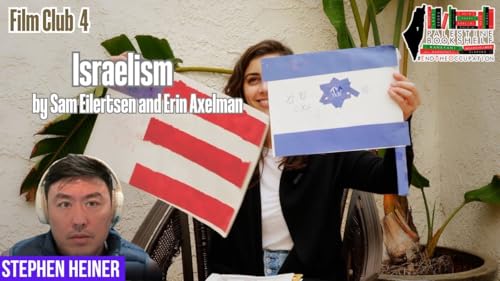
  • Israelism by Sam Eilertsen and Erin Axelman
    Mar 25 2026

    also viewable on Substack: https://open.substack.com/pub/palestinebookshelf/p/israelism-by-sam-eilertsen-and-erin

    Copy of the summary:

    https://docs.google.com/document/d/1KiBSLYqj5qd2TXU4cE9pLfRGg3Pdis7rd5fwQxwx-Tw/edit?tab=t.tb4hm97c0utv

    MAIN THESIS

    The film and the host's commentary argue that a profound generational divide is emerging within the American Jewish community. Many young Jews, raised to see unconditional support for Israel as central to their Jewish identity, are confronting the reality of Israel's treatment of Palestinians and becoming vocal critics. The documentary follows two protagonists — Simone Zimmerman and Eitan — as they move from zealous defenders of Israel to activists for Palestinian rights. The core argument is that traditional Zionist education and institutions have indoctrinated young Jews with one-sided narratives, but direct exposure to the occupation is causing an irreversible awakening and a growing movement that challenges Israel's centrality in American Judaism.

    HISTORICAL CONTEXT

    The discussion situates the film within the broader evolution of American Jewish attitudes toward Israel, from post-1967 alignment to today's tensions. It highlights how Jewish summer camps, Hebrew schools, birthright trips, and campus advocacy groups have long promoted a romanticized view of Israel as a beleaguered democracy under constant threat. The host connects this to current events, including campus protests, arrests of Jewish activists, and the intensifying debate over Zionism, especially in the wake of recent Gaza developments. The film is framed as part of a larger shift where younger Jews increasingly prioritize universal values of justice and human rights over tribal loyalty to Israeli policies.

    KEY IDEAS
    • Indoctrination and narrative control: The film powerfully shows how Jewish educational settings teach children to view Israel as a barren land made to bloom, while downplaying or erasing Palestinian presence and suffering.

    • Personal awakening and heartbreak: Viewers follow Simone's journey from campus advocacy to witnessing the occupation, and Eitan's transformation after serving in the IDF, both experiencing profound disillusionment.

    • Generational divide: Older establishment figures (such as former ADL President Abe Foxman) dismiss critical young Jews as a tiny minority or "self-hating," while the film portrays them as part of a growing wave demanding change.

    • Jewish voices for Palestine: Interviews with thinkers like Peter Beinart, Jeremy Ben-Ami, Noura Erakat, Cornel West, and Noam Chomsky underscore the legitimacy and significance of this internal Jewish critique.

    • Consequences for Judaism and the region: The documentary argues that the future of American Judaism and the Israeli-Palestinian conflict itself may hinge on whether this younger generation succeeds in decoupling Jewish identity from unconditional support for Israeli policies.

    Overall, the livestream provides a compelling and empathetic engagement with Israelism. It effectively highlights the human stories behind the shifting attitudes among young American Jews while encouraging viewers to reflect on questions of identity, loyalty, indoctrination, and justice. Highly recommended for anyone interested in understanding the changing landscape of Jewish opinions on Israel and the growing movement for Palestinian freedom.

    Find other summaries like this at Palestine Bookshelf: www.palestinebookshelf.org

    #EndTheOccupation

    Más Menos
    39 m
  • The Question of Palestine by Edward Said
    Mar 17 2026

    also viewable on Substack:

    https://open.substack.com/pub/palestinebookshelf/p/the-question-of-palestine-by-edward

    Copy of the summary:

    https://docs.google.com/document/d/1KiBSLYqj5qd2TXU4cE9pLfRGg3Pdis7rd5fwQxwx-Tw/edit?tab=t.mqezrtssm2c

    MAIN THESIS

    The video presents Said's work as a foundational Palestinian perspective asserting the reality and legitimacy of Palestinian existence, identity, and rights in the face of systematic attempts to deny, erase, or negate them. It frames the "question of Palestine" as enduring: Palestinians' mere existence accuses Israel of displacement and ethnic cleansing (the Nakba and ongoing policies). The host emphasizes that mentioning "Palestine" or "Palestinians" challenges Zionist narratives that portray the land as empty or without a people deserving self-determination. A core quote from Said is highlighted: "It is a striking fact that merely to mention the Palestinians or Palestine in Israel or to a convinced Zionist is to name the unnameable. So powerfully does our bare existence serve to accuse Israel of what it did to us. Palestinians' existence is itself an accusation." The narrative rejects Zionist claims that no Palestine exists (or that Palestinians are merely Arabs without distinct national identity), comparing them to other stateless peoples (Kurds, Basques, Welsh) who retain cultural cohesion. It ties this to historical dispossession and calls for recognition of Palestinian reality amid international complicity in shielding Israel.

    HISTORICAL CONTEXT

    The video traces the conflict through Said's lens, focusing on pre-1979 events that remain relevant: British colonialism enabling Zionist settlement, the 1948 Nakba (ethnic cleansing, expulsion of Palestinians, destruction of villages), and the myth of "a land without a people for a people without a land." Key quotes include Moshe Dayan (1969) admitting Jewish settlements replaced Arab villages, and Joseph Weitz (1940) advocating transfer/expulsion of Arabs to enable a Jewish state. It discusses post-1948 Palestinian identity solidification among refugees, diaspora growth, discrimination (e.g., "Judaization" policies in Galilee, like Upper Nazareth built on expropriated Arab land as a "security belt" while neglecting Arab Nazareth), and failed peace processes (e.g., Camp David critiques mirrored in later Oslo-era disappointments). It notes Palestinian fragmentation across exile, occupation, and diaspora, with no statehood or self-determination.

    KEY IDEAS
    • Palestinian identity exists independently of statehood, strengthened by displacement and resistance to negation.

    • Zionist objections (e.g., Palestinians as pawns of Arab regimes, fair refugee exchange with Jewish Arabs, biblical claims, or resettlement elsewhere) are debunked as evasions that avoid moral accountability.

    • Ethnic cleansing in 1948 was intentional and widespread in Zionist thinking, not requiring explicit orders.

    • Daily apartheid-like realities (e.g., land expropriation, unequal development) persist.

    • Negotiations often offer Palestinians fractions of rights in fractions of land, condemning most to exile and statelessness.

    • The host calls for recognizing Palestinian existence and rights, supporting channels like his, and donating to causes like the Palestine Children's Relief Fund.

    Find other summaries like this at Palestine Bookshelf: www.palestinebookshelf.org

    #EndTheOccupation

    Más Menos
    17 m
  • Our Narrative: Operation Al-Aqsa Flood (2024) by Hamas
    Mar 11 2026

    also viewable on Substack:

    https://palestinebookshelf.substack.com/p/our-narrative-operation-al-aqsa-flood

    Copy of the summary:

    https://docs.google.com/document/d/1KiBSLYqj5qd2TXU4cE9pLfRGg3Pdis7rd5fwQxwx-Tw/edit?tab=t.dt5qs7uk25oy

    MAIN THESIS

    The document argues that Operation Al Aqsa Flood was a necessary, defensive act of national liberation against 75+ years of Zionist occupation, ethnic cleansing, apartheid policies, and a suffocating 17-year blockade of Gaza (since 2007), described as the world's largest open-air prison. It portrays the operation as targeting Israeli military sites to destroy the Gaza Division and pressure for prisoner exchanges, while emphasizing Hamas's commitment to avoiding civilians (women, children, elderly) as a religious and moral principle.

    Civilian casualties on October 7 are attributed to chaos, Israeli forces' own fire (including the Hannibal Directive), helicopter attacks (e.g., at the Nova Music Festival), and friendly fire amid collapsed command structures—not deliberate targeting by Hamas. The text rejects Israeli claims of mass civilian atrocities (e.g., beheading babies, systematic rape) as fabricated propaganda, and asserts that resistance is a legitimate right under international law (e.g., UN resolutions on self-determination).

    It frames the broader struggle as against colonial occupation and oppression, not Jews, while calling for an end to aggression, investigations into Israeli crimes, and global solidarity with Palestinians.

    Heiner presents this as Hamas's direct narrative to counter dominant media portrayals, highlighting continuity from historical dispossession to current events (post-2023 Gaza assaults), where truth favors the oppressed side amid international complicity in shielding Israel.

    HISTORICAL CONTEXT

    The document traces the conflict over 105 years: British colonialism (1918 onward), Zionist immigration and seizure of 77% of Palestine by 1948 through ethnic cleansing (expelling 57% of Palestinians, destroying 500+ villages, massacres), the 1967 occupation of remaining territories (West Bank, Gaza, Jerusalem), and ongoing denial of self-determination. Gaza specifics include: refugee influx post-1948 Nakba, 2005 withdrawal followed by 2006 Hamas election and ensuing blockade, five major Israeli wars on Gaza, and the 2018-2019 Great March of Return (peaceful protests met with sniper fire, killing 360 and injuring 19,000, including 5,000 children). Pre-October 7 stats: 11,299 Palestinians killed and 156,768 injured (mostly civilians) from 2000-2023. It ties in failed Oslo Accords (undermined by settlements), settler violence, Al-Aqsa desecrations, detainee abuses, and US vetoes blocking over 900 UN resolutions favoring Palestinians.

    KEY IDEAS
    • Palestinian resistance as a right under international law (e.g., Geneva Conventions, UN Resolution 3236), especially in occupied territory; Gaza remains occupied per ICJ opinions.

    • Israeli justifications debunked: Self-defense claims invalid in occupied land; allegations of October 7 atrocities refuted by evidence (Israeli testimonies, revised casualty figures from 1,400 to 1,200, mixed corpses).

    • International complicity: US/allies provide military/financial support, ignore UN/Amnesty/HRW reports on violations, and obstruct ICC/ICJ accountability.

    • Blockade as collective punishment and humanitarian crisis; post-October 7 Gaza assaults as mass killings, infrastructure destruction, and ethnic cleansing attempts.

    • Hamas as a liberation movement (not anti-Semitic), committed to coexistence historically, fighting only occupiers.

    • Call for action: Halt aggression, investigate crimes (ICC/ICJ), release prisoners, support resistance, and build global solidarity.

    Find other summaries like this at Palestine Bookshelf: www.palestinebookshelf.org

    #EndTheOccupation

    Más Menos
    35 m
Todavía no hay opiniones