

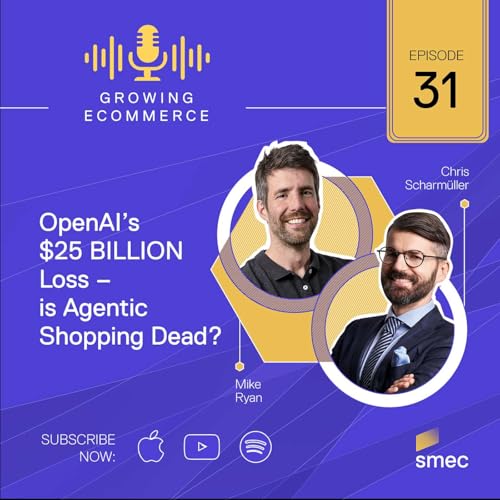
OpenAI’s $25 BILLION Loss – is Agentic Shopping Dead?
No se pudo agregar al carrito
Add to Cart failed.
Error al Agregar a Lista de Deseos.
Error al eliminar de la lista de deseos.
Error al añadir a tu biblioteca
Error al seguir el podcast
Error al dejar de seguir el podcast

OpenAI’s $25 BILLION Loss – is Agentic Shopping Dead?
-
Narrado por:
-
De:
OpenAI is facing a projected $25 billion shortfall, and their attempt to monetize ecommerce is already falling apart.
In this episode of Growing Ecommerce, Mike Ryan and Chris Scharmüller ask the billion-dollar question: Is the dream of "agentic commerce" already dead on arrival?
While the media celebrates OpenAI's early $100 million in ad revenue, the math tells a much darker story. Their projected 2026 burn rate sits between $14 and $25 billion. To survive, they need a massive, highly profitable ad network—but their recent retail experiments are failing the test.
We break down why ChatGPT quietly killed off its new "Shopping Research" feature (hint: consumers won't wait minutes for an AI to fetch product recommendations). We also reveal the shocking data from Walmart’s early checkout test within ChatGPT, where in-app conversions were three times lower than standard website traffic.
If ChatGPT wants to steal budget from Google Ads and Meta, they have to prove they can actually drive profitable sales. Right now, the data suggests users simply aren't ready to let an AI agent do their shopping.
Key Takeaways & SEO Insights:
- The Revenue Reality: Generating $100M in two months is impressive, but with Capital Expenditures (CapEx) skyrocketing to compete with Google and Microsoft, OpenAI's projected losses are staggering. Advertising is their most obvious path to close that gap.
- Speed vs. Quality in E-commerce: OpenAI shut down its specialized post-trained shopping model because generating deep product analyses took too long. In retail, friction kills adoption.
- The Conversion Crisis: Early tests with major retailers like Walmart showed that instant checkouts within ChatGPT converted at a rate 3x lower than traditional website traffic. If they can't drive efficiency, advertisers won't shift their budgets.
- The Scraping Band-Aid: OpenAI's reliance on scraping Google Shopping data for product recommendations shows they are still heavily dependent on their biggest competitor to power their agentic commerce dreams.
Resources & Links:
- Access all our webinars, reports, and playbooks in our Knowledge Hub: https://smarter-ecommerce.com/en/knowledge-hub/
- How is your industry stacking up in the market? Find out with smec’s Google Ads Benchmarks:
https://smarter-ecommerce.com/en/smec-market-observer/
About Smarter Ecommerce (smec):
Smarter Ecommerce (smec) empowers e-commerce brands with AI-driven PPC automation that optimizes for profit and business outcomes while maintaining strategic control.
The platform activates first-party data - profit margins, customer lifetime value, and key business metrics - to automate campaign optimization toward goals like profitability and efficient growth, while detailed campaign insights provide full transparency and enable PPC teams to focus on strategic oversight rather than manual execution.
As a Google Premier Partner and three-time Microsoft Retail Partner of the Year, smec manages over €500 million in ad spend and drives €5B+ in annual e-commerce revenue for 350+ global retail clients including THG, Snipes, REWE, and Intersport.
Make sure to follow smec - Smarter Ecommerce for more performance marketing insights:
smec - Smarter Ecommerce: https://www.smarter-ecommerce.com
LinkedIn: https://linkedin.com/company/smarter-ecommerce-gmbh
Newsletter: https://smarter-ecommerce.com/en/newsletter/
Instagram: https://www.instagram.com/smarterecommerce/