Off the Chart: A Business of Medicine Podcast Podcast Por Medical Economics arte de portada

Off the Chart: A Business of Medicine Podcast

Off the Chart: A Business of Medicine Podcast

De: Medical Economics
Escúchala gratis

Off the Chart: A Business of Medicine Podcast features lively and informative conversations with health care experts, opinion leaders and practicing physicians about the challenges facing doctors and medical practices. New episodes release every Monday and Thursday morning. Brought to you by Medical Economics and Physicians Practice.

Off the Chart: A Business of Medicine Podcast Staff

Hosts: Keith Reynolds, Austin Littrell
Contributors: Chris Mazzolini, Todd Shryock, Richard Payerchin, Keith Reynolds, Austin Littrell
Inquiries: Please email Hosts Keith Reynolds (kreynolds@mjhlifesciences.com) or Austin Littrell (alittrell@mjhlifesciences.com) with feedback, questions, guest suggestions and more.

MJH Life Sciences
Economía
Episodios
  • S1 Ep142: The legal risks of AI in your practice, with Dan Silverboard, J.D., of Holland & Knight
    Apr 16 2026
    Artificial intelligence (AI) tools are proliferating fast in health care, but the legal framework around them is still catching up. In this episode, Dan Silverboard, J.D., a health care attorney at Holland & Knight, joins Medical Economics Managing Editor Todd Shryock to explain how AI is currently being regulated — by states primarily, and by the FDA only indirectly — and where the biggest liability gaps exist for physicians and practices. He walks through what happens legally when an AI-generated recommendation contributes to patient harm, why the responsibility almost always lands on the provider, and why there is no get-out-of-jail-free card when an AI tool generates a higher billing code than what was actually performed. Music Credits:Sky Drifter by Cephas - stock.adobe.comA Textbook Example by Skip Peck - stock.adobe.comEditor's note: Episode timestamps and transcript produced using AI tools.0:00 – 0:25 | Sponsor message Copic medical liability insurance.0:25 – 0:51 | Cold open Silverboard delivers the episode's central warning: periodic auditing of AI-generated billing documentation is non-negotiable, and there is no get-out-of-jail-free card when an AI tool recommends a higher code than what was performed.0:51 – 1:53 | Introduction Austin Littrell introduces the episode and previews the conversation with Silverboard.1:53 – 3:09 | How AI in health care is currently being regulated Silverboard explains that states are the primary regulators, treating AI as a technology that supports clinical decision-making rather than a medical device. The FDA regulates AI only indirectly, based on whether it's incorporated into a regulated medical device.3:09 – 4:57 | The two biggest liability risks for physicians using AI Silverboard identifies the core risks: 85% of health care AI investment is going to startups without proven compliance track records, and providers who blindly sign off on AI recommendations — clinical or documentation-based — without verifying accuracy are taking on serious legal exposure.4:57 – 6:45 | Who is liable when AI contributes to patient harm Silverboard explains that legally, the provider must sign off on any AI recommendation, making them the primary responsible party. Technology vendors can face liability if their product is found to be wholly deficient — trained on biased or false data, for example — but broad liability disclaimers in vendor contracts make that a high bar.6:45 – 7:28 | Should physicians document AI use in the medical record Silverboard says yes — physicians should document whether AI was used, whether they followed its recommendations and, if they deviated from them, why. Several states, including North Carolina, have already passed legislation or board guidance requiring exactly this.7:28 – 8:37 | Compliance and billing risks from administrative AI tools Silverboard is direct: providers attest to the accuracy of their claims, and that responsibility doesn't transfer to an AI tool. Up-coding, down-coding and unbundling errors generated by AI are still the provider's problem. Periodic auditing and monitoring of all billing documentation — AI-generated or not — is essential.8:37 – 9:27 | P2 Management Minute Keith Reynolds shares practice management tips and invites listeners to submit their own workflow ideas.9:27 – 10:36 | What to demand in an AI vendor contract Silverboard outlines the must-haves: robust HIPAA compliance representations and warranties, ongoing validation and bias testing with reporting obligations, and a data governance plan confirming the AI system and its training data are free from bias or untrustworthy sources.10:36 – 12:30 | Privacy complications when AI learns from patient data Silverboard explains a key HIPAA limitation: vendors can only train on protected health information for the benefit of the contracting provider — not to improve their own product. De-identified data is simpler, but practices still need contract provisions prohibiting re-identification, which is an increasingly realistic risk as AI becomes more powerful.12:30 – 13:24 | Legal concerns around ambient AI and automated note generation Silverboard says the core risk is providers relying too heavily on ambient AI without verifying that the record accurately reflects the encounter. Texas has already codified this as a statutory requirement for all providers using AI to record patient encounters.13:24 – 15:13 | Three questions practices should ask before deploying AI Silverboard's framework: first, vet the vendor thoroughly for HIPAA compliance and a proven track record; second, understand your patient population's comfort level with AI, which should shape how and where you deploy it; and third, decide how you will disclose AI use to patients — regardless of whether your state requires it.15:13 – 16:16 | Where AI-related litigation is heading Silverboard says if HHS projections hold, AI could actually reduce adverse events ...
    Más Menos
    18 m
  • S1 Ep141: Meet the congressman trying to stop AI from denying Medicare claims, with Rep. Greg Landsman of Ohio
    Apr 13 2026
    Medicare's Wasteful and Inappropriate Service Reduction (WISeR) Model launched January 1, 2026, in six states, immediately drawing fire from physicians, patient advocates and members of Congress. In this episode, Rep. Greg Landsman (D-Ohio), a co-sponsor of the Ban AI Denials in Medicare Act, explains why he believes the pilot needs to be stopped. He argues the model is less about reducing waste and more about using artificial intelligence (AI) to deny claims faster, at the expense of seniors — he points out that the entire program operates as a black box, with no transparency about how it works, why the six states were selected or how the financial incentives are structured.Music Credits:Rooftops by Buurd - stock.adobe.comA Textbook Example by Skip Peck - stock.adobe.comEditor's note: Episode timestamps and transcript produced using AI tools.0:00 – 0:28 | Sponsor message Copic medical liability insurance.0:28 – 1:02 | Cold open Landsman previews the episode's central argument: human beings denying claims is already a problem — handing that job to a computer system that isn't learning, just denying faster, makes it worse.1:02 – 1:59 | Introduction Austin Littrell introduces the episode and previews the conversation with Landsman.1:59 – 3:29 | What the WISeR model actually does Landsman describes the model as the administration contracting with big tech to deny claims for seniors, starting with procedures they expect to be noncontroversial — specifically to normalize AI-driven claim denials.3:29 – 5:05 | The Ban AI Denials in Medicare Act Landsman explains the bill would stop the pilot entirely, not just the prior authorization component. He argues it should attract bipartisan support — the target should be fraud, waste and abuse, not senior care.5:05 – 6:06 | What physicians and patients are actually experiencing Landsman says the most common story he hears is a claim that got denied, then reversed on appeal because it was always medically necessary. His argument: that's where AI should be deployed — reducing wrongful denials, not speeding them up.6:06 – 7:13 | The transparency problem Landsman says no provider he has spoken with understands how the model is being implemented or why these six states were selected. The financial incentives reward more denials, but the formula is unknown and the code is invisible — a black box with no accountability.7:13 – 7:56 | Has any Medicare payment model ever been stopped by Congress retroactively? Landsman says he's not aware of one — and adds that the chaotic rollout of the WISeR model has compounded the underlying policy concerns.7:56 – 8:44 | What prior authorization reform should actually look like Landsman calls for full transparency and a measurable reduction in wrongfully denied claims as the baseline expectation for any entity receiving public money.8:44 – 9:36 | P2 Management Minute Keith Reynolds shares practice management tips and invites listeners to submit their own workflow ideas.9:36 – 11:35 | The fate of ACA premium tax credits Landsman says 22 million Americans rely on the ACA, and 32,000 of his own constituents needed the extension to pass. He calls on the Senate to act, warning that failure to extend the credits will cause real harm — and that people will die. He frames it as a political loser for Republicans who try to block it.11:35 – 12:42 | Common ground 2025: key provisions Landsman highlights the ACA subsidy extension and PBM reform as the plan's most important pieces, arguing that pharmacy benefit managers are charging enormous markups and those savings need to reach patients.12:42 – 13:22 | Medicare physician fee schedule Landsman acknowledges he wasn't focused on that specific piece of the plan, but says the broader point is clear: physicians aren't getting paid what they need to be paid, and it's causing serious problems across the health care system.13:22 – 14:24 | A message to primary care physicians Landsman closes with a direct message to physicians: he's a huge supporter, he recognizes they're being asked to do more under greater pressure for less pay, and he wants them to know they have allies in Congress.14:24 – 15:30 | Outro Payerchin closes the interview. Littrell thanks listeners and reminds the audience to subscribe and visit MedicalEconomics.com and PhysiciansPractice.com.
    Más Menos
    16 m
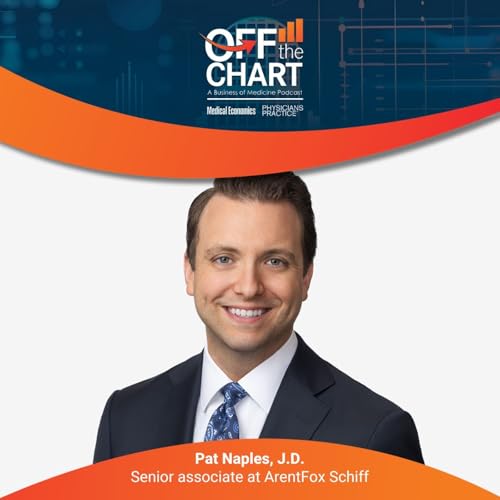
  • S1 Ep140: The AI enforcement era is here, with Pat Naples, J.D., of ArentFox Schiff
    Apr 9 2026
    CMS's latest antifraud actions — withholding Medicaid funds from Minnesota, freezing enrollment for certain durable medical equipment suppliers and launching the CRUSH initiative — signal a broader shift in how the federal government plans to police health care fraud. In this episode, Pat Naples, J.D., senior associate at ArentFox Schiff, walks through the legal authority behind each of those actions and explains what the move from "pay and chase" to AI-driven real-time fraud detection means for physician practices. Naples covers what rights physicians actually have when payments are flagged or withheld, why CMS has near-total immunity even if an AI system makes a mistake, and why the Minnesota action is a warning shot for state-level enforcement everywhere. He also lays out a practical compliance roadmap for small practices without dedicated staff.Music Credits:Midnight Serenade by MORRIX Holyhold - stock.adobe.comA Textbook Example by Skip Peck - stock.adobe.comEditor's note: Episode timestamps and transcript produced using AI tools.0:00 – 0:25 | Sponsor message Copic Medical Liability Insurance.0:25 – 0:46 | Cold open Naples previews the episode's bottom line: health care fraud enforcement is not going away, and providers need to be vigilant on the front end.0:46 – 1:42 | Introduction Austin Littrell introduces the episode and previews the conversation with Naples.1:42 – 2:43 | Meet Pat Naples and ArentFox Schiff Naples describes his practice — health care fraud enforcement, compliance and managed care litigation — and ArentFox Schiff's national footprint.2:43 – 5:52 | The legal basis behind CMS's three-part crackdown Naples walks through the distinct legal authority behind each action: the Social Security Act for the Minnesota funding withholding, the Affordable Care Act for the DME enrollment moratorium, and broad government rulemaking authority for the CRUSH request for information. He explains how the moratorium and CRUSH initiative work in tandem — one freezing new enrollment, the other seeking longer-term solutions.5:52 – 7:17 | Legal guardrails on AI-driven fraud detection Naples identifies the two primary guardrails on the "detect and deploy" approach: a credible allegation of fraud must exist before funds are withheld, and CMS must follow procedural notice requirements. He notes that both are largely within the agency's own discretion in practice.7:17 – 9:00 | Can an AI flag alone justify withholding payment? Naples explains that claims data mining has been part of federal health care regulations since 2011 — this isn't new. He says regulators typically look for large outliers across the data set, not single anomalous claims, though circumstances and provider profile both factor in.9:00 – 12:13 | What physicians can do when payments are withheld Naples walks through the appeals path: a written rebuttal statement, then administrative review, then judicial review — a process he acknowledges can be slow. He stresses that providers should be monitoring their own claims data proactively, and that voluntary self-disclosure under the new policy can reduce penalties significantly if issues are caught early.12:13 – 13:02 | P2 Management Minute Keith Reynolds shares practice management tips and invites listeners to submit their own workflow ideas.13:02 – 14:48 | What the Minnesota action signals for other states Naples says the federal government's message is clear: states that aren't sufficiently vigilant about fraud will face intervention. He expects a meaningful uptick in state-level enforcement activity, pointing to Texas Attorney General Ken Paxton's aggressive pursuit of pharmaceutical companies as an early indicator.14:48 – 17:35 | What the DME moratorium means for referring physicians Naples advises practices that refer patients to DME suppliers to scrutinize those relationships now — ensuring referral agreements fall within CMS safe harbors. Even practices that aren't targets of an investigation can be pulled in as witnesses, which requires responding to subpoenas, producing documents and making staff available for interviews.17:35 – 18:39 | Other enforcement developments to watch Naples flags three: DOJ's new uniform corporate enforcement policy, a new joint HHS-OIG-DOJ task force, and the creation of a National Fraud Enforcement Division — all signals of increased focus and resources devoted to fraud, waste and abuse.18:39 – 22:17 | Compliance risks that keep coming up at small practices Naples identifies the three most common compliance vulnerabilities: referral relationships and Anti-Kickback Statute exposure, documentation gaps around medical necessity, and inadequate cybersecurity resources. He notes HIPAA compliance has grown more complicated as cyber threats have multiplied.22:17 – 23:48 | A compliance roadmap for practices without dedicated staff Naples outlines four practical steps: identify your high-risk areas first; implement proper...
    Más Menos
    27 m
Todavía no hay opiniones