Episodios

  • Nordic Folktales of the Heart
    Aug 12 2025

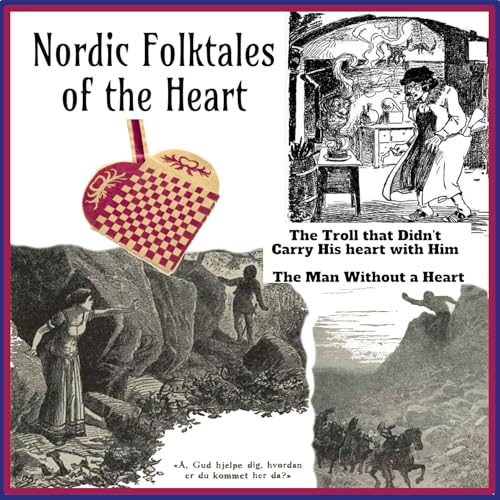
    The heart has long been associated with heavy emotions, from joy to the deepest sorrow. Why is that? How long have humans even known there was this organ inside all of us?

    In this program we explore the history of what we believe about the heart and the many Nordic and English expressions that refer to the heart. Then we turn to Nordic folklore to learn what folk belief says about the necessity of having the organ called the heart, even if you are a troll. What might you sacrifice or gain by magically living without a heart (i.e. without a conscience)?

    We find out in the stories, "The troll who didn't carry his heart with him", and "The man without a heart."

    Why is this question about "having a heart" so important today?

    Visit our home page for this episode to to learn more and to leave a comment: https://nordicontap.com/nordic-folktales-of-the-heart/

    If you like what you hear, please follow us in your favorite podcast service or app!

    Más Menos
    35 m
  • The Ritual of St. Lucia then and Now with Stina Cowen
    Mar 26 2025

    Anthropologist Dimitris Xygalatas said in his book, Rituals: How Seemingly Senseless Acts Make Life Worth Living, that rituals often have no physical result when performed. Instead, rituals are symbolic, and perform a very essential function in the roles of community building, cooperation, and trust.

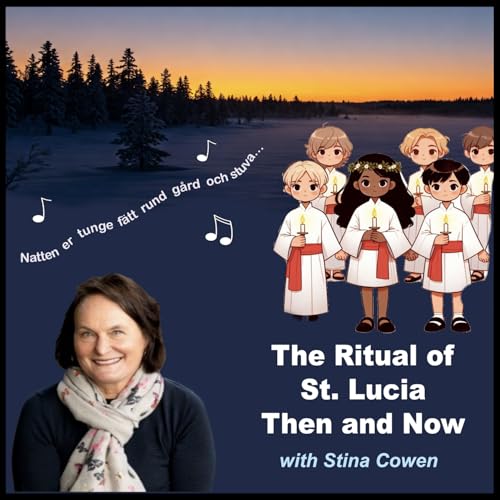
    In this Nordic on Tap episode, we delve into the Saint Lucia ritual, which coincides with the old winter solstice date (Dec 13th) on the Julian calendar. What happens during the St. Lucia ritual? Who participates?

    Traditionally in Sweden, Lucia was depicted as a blue-eyed, blonde girl with fair skin. However, in modern times, as the population becomes more diverse, the St. Lucia ritual has evolved to reflect a broader range of backgrounds, promoting greater inclusivity. This highlights how traditions can evolve to reflect societal changes while still maintaining their cultural significance.

    Join me as we try to make sense of this with Stina Cowan, the Cultural Director at the Swedish Club Northwest, in Seattle, Washington USA. We also listen to 3 traditional and lovely Lucia Day songs associated with the ritual.

    See extras and links on our website episode page on Nordic on Tap.

    Más Menos
    36 m
  • Making Joyful Music - The Handbell Choir
    Jan 31 2025

    I remember when I first saw 7 people line up at a table, pick up two bells with each hand, and proceed to make music unlike anything I've heard before or since. Not a single one of them played the melody. They created the melody and chords by coordinated movements and exquisite timing. They played hymns, popular songs, you name it. And the sound of bells was magical and enchanting.

    Imagine being in a choir without having to sing a single note. But you sure have to be able to concentrate, and read music.

    Join me as we dive into the world of a handbell choir, how the bells work (more complicated than you'd think), and how with lots of practice they learn to play together. You'll get to meet Matt Weed, a long-time handbell player who really knows his way around the bells. Like Matt, many of those in the Faith Lutheran Church Handbell Choir of Redmond, Washington, have been playing in the choir for 40-50 years. What is it that motivates these people to take time out at the end of their workdays to play bells?

    They say it's a lot of fun. And they invite anyone to experience handbell playing, including with digital bells online or on your phone. But it's more fun with a group of people!

    Please see for links, videos, and photos at https://nordicontap.com/making-joyful-music-the-handbell-choir/.

    Más Menos
    46 m
  • Carolus Linnaeus: Names, Flowers, and Bananas
    Sep 4 2024

    Did you know that the forbidden fruit in the Biblical Garden of Paradise, that tempted Adam and Eve, was once thought to be a banana instead of an apple? That’s why Carl Linnaeus gave it the scientific name, Musa paradasiaca. Who was this fellow anyway, the Swedish botanist and doctor whose concept of naming living things and grouping them by similarity established a coherent way to talk about and understand the diversity of life? Linnaeus’ system of binomial nomenclature using genera and species adjectives is still used today. In this unconventional biography of the ”King of Flowers” we visit a tropical greenhouse at Central Washington University to understand how Linneaus got a banana "tree" in the Netherlands to produce the first banana fruit grown in Europe. We also talk with science historian Dr. Tamara Caulkins about Linnaeus, the time when he was working (1700s), his rival George LeClerc du Bufon, and the book he worked on throughout his life: Systeme Naturae. Finally, we hear two delightful classical guitar pieces played by our Tamara and Neil Caulkins, from their Grand March album. Please see https://nordicontap.com/carolus-linnaeus-names-flowers-and-bananas/ for lots of links, pictures, and additional information.

    Más Menos
    51 m
  • Wealth, Greed, and Responsibility in Nordic Folktales
    May 29 2024

    In this podcast we listen to the tales “Big Peter and Little Peter” from Norway and “The Merchant” from Denmark. We talk about how greedy people may acquire riches and become quite wealthy.

    Then there are wealthy people who come to be rich through hard work and dealing fairly with others. We look at how these folktales differentiate between wealth gained through greed and wealth acquired honestly, and the responsibility they have in spending their riches.

    But what about ourselves? — we may be talented and skilled, rich in compassion and understanding…shouldn’t we consider these part of “personal” wealth? Everyone is rich in many ways. What responsibility do we have in “spending” that wealth?

    Links

    Big Peter and Little Peter, Peter Christen Asbjørnsen and Jørgen Moe, Store Per og Vesle Per, Norske Folkeeventyr (Christiania [Oslo], 1842-1852), translated by George Webb Dasent (1859)on Wikimedia.

    The Merchant, Danish Fairy and Folk Tales, Jens Christian Bay, Svend Hersleb Grundtvig and others, translated by Jens Christian Bay, on Wikimedia

    Más Menos
    50 m
  • Norwegian Society and the Laws of Jante
    Feb 7 2024
    Nordic society seems to be governed by a set of unspoken rules on how to behave around others. These rules or "laws" were first articulated by the Danish author, Aksel Sandemose in a novel that described life in a fictional town called Jante, ruled by a set of ten laws. The laws dictated that no one was to be boastful, to think they are more special than anyone else, not to imagine themselves as better than anyone else. They were known as Janteloven, or the Laws of Jante. Sound familiar? Have any relatives that strictly mind their own business, don't gossip, and don't bother anyone else while passing on the street? If Nordic people all behave this way (and they don't), how does that affect society innovation and initiative, especially in business? One person who has thought about Nordic society is Fiona McKinna, an immigrant from England who produces the podcast and blog, Living a Nordic Life. Join us as we talk about the ramifications of Janteloven, delve into Nordic sociology, and about the way people behave in Nordic countries today. Special thanks to her for sharing her perspectives. LINKS A nice summary of Jante's Laws, including a list of all 10. From the Scandinavian Standard, Feb. 2023. Fiona McKinna's Living a Nordic Life website contains a plethora of delights, from the podcast to recipes, blog, ecourses, with associated Facebook group (for which you need to sign up). Paul Anderson, a Lutheran pastor ("Lutheran Renewal"), wrote an essay called Breaking the Stronghold of Jante that I found interesting. I'm not explicitly supporting nor disagreeing with his ideas, but I found his perspecitve from "inside" the Lutheran church interesting. The Knitting Cruise from Kragerø among the islands of the SE Norwegian Coast (Telemark), mentioned by Fiona. They advertise that you can "enjoy the view of the beautiful archipelago, knit and have a good time". M. Michael Brady wrote a short article, Rules that Restrain, in the November 2018 issue of the Norwegian American. If you are blocked from viewing the article, you may be encouraged to subscribe to the paper (both paper and digital versions) at very reasonable prices, in my opinion: $70/year for the print + digital subscription, or $30/year for digital/online only. The Norwegian American has articles about all of the Nordic countries (not just Norway) as well as Scandinavians abroad. Full disclosure: I am a contributing author for the Norwegian American. If you're so inclined, a translation of Sandemose's A Fugitive Crosses His Tracks (Internet Archive, open source) can be read online. I've heard it described as bitter and unhappy. Oddly, there's a Forward ("A Note") by Sigrid Undset at the beginning which is rather sobering about how far reaching Jante's Laws are. She is an author I respect (e.g. Kristin Lavransdatter), and she was very keen on observing how society works. A plaque of Aksel Sandemose and his 10 Janteloven (above), based on his book A Fugitive Crosses His Tracks (En flyktning krysser sitt spor), 1933. The plaque is displayed in the Danish town of Nykøbing Mors where Sandemose grew up, upon which he modeled his fictional town of Jante. Rather ominous to have these ten laws posted right there in the the town....unless of course everyone agrees with them! A couple of English expressions. In this podcast, Fiona uses a couple of expressions that I think are more common in the UK than in the USA, so I thought I'd explain them. 1) Fiona says "they looked at me as if I were a nutter". This isn't that far from Amercian English expressions like a nutcase or completely nuts. My British dictionary says nutter means someone who is silly, strange, or crazy; synonyms include whacko, flake, oddball, or lunatic. An excellent word! 2) Fiona mentioned "living an A-four life", suggesting this was a fairly bland and uneventful type of life. I learned she was referring to "A4", a standard, paper size (210 x 297 mm) used in almost every printer and copy machine outside of Canada and the USA. In the USA, the sheets of paper are usually slightly larger at 8.5 x 11 inches (215.9 mm x 279.4 mm), called US letter size. So an A4 life is one neither extravagant nor lackluster, but regular and common. Perhaps meets the definition of lagom, neither too big nor too small? Is this a new expression for you? It sure was for me.
    Más Menos
    42 m
  • Nordic Noir: Dr. Jerry Holt on Crime Fiction in Bergen
    Dec 29 2023

    Join us for a journey into Nordic crime fiction or noir with Dr. Jerry Holt as our guide. Fiction has the ability to transport us into worlds, cultures, geography, and the thoughts of heroes and villains that non-fiction just can't touch. And we are changed by those stories. At a time when we are home-bound due to social distancing, catching up on your reading has never been better. In Norway, this is the time of påskekrim, that spate of dedicated crime fiction reading that occurs around Easter. Really, it's a thing.

    Dr. Holt is a professor at Purdue University NW who led a trip of Norwegian noir readers to Bergen, Norway, where they had the once-in-a-lifetime chance to walk the streets and visit the crime scenes with the authors who created private detective Varg Veum, and Inspector Konrad Sejer, among others. What would it be like to meet your favorite authors and pick their brain about what the characters were really thinking? What life experiences did these authors draw upon? What is special about certain parts of the city and surrounding areas? For myself, I would love to visit Restaurant Schroder in Oslo, the favorite hangout of Jo Nesbø's famous police detective, Harry Hole.

    To wrap up, we catch a "driveway concert" by a trio in a neighborhood of Mukilteo, Washington. They decided to perform for the neighborhood at large during this time of quarantine, and they've cleverly named themselves Six Feet Back.

    We also have some Nordic noir reading recommendations for you, as does the April 3rd edition (2020) of the Norwegian-American News at norwegianamerican.com. Check them out!

    Links

    Nordic Noir: Scandinavian Crime Fiction website with bios on Gunnar Staalesen, Karin Fossum, Trude Teige, and Alex Dahl among many others (I'm a Jo Nesbø fan, myself).

    "Crime time: Norwegian Easter equals brutal murders" (sounds grim, but it's tongue in cheek) the Visit Norway website's explanation for this extremely popular pastime.

    The Noir Connection, article by Jerry Holt in the Norwegian American News, about Dr. Holt's class that travelled to Bergen to meet local authors. You may be invited to subscribe if you viewed other articles already.

    Jerry Holt's Nordic Nordic noir picks for winter reading, in the Norwegian American News.You may be invited to subscribe if you viewed other articles already.

    A Journey into Norwegian Noir, by Jerry Holt, (Norwegian American News) also describes Bergen's noir scene.

    The Youtube channel of the Six Feet Back Band from Mukilteo, WA, with Nick Ericson, Jared McFarlane (at left) on toreador button accordion and fiddle, and with others on flute and bass. These are the great folks who played in this Nordic on Tap podcast.

    Más Menos
    36 m
  • The Rosemaled Church and the Journey to Belong
    Sep 30 2023

    An ocean-going ship has long been a metaphor for a journey, literal or spiritual, and model ships are still found in some Scandinavian Churches today. It was on a tall ship that immigrants from Scandinavia came to America, carrying their prized possessions in storage trunks, adorned with colorful flowers and vines - an art form called rosemaling.

    In this episode (see website ) we trace the origins of rosemaling in Norway and then in the United States, and learn about a group of rosemalers and parishioners to renovate the Glendale Lutheran Church chapel with rosemaling paintings. But after 25 years, the congregation, largely of Scandinavian descent, moved away or passed away, leading eventually to the sale of the church property in Burien, Washington State (USA) in 2023. The rosemaled panels and decorations, which included a model ship, were given away or returned to their owners - one church received and hung up the ship in their building.

    In this podcast, we talk to a handful of people who used to call Glendale Lutheran their spiritual home, and ask what that church life meant to them. We also meet someone from Prince of Peace Lutheran, who received the ship, and consider what "community" means in today's world. Given the reduction in membership of churches, synagogues, mosques, fraternal orders, and other groups where we traditionally found a place to belong, we consider where our spiritual ship will travel next in today's world to find "community".

    Más Menos
    45 m