

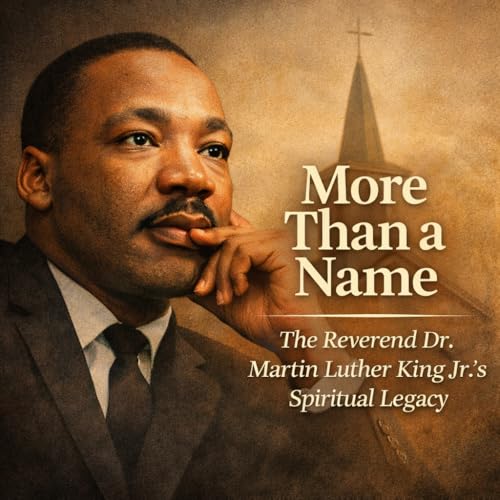
More Than a Name: The Title of the Man and the Faith Behind Dr. King's Legacy
No se pudo agregar al carrito
Add to Cart failed.
Error al Agregar a Lista de Deseos.
Error al eliminar de la lista de deseos.
Error al añadir a tu biblioteca
Error al seguir el podcast
Error al dejar de seguir el podcast

More Than a Name: The Title of the Man and the Faith Behind Dr. King's Legacy
-
Narrado por:
-
De:
In this special birthday-commemoration edition of Inconvenient Ideas, broadcaster Stan Hustad invites listeners to pause, reconsider, and remember something easily overlooked in the story of one of America's greatest heroes: the full and formative identity of the Reverend Dr. Martin Luther King Jr.
The program opens with a light, affectionate nod to radio history and the marvel of modern podcasting—how a single voice can now circle the globe without towers, transmitters, or billion-dollar budgets. From there, the focus turns to the meaning of this national holiday and to the man it honors.
The heart of the episode centers on a deceptively simple but surprisingly powerful idea: "Dr. Martin Luther King Jr." was not his complete title. His full and proper designation was the Reverend Dr. Martin Luther King Jr. That distinction matters.
Listeners are reminded that King was not merely a civil-rights strategist, political activist, or moral philosopher—though he was all of those. First and always, he was a Christian minister. His authority flowed from the pulpit to the people and into the public square. His sermons, marches, and moral clarity were not parallel tracks; they were one unified calling rooted in faith.
With warmth and candor, the program reflects on the shock of King's assassination, the brutality of the moment, and the lasting imprint it left on a generation. From there, the story widens to reveal an often-missed spiritual lineage behind King's philosophy of nonviolence.
That path leads to missionary-evangelist E. Stanley Jones, whose writings on Mahatma Gandhi deeply influenced King's thinking. Through Jones's work, King encountered a practical theology of nonviolent resistance—one he embraced, embodied, and ultimately gave his life to defend.
Along the way, the program maintains a gentle, conversational tone—personal anecdotes, naming stories, and moments of humor included—while never losing sight of the central message: to honor Dr. King fully, we must acknowledge the spiritual foundation that shaped his life and leadership.
Things to Remember
• Dr. King's full title—the Reverend Dr. Martin Luther King Jr.—tells a deeper story than "Dr." alone.
• His faith was not an accessory to his work; it was its source.
• King's commitment to nonviolence was shaped by Christian conviction and global spiritual influence.
Things to Share
• King's sermons and public actions were one integrated calling.
• The civil-rights movement drew strength from theology, not just strategy.
• Faith-driven leadership can reshape nations without resorting to violence.
Things to Take Note Of (and Act Upon)
• Language matters: how we name people reflects how we understand them.
• Spiritual roots are often edited out of public memory—but they still matter.
• Nonviolence is not weakness; it is disciplined moral courage.
A Closing Challenge
As you listen to this program, consider the ways we simplify history to make it more comfortable—or less demanding. The Reverend Dr. Martin Luther King Jr. challenges us not only to remember his dream, but to reckon with its source.
What might change in our own lives, leadership, or communities if conviction once again shaped courage—and faith informed action?
26
Blessings on his memory, his family, and all who continue the work of justice, courage, and nonviolent love.